Ford government silenced symposium of experts whose overdose remedies conflicted with Alberta Recovery Model
As the Ford government faced one of the worst public health crises in Ontario's history, it convened more than 100 experts from policing, health, and lived experience to find solutions. Three years on, the ministry won't talk about it – and never released its report.

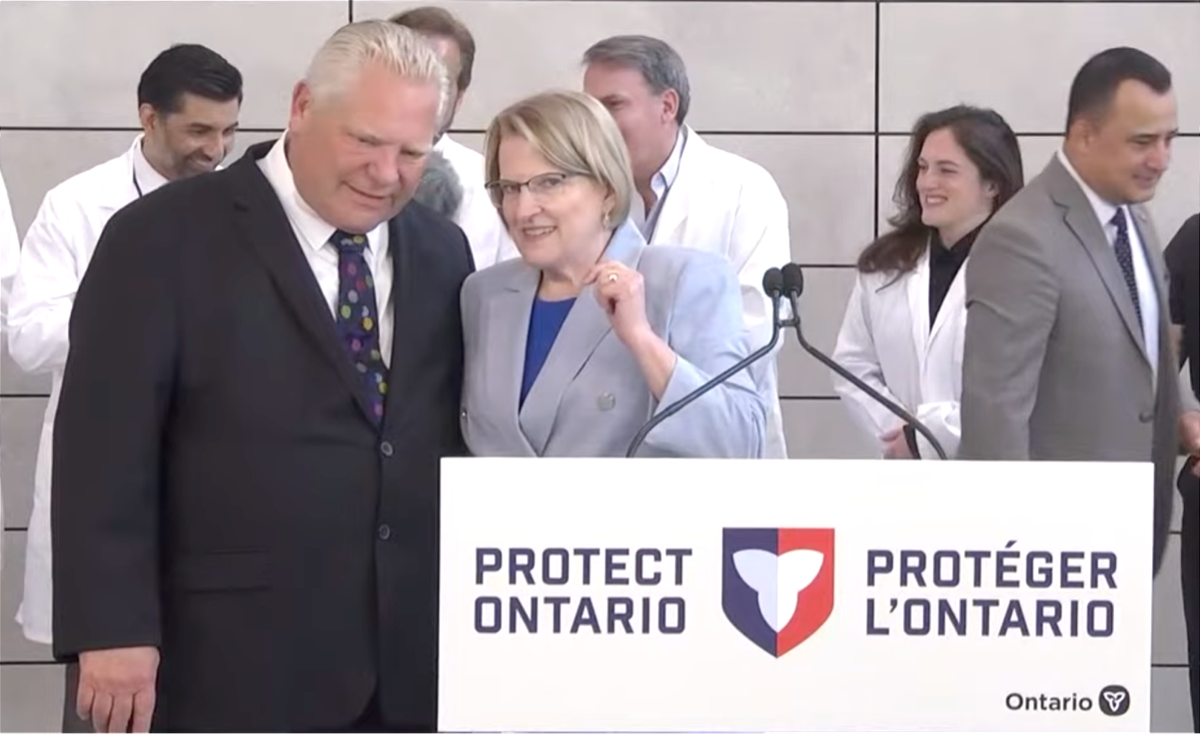
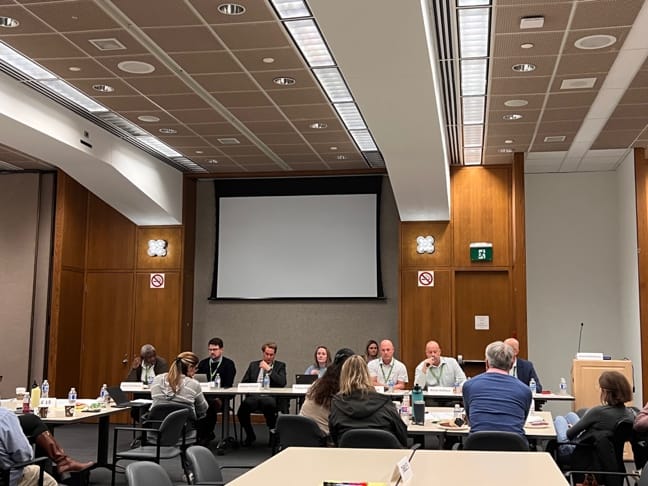
In February 2024, Ontario's toxic drug crisis was killing around nine people each day. In response, Ontario's Ministry of the Attorney General and Office of the Chief Coroner convened more than a hundred experts from the justice, health, policing, public health and community sectors. The Opioid and Toxic Drug Symposium was tasked with advising the Ford government on policy changes that could reduce death and injury from its toxic drug crisis.
By June 2024, the Symposium facilitators had produced a 19-page draft report summarizing the discussions and proposed actions to replace the unregulated drug supply, minimize stigma and criminalization, expand addiction treatment and harm reduction infrastructure, amend frontline and justice system policies, and implement system evaluation. Special focus was placed on the most heavily impacted populations including incarcerated people, youths, and Indigenous communities.
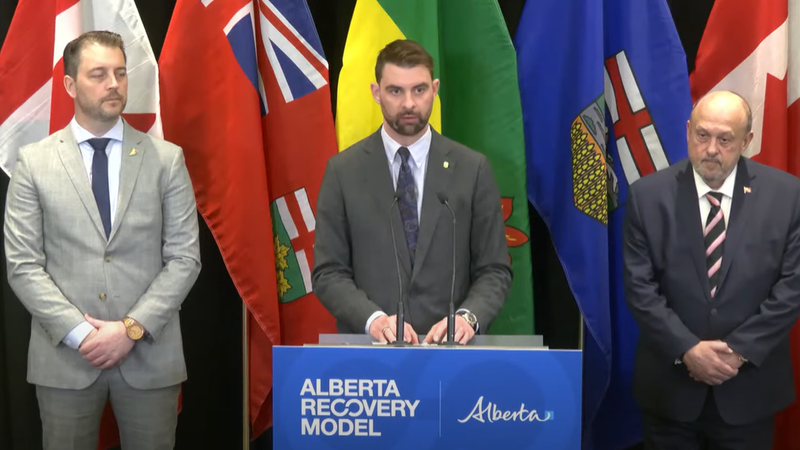
However, in April 2024 – precisely the halfway point between the Symposium and its draft report – the Ontario government announced the full-scale adoption of the Alberta Recovery Model through an interprovincial partnership with Saskatchewan and Alberta. This would, by definition, rule out responses to the crisis that would centre harm reduction, safer supply, and drug decriminalization, instead centring bed-based rehabilitation veering toward the extreme of involuntary treatment.
The February Symposium report never saw the light of day. A draft report was only released through a freedom of information request by the author in mid-2026.
In a remarkable contradiction of its Symposium recommendations, the Ontario government proceeded to make the province’s most ideologically driven drug policy changes in decades – each of which happened to fit with Alberta government policy:
- Supervised consumption sites were closed;
- Municipalities were restricted from pursuing new sites, decriminalization, or prescribed safer supply;
- Public drug consumption became subject to new police and enforcement powers;
- Hundreds of millions of dollars were put toward an abstinence-focused 'treatment' model that explicitly excludes critical harm reduction supports; and
- Millions of dollars were spent on a public communications campaign stigmatizing harm reduction and people who use drugs.
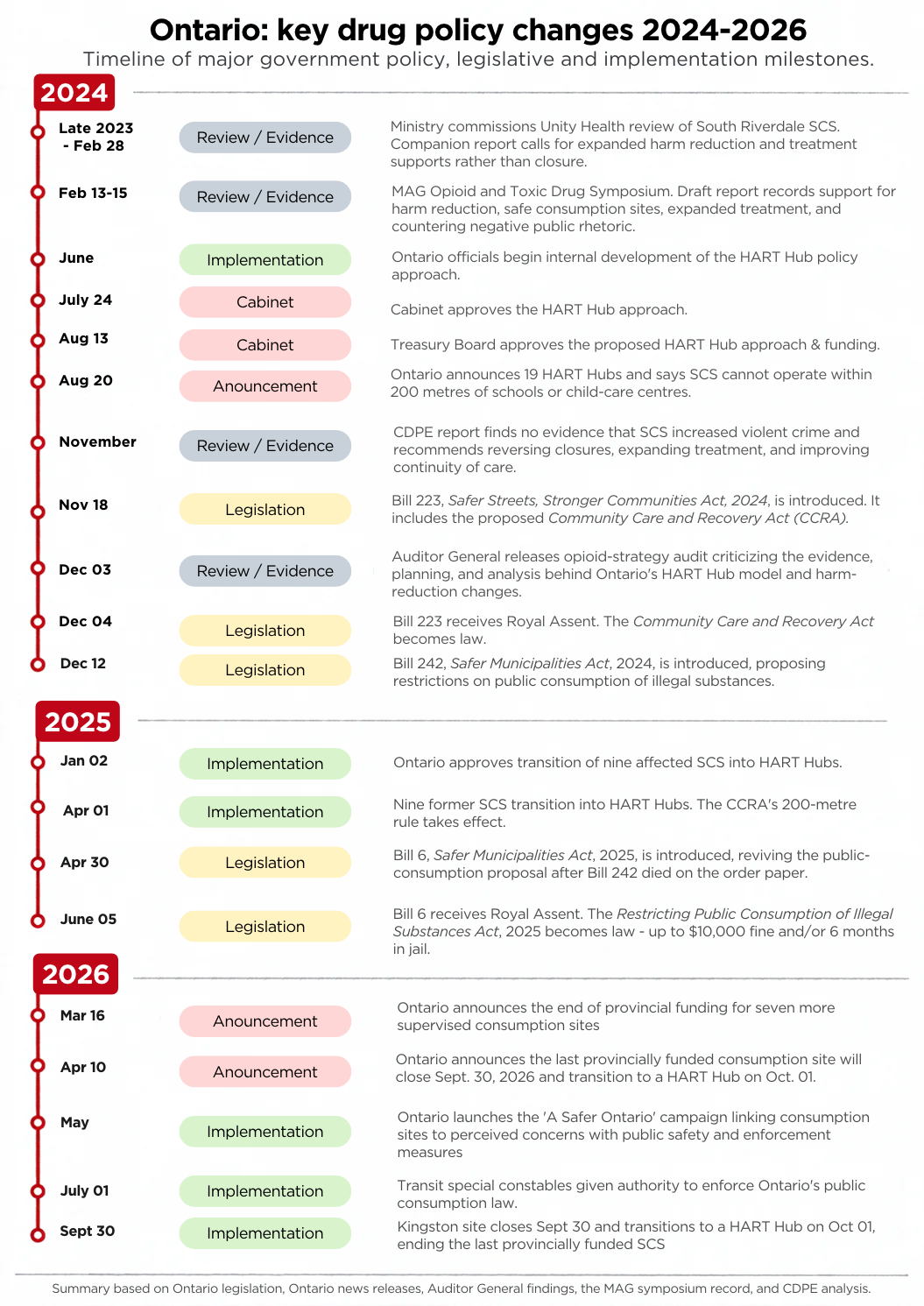
The chronology of these events (chart provided at end) points to a failure of accountability and demonstrates the Ford government’s deliberate discrediting of evidence, expert insights, and advice. Instead, the Ford government turned people who use drugs into a political wedge – particularly those at the intersections of disability, race, class, and homelessness.
As explored below, the draft symposium report is not the only advice or report about the toxic drug crisis that the Ford government has ignored, further underscoring its strategy of ‘policy-based evidence-making’ and an authoritarian tendency that echoes Alberta’s United Conservative Party manoeuvring on drug policy since 2019.
The Symposium and its stated purpose
The Symposium on Toxic Drug Deaths in Ontario: Having Collaborative Discussions was held February 13-15, 2024 in Toronto. It was organized by a committee with representatives from the Office of the Chief Coroner, Ministry of the Attorney General, Ministry of the Solicitor General, Ontario Health, Ontario Provincial Police (OPP), Office of the Medical Officer of Health, Public Prosecution Service of Canada, Toronto Public Health, Centre for Addiction and Mental Health, Canadian Mental Health Association (Ontario), and Canadian Drug Policy Coalitions.
In total, around 150 people registered following direct invites: Crown attorneys, police leadership (including the OPP and Nishnawbe-Aski Police Service), corrections physicians, emergency and addictions medicine specialists, primary care physicians and nurses, Indigenous justice leaders, harm reduction organizations, and people with personal experience of drug use and criminalization. Indigenous Elders opened and closed the Symposium with guidance and prayer, providing spiritual and cultural support during the event.
The invitation to participants was direct: “Nine people in Ontario die every day from drug toxicity. The devastating increase in fatal drug poisonings, including opioids and toxic substances, demands urgent attention and comprehensive solutions to save lives.” The objective, the ministry told invitees, was to “examine the justice, health and social services systems in a collaborative setting to find opportunities to improve the prevention of further deaths and support an increase in change actions by actors across the justice and health sectors.” It was a rare conversation across institutional divides, among participants with “knowledge and influence necessary to lead immediate changes within the system structure.”
Day 1 of the Symposium focused on the justice system, day 2 on the health system, and day 3 on “exploring the potential for change” (agenda provided at end of story). Of 27 panellists, four were police officers. Assistant Deputy Attorney General Randy Schwartz provided opening remarks, a keynote was given by Chief Coroner (view here) Dirk Huyer, short videos were shown by people who use(d) drugs, and the Canadian Drug Policy Coalition gave a policy overview. Four different panel discussions by speakers from varied perspectives alternated with structured table discussions, where participants discussed what they could act on, how they could change practices, and what would require broader legal or policy change.
"Waiting for approvals": Consensus gets buried
Despite repeated requests to the ministry from the organizing committee and attendees, the report remained hidden from public view. On July 18, 2024, five months after the Symposium, the ministry provided a brief update: "[The consultant] completed what was required of her as a facilitator, including follow up after the symposium, in a very timely fashion and we are waiting for approvals."
No further communication followed, and the ministry ignored all follow-up requests.
The report frames the crisis as the result of a broad range of social, economic, political, and human conditions that have created an unchecked and constantly changing supply of illicit drugs and a series of systems that criminalize, stigmatize and discriminate against people who use drugs. It also warns of increased potential harm to those already experiencing other negative social determinants of health, including lack of housing, poverty, trauma, and mental health challenges.
Participants highlighted that criminalization adversely affects health, and that requiring abstinence from drugs as a condition of judicial orders, or release from detention or treatment, is often unrealistic and harmful. Legislation lacking evidence and rooted in morality, discrimination, racism, and colonialism was identified as driving mistreatment and distrust. Persistent stigma in health care, policing, and public policy was flagged as a key barrier to safety for people who use drugs.
The report recognized that, while many people work to respond in their communities or their roles, no individual solutions are adequate. Positive consensus was created around regulating the drug supply, reduction of criminalization, improved health system integration and protocols, community advocacy, supervised consumption, partnerships between police and social workers, drug treatment courts to divert people from the justice system, and community justice centres.
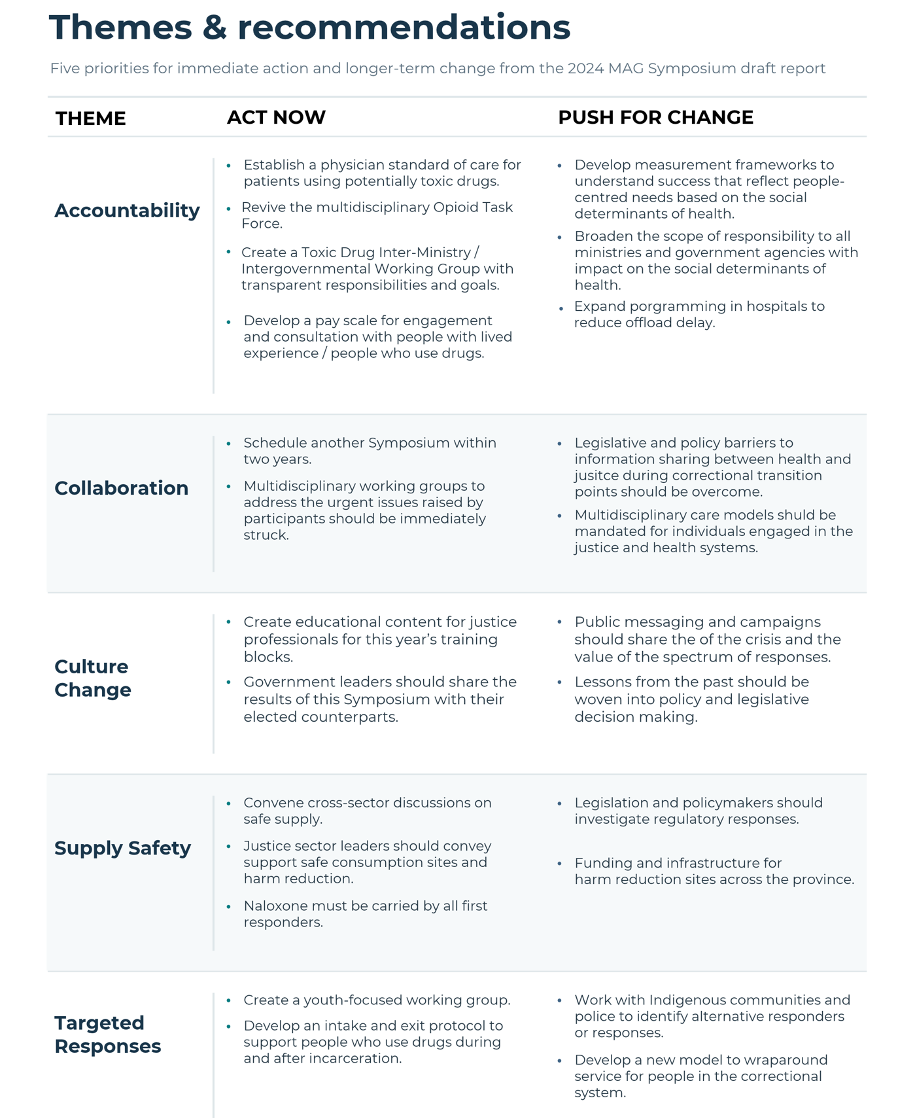
The report summarized discussions from the Symposium under five themes: Accountability, Collaboration, Culture Change, Supply Safety, and Targeted Responses. Each included specific recommendations for immediate action and longer-term aspirations.
Recommendations versus policy
The draft Symposium report called for improved access to treatment but in addition to – rather than at the expense of – harm reduction initiatives. Regardless, the Ford government went to work dismantling harm reduction infrastructure while ignoring additional reports from Unity Health, the Centre for Drug Policy Evaluation (CDPE), and Ontario’s Auditor General.
Two concurrent policy processes
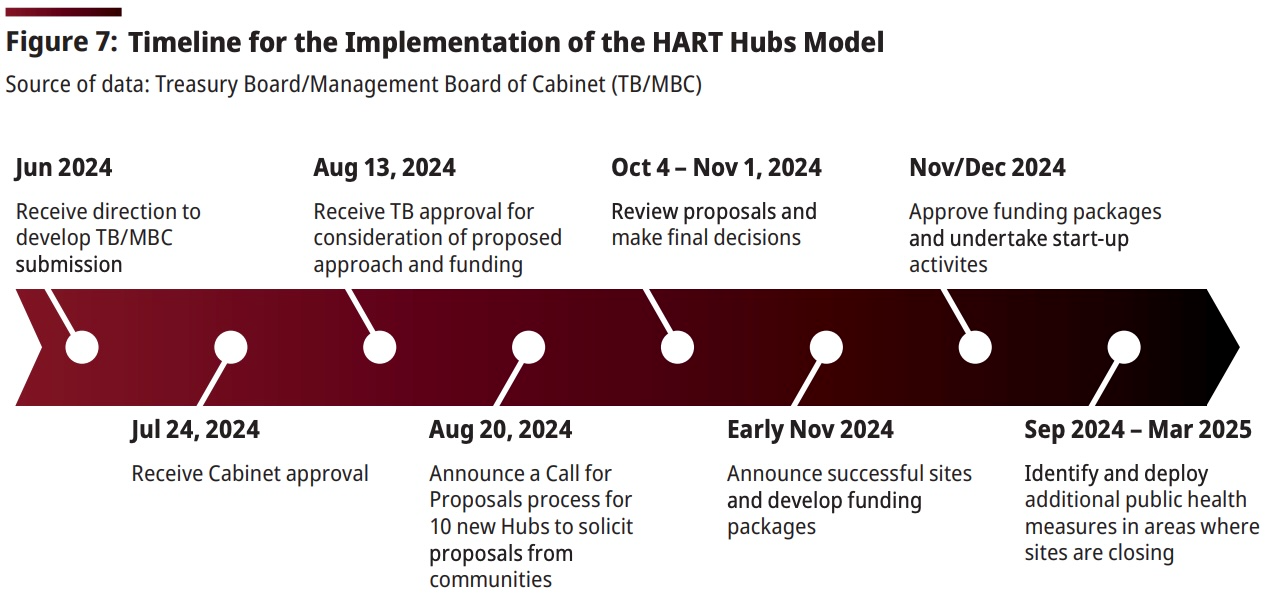
On July 24, 2024, six days after the Ministry of the Attorney General said it was “waiting for approvals,” the Ford government created a new policy. This was announced publicly on August 20 and established a 200-metre prohibition on supervised consumption sites near schools and child-care centres, forcing ten sites to close. Meanwhile, the Ford government committed $378 million to new Homelessness and Addiction Recovery Treatment (HART) Hubs, a commitment that was later expanded to $560 million. The province was explicit that HART Hubs would not provide prescribed safe supply, supervised consumption, or sterile consumption equipment such as pipes and syringes.
In December 2024, the Auditor General revealed that the Ford government had set the HART Hub direction in June 2024 – the same month the Symposium report was awaiting 'approvals' and two months after the province announced the adoption of the Alberta Recovery Model. Whether Cabinet or the Ministry of Health ever saw the Symposium draft report is not known.
The Ministry of the Attorney General did not respond to a request for an interview by Drug Data Decoded.
A coordinated, publicly accountable response
A clear theme from the Symposium report was accountability by government on its responses to the toxic drug crisis. One immediate proposed action was to revive a multidisciplinary Opioid Emergency Task Force, which had been dormant since the Ford Government came to power in June 2018. Another was to create a Toxic Drug Working Group across the government with transparent responsibilities and goals.
In tandem, the 2024 Auditor General report concluded the Ministry of Health lacked processes to meet the changing nature of the crisis and had not implemented Ontario's 2016 Opioid Strategy. This had called for modernizing opioid prescribing and monitoring, improving pain treatment, enhancing addiction supports, and expanding harm reduction. The Auditor General emphasized that the Ford government was not coordinating, evaluating, or overseeing services adequately, and lacked evidence for implementing its HART Hub model.
The Auditor General’s report also found that the 2016 Opioid Strategy required updates in light the evolving unregulated drug supply, continuous increase in deaths, and disproportionate impacts on specific regions and groups. The report found the government had no party designated to lead its response, no goals or targets, and no monitoring or evaluation structure.
The Auditor General’s recommendations largely matched what the Symposium discussions had said months earlier. The Ministry of Health accepted the recommendations of the Auditor General’s report, but two years later, a legislative committee revealed that Ontario's Roadmap to Wellness still contained no updated opioid strategy. That committee again recommended measurable objectives, annual public reporting, and a public dashboard covering prevention, treatment, recovery, and harm reduction outcomes. This remains outstanding.
The supervised consumption 180
In the Symposium report, a section labelled “Supply Safety” recorded participants discussing the need for more supervised consumption sites, treatment services, and harm reduction infrastructure to reduce drug-related deaths and injuries. It noted the urgency for these measures was increasing exponentially as the toxicity of the supply was growing and changing rapidly.
While not captured in the report, since 2020, around half of opioid toxicity deaths had evidence of inhalation, rather than injection, as the main mode of consumption. This was underscored in the Chief Coroner’s Symposium presentation. Public complaints of ‘loitering’ and ‘open-air drug use’ near consumption sites were closely tied to the unmet need of supervised inhalation capacity.
Ontario went in the opposite direction. The Community Care and Recovery Act, 2024, passed as part of Bill 223, Safer Streets, Stronger Communities Act, 2024, which prohibited supervised consumption sites within 200 metres of schools and child-care facilities, also removed municipalities' power to seek federal decriminalization exemptions and imposed a provincial approval requirement on municipalities seeking to expand supervised consumption sites and prescribed safe supply access.
By March 2025, one year after the Symposium, the Ford government had closed half the consumption sites across the province. A year after that, in March 2026, the Ford government defunded all remaining consumption sites, and nearly all remaining sites closed in June 2026 – in lockstep with Alberta government manoeuvring to close its busiest sites in Calgary and Lethbridge. Indeed, Ford used a false and overwhelmingly debunked study authored by Alberta government officials as justification for defunding the sites. By October 2026, Ontario announced that the HART Hub in Kingston had replaced the last remaining provincially funded consumption site in the province.
Just three sites, all in Toronto, remain operational on private funding – one of which faces uncertainty, as it operates within the 200-metre zone operating a daycare facility in addition to the consumption site. It currently holds a temporary court injunction.
One recommended action from the Symposium report is noteworthy, given the Symposium was organized by the Ministry of the Attorney General: “Justice sector leaders should convey support for safe consumption sites and harm reduction.” This has yet to occur. Meanwhile, the Auditor General’s report described supervised consumption services as life-saving interventions and found that in 2022–23, zero out of more than 3,600 overdoses reported at Ontario consumption sites resulted in a death. More than 1,500 potentially fatal overdoses occurred at the ten sites initially identified for closure. The Auditor General concluded that the move to ‘replace’ consumption sites with HART Hubs was done without proper planning, risk analysis, or consultation.
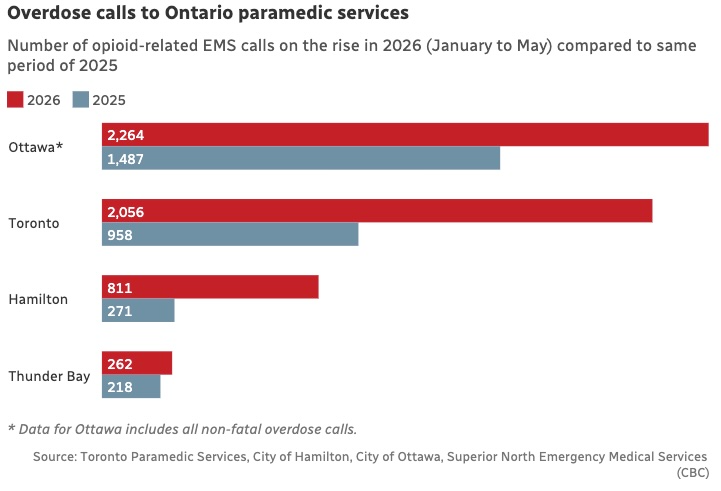
As of October 2026, twenty-nine HART Hubs were operating, though many are still not providing the full range of supports promised. As well, many of their services were already being offered by organizations that had previously housed consumption sites. When the sites were closed there was an immediate gap in services: people who were once injecting drugs in controlled, sterile environments out of public view were forced onto sidewalks, into parks, and around businesses. Connections to and relationships with people that had often taken months and years to develop were suddenly ended. In some regions, EMS calls escalated after sites closed.
Other advice the Ford government ignored
The Symposium and Auditor General reports were not alone in recommending an opposite path to the Ford government’s Alberta-informed orientation.
Just two weeks after the Symposium, on February 28, 2024, Unity Health Toronto completed an external review of the South Riverdale Consumption and Treatment Service (CTS) at the request of the Ministry of Health. A tragic incident in which a person was killed by a stray bullet near the South Riverdale CTS in July 2023 had raised questions about the site’s operation and safety. While some residents raised concerns about public disorder, personal safety, and the site's relationship with the surrounding community, others have pointed out drug-related shootings are common across the city and inherent to illegal markets.
The ministry’s review did not recommend closing consumption sites, instead concluding that the South Riverdale CTS was providing a necessary service within “reasonable and appropriate” parameters with opportunities for improvement, and a clear need remained for sites more generally. Through dozens of recommendations, the review suggested operational, oversight, and safety improvements, additional resources, and expanded hours of operation to ensure around-the-clock access.
Who gets a seat at the table?
Given that they have consistently been shut out of conversations with the Ford government, and the power imbalance inherent in a room of police and prosecutors, many people who use drugs and those working in harm reduction were justifiably hesitant to participate in the Symposium.
Responding to this issue, the Symposium report emphasized the need for people who use drugs to participate in policy and legislative discussions. It also said justice-sector policy decisions should be made with input from health and social service professionals. The proposed immediate actions included “striking multidisciplinary working groups” and “scheduling another Symposium within two years.” Nearly three years later, neither has happened.
According to the Auditor General’s report, the decisions to eliminate supervised consumption services and open HART Hubs was finalized without “formal consultations with all affected external stakeholders, including people using the sites that were to close and high-risk populations such as Northern communities and Indigenous and younger communities.”
Ontario is not the only government ignoring expert advice. The federal government has not implemented most recommendations from its own convened Expert Task Force on Substance Use (2021), suppressed the Expert Working Group on Safer Supply reports which only became public after a leak to CBC, and stopped meeting with a civil society working group after they made a written submission supporting non-medical safe supply.
 Euan Thomson
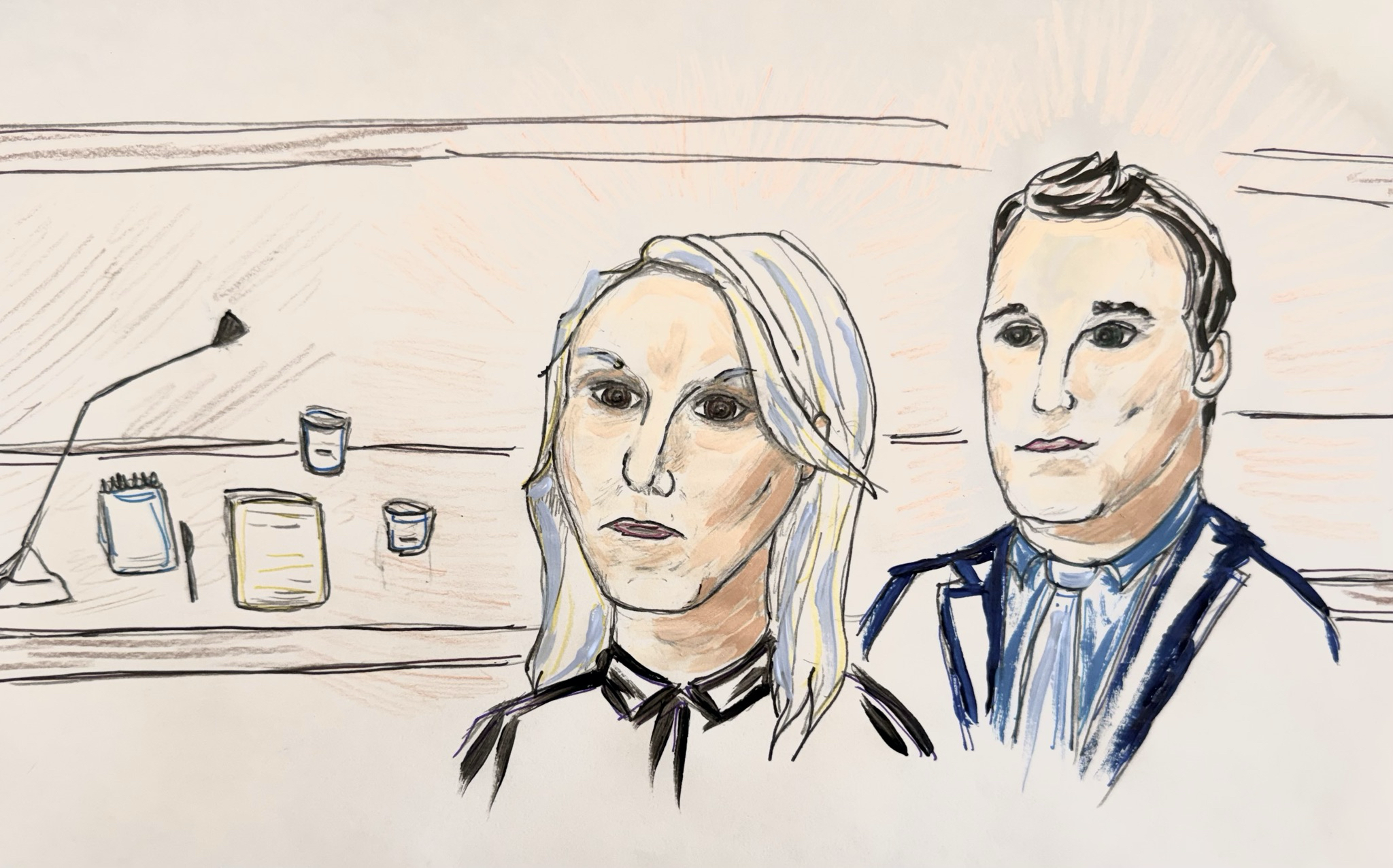
A flip from reduced criminalization to new police powers
The Symposium report noted power imbalances in justice and health systems that create harms for people who use drugs, their families, care providers, and advocates. Participants called for a shift away from “viewing drug use as a justice-involved issue,” calling for reduced street-level drug enforcement as it causes increased overdoses. The report stressed trauma-informed, people-centred, and culturally responsive approaches.
Instead, Ontario expanded provincial enforcement around public drug use. On June 5, 2025, the Safer Municipalities Act, 2025 received Royal Assent which included the Restricting Public Consumption of Illegal Substances Act. Police and designated provincial officers could now direct someone to stop consuming illegal substances or leave a public place. If an officer has ‘reasonable grounds’ that a person is consuming an illegal substance in a public place, they can demand identifying information, arrest without a warrant, and seize and destroy substances. Failure to comply can result in a $10,000 fine, up to six months' imprisonment, or both. On July 1, 2026, those enforcement powers were extended to transit officers.
Ontario’s new provincial enforcement regime escalated seizure and destruction of drugs, while the government closed the very sites that helped people to not use in public. Stops and arrests for simple drug possession were increasing before the site closures in some parts of Ontario.
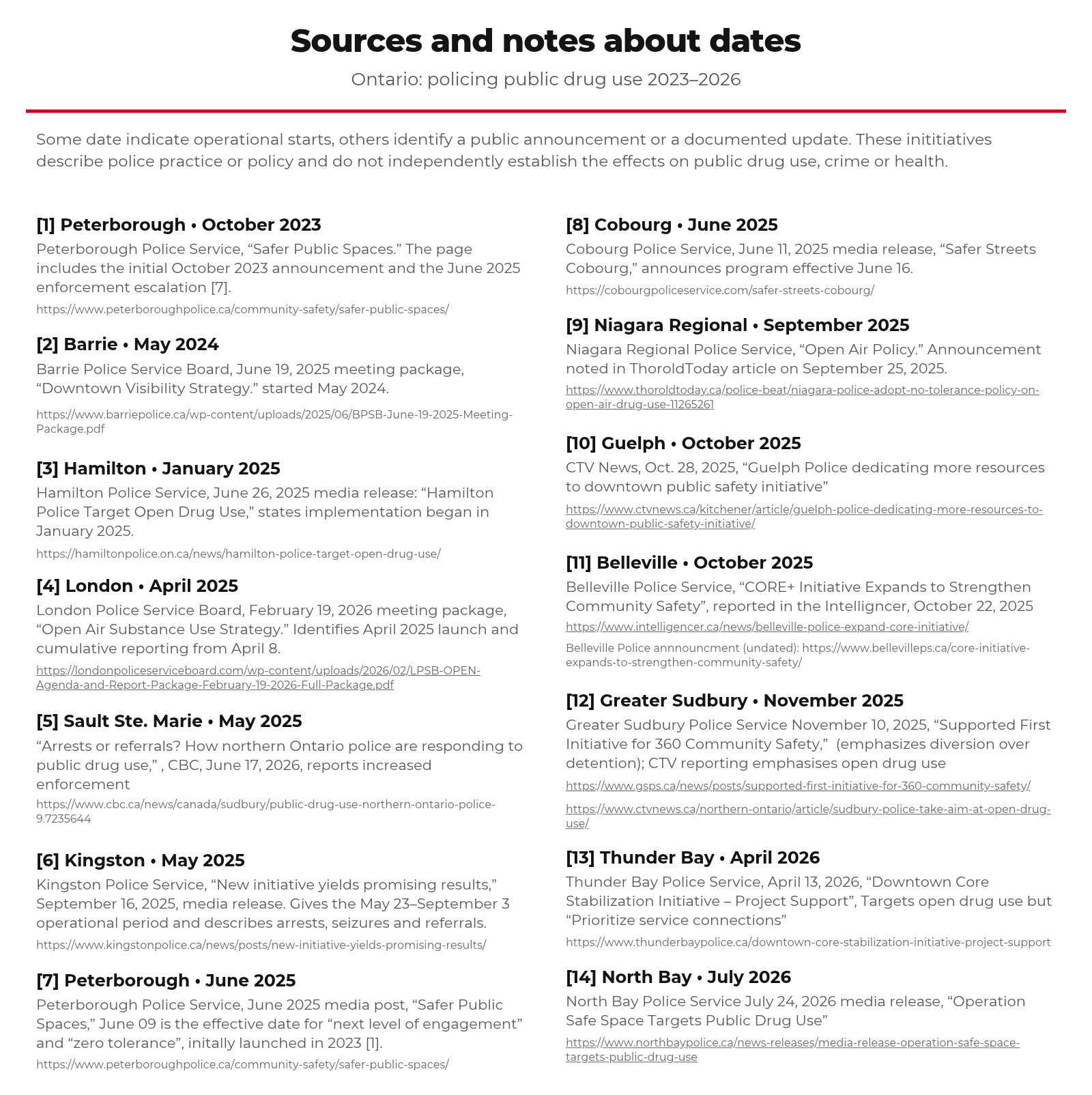
In October 2023, just sixteen months after the CTS in Peterborough Ontario opened in June (allowing for injection but not inhalation drug use), Peterborough Police Service announced it “Safer Public Spaces” initiative – a “no-tolerance approach to open air illicit drug use”. The first 18 months focused on “education and redirection to community services,” such as the CTS but in June 2025, the focus changed to one of strict enforcement. According to the Peterborough Police Services 2025 Annual Report, the change in approach has resulted in more calls for service, more arrests, charges and drugs seized.
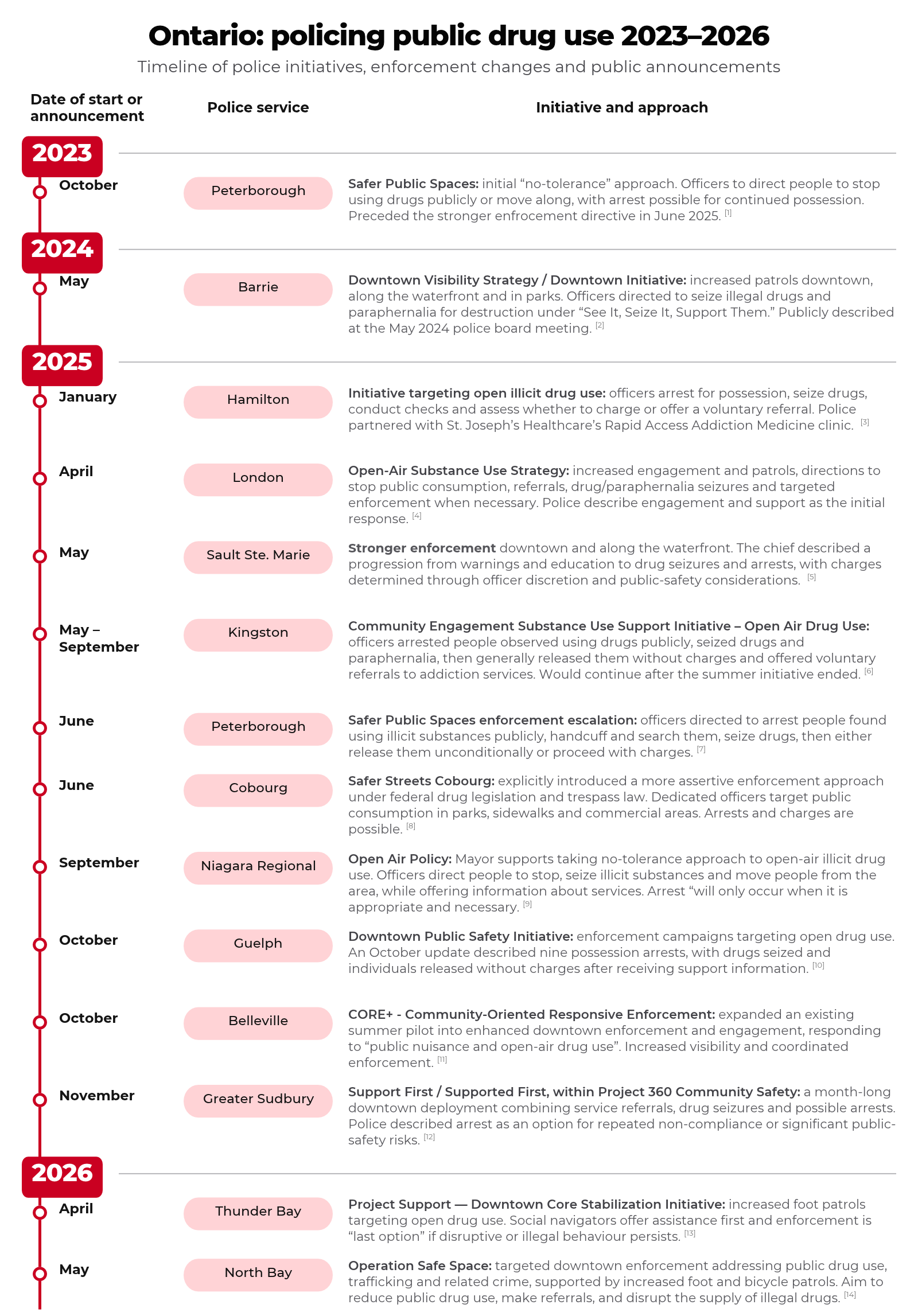
In April 2025, London Police Service (LPS) announced their increased enforcement initiative. In an August 2026 LPS report assessing January 01 to June 30, 2026 performance, they note that “recorded opioid-possession occurrences increased from 49 in 2024 to 1,430 in 2025, while other controlled-drug possession occurrences increased from 54 to 474. These increases contributed to police-reported crime totals and, in part, reflect deliberate enforcement activity undertaken in response to identified community concerns.”
London’s Carepoint SCS closed in June 2026. Statistics Canada’s 2025 Crime Severity Index for London was 73, a 10.9% increase from 2024. LPS identified firearm violence, proactive detection of child sexual abuse material offences, and increased drug possession enforcement associated with the city’s Open-Air Substance Use Strategy as significant contributors. This could help drive the broader ‘public safety narrative’ of the Ford government, if not carefully interpreted.
The public narrative
Another significant contrast is in the framing of the crisis. The Symposium report noted the “tension in current social discourse around public safety and safe consumption sites, including a tension with respect to which people are included in the definition of the public.” Morality and social norms, the Symposium suggested, impact resource allocations and policy. The report called for training for justice professionals on empathy, language, stigma, and evidence, as well as multidisciplinary and trauma-informed responses. Health professionals were seen as needing training on standards of care for people who use drugs.
The report also called for greater emphasis on public messaging around the scale of the crisis and a reversal of stigmatizing public discourse, specifically toward consumption sites. That discourse, the participants agreed, should be “countermanded with evidence about their value and support for additional resources to prevent negative outcomes.”
Ontario's public messaging took a drastically different tone. When the province announced the consumption site closures in August 2024, it said crime near sites was “significantly higher” than in surrounding communities, citing assault and robbery figures from Toronto and violent-crime comparisons in Hamilton and Ottawa. Those statistics were misleading, comparing ward-to-wide crime and failing to examine causality.
To address this gap, the Centre on Drug Policy Evaluation published an analysis using multiple data sources, including Toronto Police Service data, in November 2024. The report demonstrated that neighbourhoods with supervised consumption services did not experience increases in major crime after the sites opened. On the contrary, assault and robbery rates declined significantly near consumption sites.
Supervised consumption sites are not exempt from critique, and community safety perceptions should not be simply dismissed. However, anecdotes cannot stand in for robust analysis on policy decisions, and the Symposium report was clear that perceived concerns needed to be balanced against the fallout of broader systemic crises, such as long waitlists for treatment, a lack of shelter and housing as houselessness exploded, and increasing unaffordability while social assistance rates have declined since the Ford government took power in 2018.
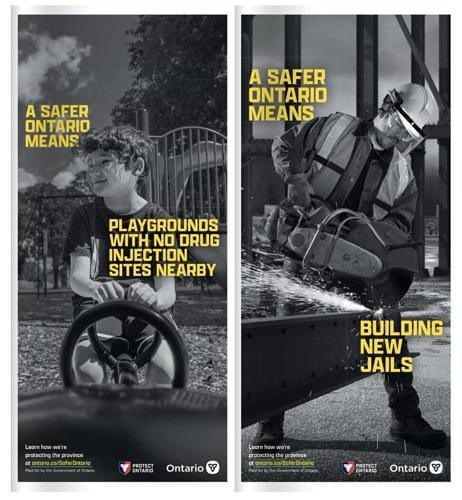
Ignoring the Symposium recommendations, the Ford government ran a propaganda campaign in early 2026 titled “A Safer Ontario." By May, airwaves across the province were flooded with commercials running on loop to promote consumption site closures, encampment evictions, new jails, and higher barriers to bail – all under the guise of "protecting neighbourhoods."
This TV ad by the Ford government was a frequent sight on airwaves in 2026, running utterly counter to the government-convened Symposium recommendations to reduce criminalization, support people who use drugs, and replace the toxic drug supply.
Some policy measures aligned with Symposium
Despite its clear refusal of most expert recommendations, the Ford government did not ignore everything discussed at the Symposium. The report was clear in calling for expanded bed-based treatment and opioid agonist treatment (OAT) such as methadone and buprenorphine. In fact, many of the report’s proposals are consistent with components of the HART Hub model. Participants also called for expanded access to housing, better transitions from corrections, and stronger connections between health and social services.
HART Hubs ostensibly provide wraparound supports of primary care, addiction treatment, mental-health care, social services, shelter, and supportive housing. Budget 2025 included an investment of $303 million over three years to stabilize the community-based mental health and addictions services sector, investments the Auditor General described as “very positive.” The Auditor General’s criticism was that the province was expanding these while gutting proven harm reduction infrastructure – without adequate planning or system evaluation.
Ontario also expanded access to Rapid Access Addiction Medicine clinics, which provide outpatient rather than bed-based services, in alignment with a community health model. These provide easier access to OAT and other outpatient-based treatments. In 2026, the legislative Public Accounts Committee reported that there were 89 RAAM clinics in Ontario, compared with 11 in 2016, and recommended further expansion of OAT services.
However, the Ford government has consistently created a false dichotomy that positions treatment and public safety against harm reduction, which the government refers to as “enabling continued drug addiction.” Like the policy direction, this matches stigmatizing Alberta government framing and runs counter to the Symposium report, which stated that “no individual solutions are adequate on their own” and called for a “multi-sectoral spectrum of responses.”
Ontario's crisis rages on
While Ontario has seen a decline in toxic drug deaths from the peak reached during the COVID-19 pandemic, the crisis remains severe. The Office of the Chief Coroner reported 207 suspect drug-related deaths in September 2026 and 688 between July and September, roughly seven deaths a day. That three-month total was comparable to the same period in 2025 and 54 percent higher than the same period in 2019. At that time, after the scaling up of supervised consumption sites and naloxone distribution, Ontario was starting to see a decline in overdose deaths, just before the COVID pandemic.
While some conservative commentators attribute the recent decline to the current policy shifts in Ontario, this is a weak analysis of political convenience. It ignores the continent-wide downward trend in overdose deaths and the fact that several regions in Ontario have fatalities continuing to fluctuate up and down. Most significantly, it does not account for the ongoing shift in the unregulated drug supply, which remains visible in near-record-level emergency department visits.
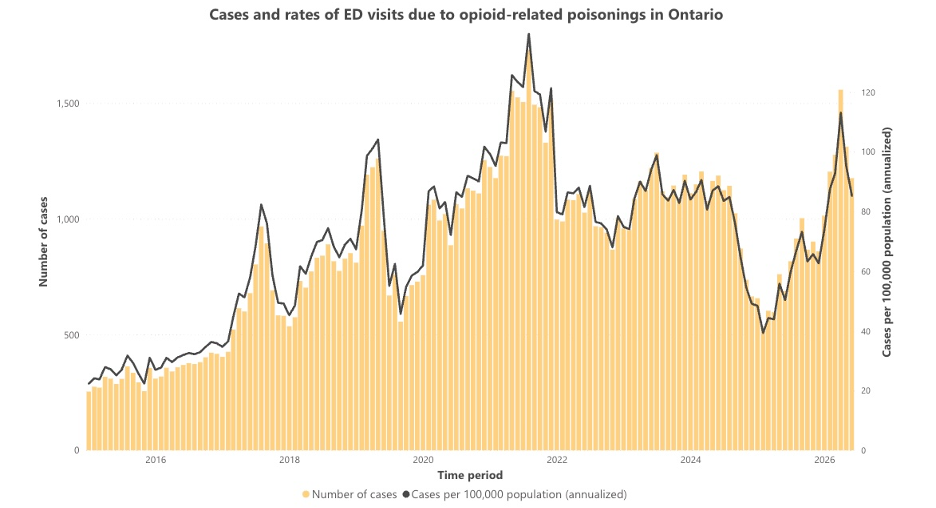
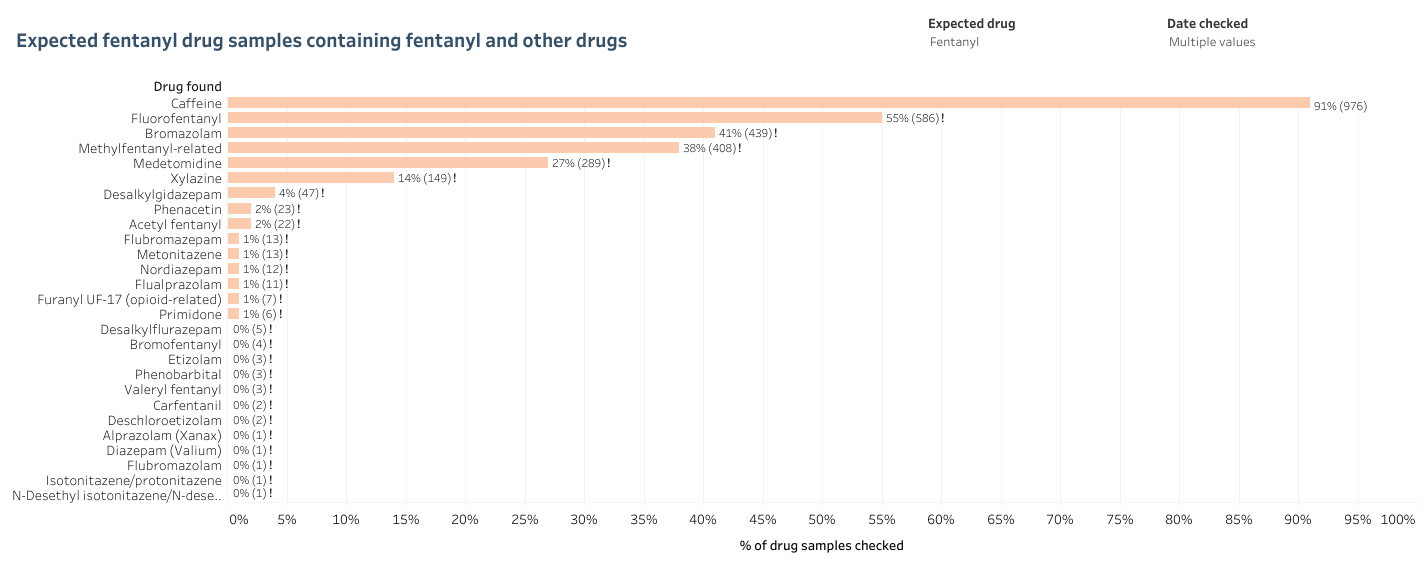
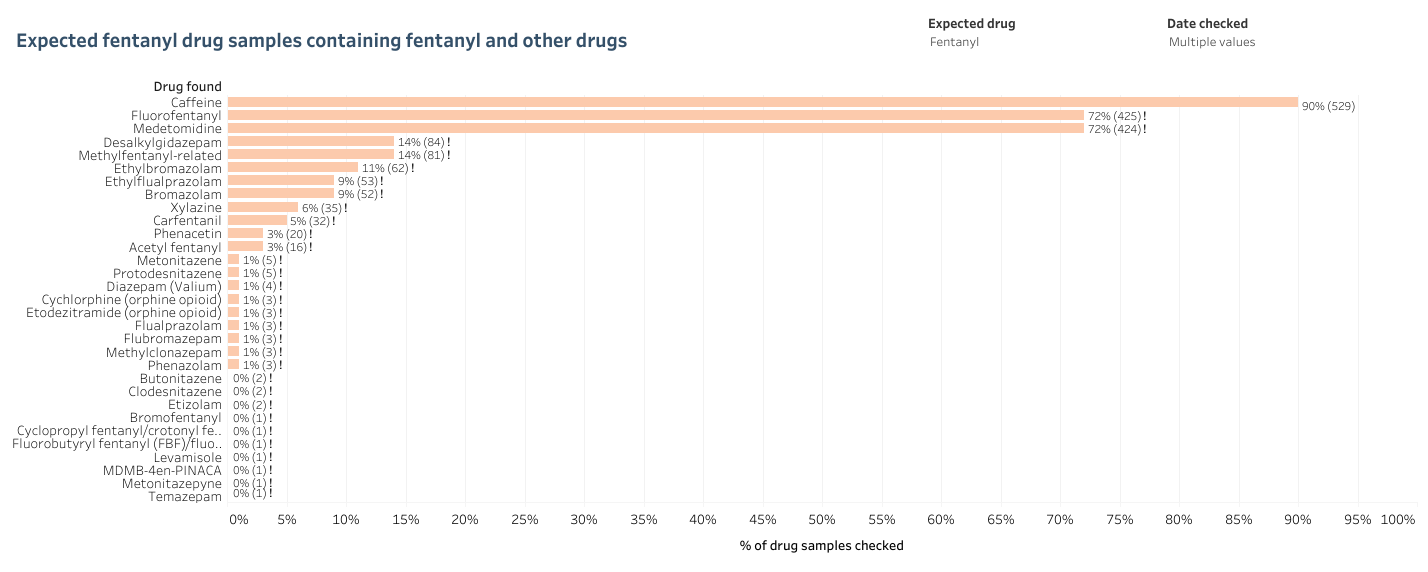
In particular, Ontario’s unregulated supply has seen an increasing prevalence of benzodiazepines and veterinary tranquilizers. For example, based on data from Toronto’s Drug Checking Service, medetomidine was detected in 27 percent of expected fentanyl samples in 2024, the year of the Symposium, but so far in 2026, it has been detected in 72 percent of expected fentanyl samples. While the risk of acute death may be lower than unregulated fentanyl, the sedative effects of these new drugs are causing other medical issues, complicating overdose responses, and increasing strains on already overburdened paramedics and hospital emergency departments and intensive care units. As noted above, while there has been a decrease in mortality, there have been significant increases in EMS calls in some regions. Frontline harm reduction workers are once again having to adapt education, training, and overdose responses.
Further toward coercion
Meanwhile, the policy discussion is moving toward forced ‘treatment’ and involuntary detention, replacing informed consent with carceral violence – once again falling in line with the Alberta Recovery Model. On September 10, 2026, Premier Doug Ford said he was open to expanding involuntary addiction treatment, after calls from Ontario's Big City Mayors for the Ontario government to consider what they call a “compassionate care and intervention model.” The messaging from the mayors is in stark contrast to a July 2024 report from the Ontario Municipalities Association (OMA), “The Opioid Crisis: A Municipal Perspective,” which specifically called for “treatment to those who want it rather than being pulled into contentious debates that will distract from making progress on this crisis” as voluntary options would “more effectively treat addiction and reduce the risk of overdose.”
It is worth noting, but not explored here, the growing concern about the ingress of corporate interests, privatization, and capitalization into addiction treatment.
It is unknown what evidence drove this 180-degree reversal among mayors, but it appears to reflect a small number of mayors forcing their chosen policies over a broader consensus and evidence. Meanwhile, polling among Ottawa residents shows increasing public support for involuntary treatment. Given the lack of evidence around its effectiveness, evidence of increased harms, and the fact that voluntary treatment remains largely inaccessible, politicians are allowing a popular, yet baseless, opinion to trample evidence-based services designed for people made vulnerable by drug criminalization.
Governments can refuse advice while staying accountable. The February 2024 Symposium convened more than 100 experts to confront the drug toxicity crisis head-on. It intentionally convened people with divergent experience in prosecution, policing, corrections, medicine, public health, Indigenous justice, harm reduction, treatment, and lived experience, and asked them to discuss what could reduce deaths and minimize harms caused by existing systems. Its report was explicitly marked as a draft and stated that it did not represent the views of the Ministry of the Attorney General. Its calls to action should not be mistaken for policy decisions or unanimous opinions of all participants. There was no political imperative for the Ford government to adopt its positions – but instead of informing a public debate, the process halted at “waiting for approvals.”
Had the report been made public in 2024, Ontarians discussing the government's new direction would have known that a major cross-sector process convened by their justice system had produced substantially different advice. The Ford government could have explained why it agreed, why it disagreed, what evidence it relied upon, and why it chose a different course.
As the Ford government moves further toward escalation of enforcement and coercion, it should explain what happened to the work it already commissioned:
- Who received the Symposium report?
- Who reviewed it?
- Whose “approval” was the Ministry of the Attorney General awaiting in July 2024 prior to releasing the report?
- How was the Ministry of Health involved?
- Did the report reach Cabinet Office or the Premier's Office?
- Was there a decision not to release the report, or did the approval process simply stop?
- Did the report inform the Ford government’s drug policy decisions? If so, how were so many of its recommendations ignored?
The Toxic Drug Deaths Symposium was the start of a multidisciplinary policy conversation. Ontarians should know why it was silenced.
Story author Nick Boyce is an Ottawa-based analyst and researcher who has worked in every facet of drug policy over 25 years.
Additional documents used in this story:
Freedom of information package may be made available on request.
An early version of this story was shared with Paid subscribers on November 3.
Thanks to 119 Paid subscribers for making this work possible.
Drug Data Decoded provides analysis using news sources, publicly available data sets and freedom of information submissions, from which the author draws reasonable opinions. The author is not a journalist.
This content is not available for AI training. All rights reserved.