Alberta is pressuring provinces on involuntary treatment – but some are pushing back
A conservative provincial government is writing off Alberta's Compassion Intervention Act as a violation of disability rights, favouring community-based treatment over residential rehab. However, a trip out west last June shows its evolving interest in privatized inpatient facilities.

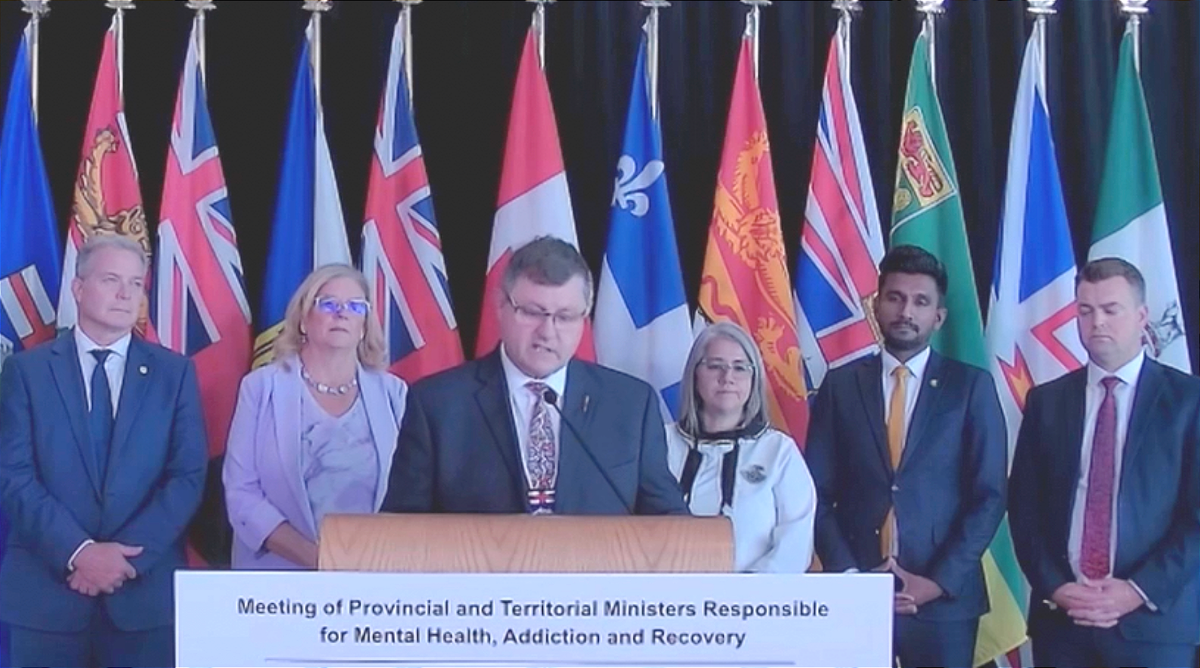
"We're all looking for [federal] funding," Alberta's Mental Health and Addiction Minister Rick Wilson told the gathered press, "but we don't want our funding tied to various programs... We're all doing something a little bit different, and if they start tying our hands, it could mess up programs that we're working on."
'A little bit different' was a significant understatement by the minister, flanked by five of his provincial counterparts who attended Alberta's September 2025 meeting of "Ministers Responsible for Mental Health, Addiction and Recovery." Months earlier, Alberta had passed its infamous Compassionate Intervention Act, legislation that permits indefinite detainment and force-medication of adults and children deemed a 'danger to themselves or others' owing to substance use.
The gathering in Banff, Alberta appeared intended to consolidate consensus around Alberta's 'recovery-oriented systems of care,' for which Saskatchewan and Ontario gleefully enlisted in 2024. Delegates were subjected to a barrage of group discussions and seminars. One of these was delivered by Dr. Rob Tanguay, who oversees the implementation of the CIA across Alberta as Senior Medical Director at Recovery Alberta.
Months previous — one day after passing the CIA – Alberta officials were aggressively encouraging other provinces to adopt involuntary treatment measures. The provinces then joined a 'technical briefing' by the Alberta government, prompted by four documents circulated to the provinces.
The documents were a 26-slide pitch deck, a CIA "fact sheet," a Canadian Centre of Recovery Excellence (CoRE) position paper on involuntary treatment, and a summary of that position paper. CoRE, which recently published a demonstrably fraudulent study on supervised consumption outcomes, is named in the documents as overseeing CIA outcomes. In addition to his role at Recovery Alberta, Tanguay is employed by CoRE and coauthored both the study and the CoRE position paper. Both of these were discussed in an academic roundtable hosted by The Breakdown on April 15.
But despite Alberta's sales tactics, cracks are forming in the conservative consensus. Drug Data Decoded has uncovered internal documents that reveal how the so-called Alberta Recovery Model is being criticized by other governments, one of which – the conservative-led government of Nova Scotia – names Alberta's strategy as an infringement of human rights.
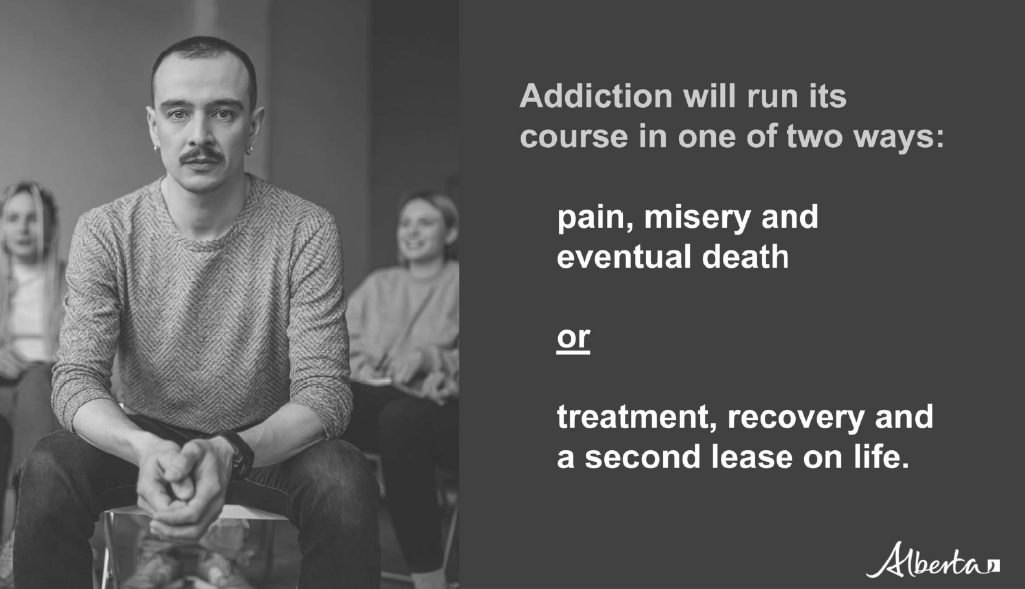
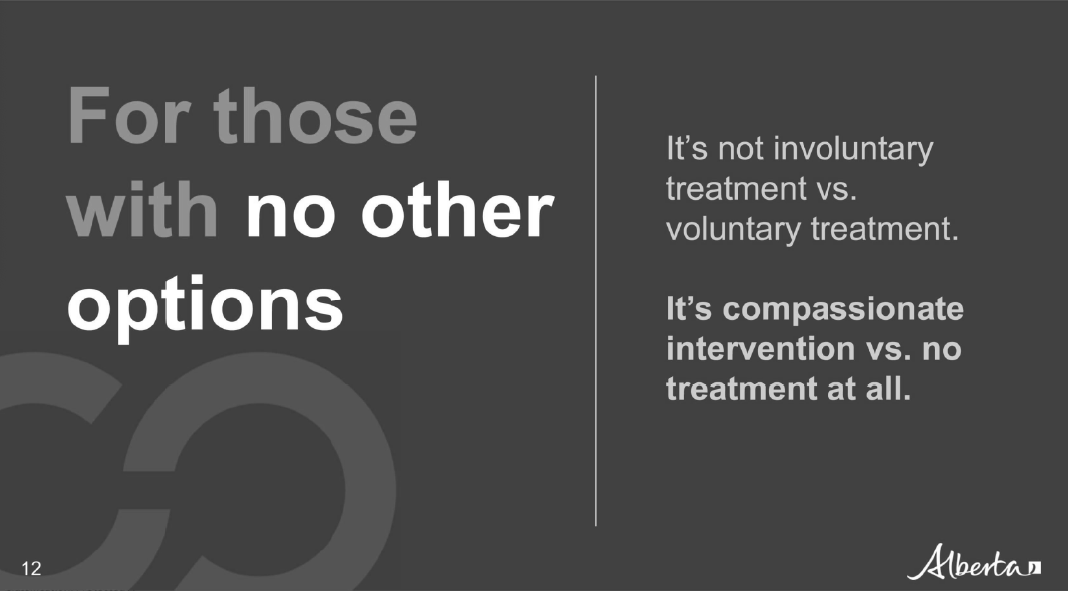
The slide deck encompasses frequent tropes promoted by the Alberta government around substance use, including that "addiction will run its course in one of two ways: pain, misery and eventual death, or treatment, recovery and a second lease on life." Another slide creates a false dichotomy between "compassionate intervention vs. no treatment at all." This line, trumpeted by Alberta government proponents, ignores many evidence-based options that the same proponents have helped to dismantle, including prescribed safer supply, supervised consumption, and sterile tool distribution.
Then, in a single slide, the messaging throws up its own medicine. First claiming "individuals will have the right to refuse treatment," the slide then affirms that "certain treatments will not be able to be refused."
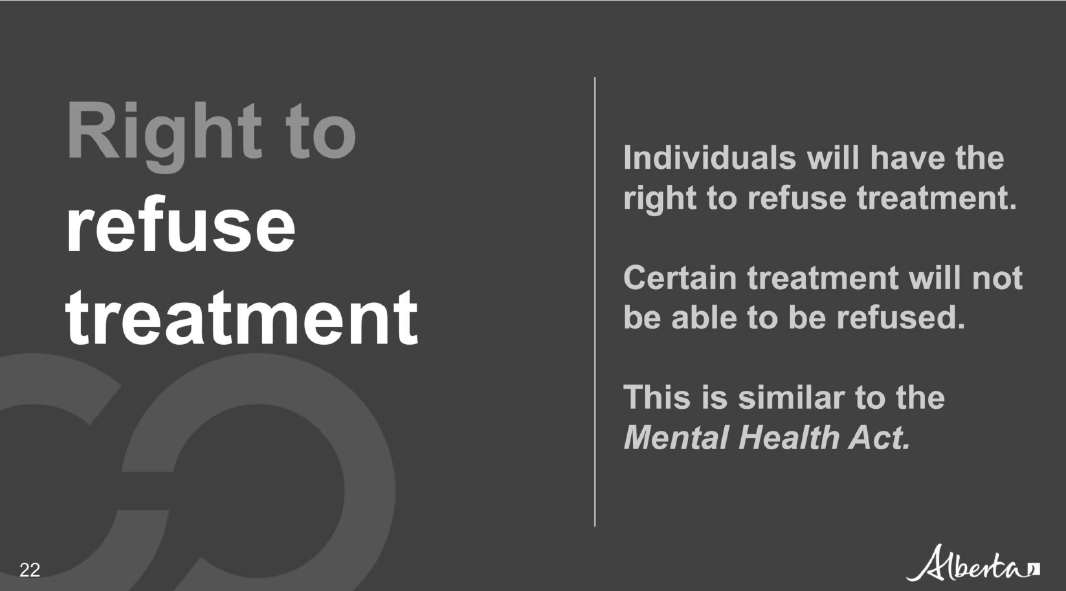
This may have been the moment where provincial governments began questioning the legal integrity of the so-called Alberta Recovery Model.
The Nova Scotia government's key takeaway in a September 2025 internal briefing note was that "legislative options that impose interventions on persons with disabilities where the individual has capacity face serious risk of Charter infringement due to greater powers to intervene in a vulnerable population and because it goes against least intrusive principles. As such, it is not the direction of choice for Nova Scotia."
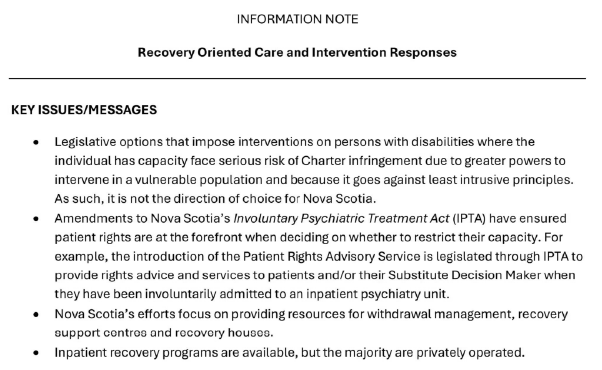
The document goes further, with the Nova Scotia government reaffirming that the provincial direction will continue to follow Canadian obligations under the United Nations Convention on the Rights of Persons with Disabilities. Its key principles, emphasized in the correspondence, include that "treatment and related services should be offered in the least-restrictive manner and environment possible, with the goal of having the person continue to live in the community... all persons have a right to a treatment plan that maximizes the person's potential, and is based on the principles of evidence-based best practices." This is embedded within the province's 2024 updates to its Involuntary Psychiatric Treatment Act.
The freedom of information response from the Nova Scotia government redacts large swaths of the summary notes from the Banff summit, using a clause allowing public bodies to obscure documents that could harm relations between provinces. The use of this clause suggests the descriptions of the Alberta model were less than flattering, and perhaps less than diplomatic.
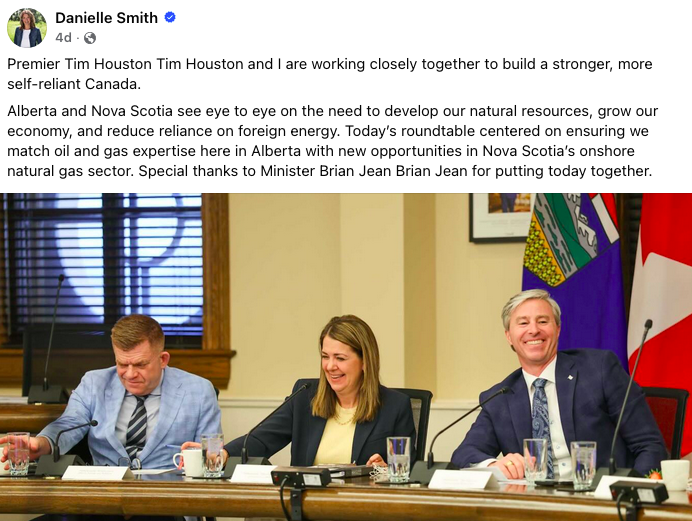
The Alberta and Nova Scotia premiers recently met to discuss oil and gas expansions. Days before, Alberta’s Technology and Innovation Minister was promoting AI data centres as a means to shore up oil and gas demand. But fossil-fuelled diplomacy ignites between the premiers as Nova Scotia quietly spurns Alberta’s war on people who use drugs.
As Alberta pitches its $2 billion-per-year privatized system to the chronically cash-strapped Nova Scotia, the oil giant itself faces a $9 billion deficit owing to price volatility in its key export. Its drug strategy has not produced independently verified outcome data to show return on public investments that emerging reports link to perhaps the largest provincial corruption scandal in Canadian history.
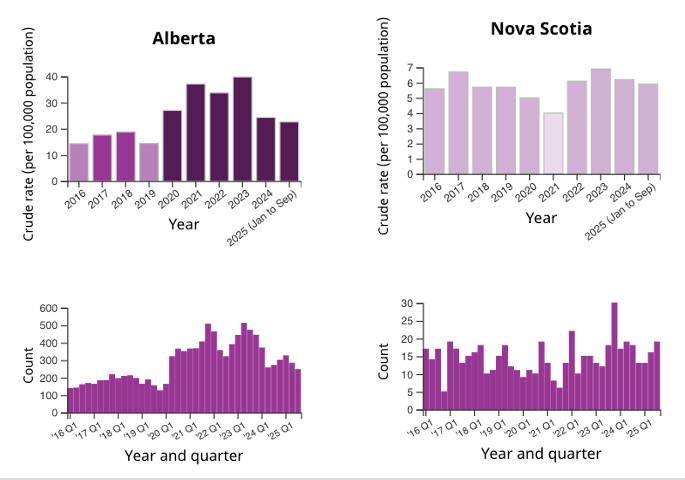
Along with the other eastern provinces, Nova Scotia has sustained among the lowest drug toxicity death rates in the country since 2020, never exceeding 7 opioid deaths per 100,000. By contrast, Alberta has allowed between 25 and 40 opioid deaths per 100,000 every year since 2020.
Some of this pattern is owing to the difference in the drug supply. In 2024, data from drugs seized by police were analyzed from across the country. This showed that Atlantic provinces experienced only a shadow of the drug supply shift seen in western provinces, where fentanyl and carfentanil came to dominate the opioid market by the time the pandemic arrived. The reasons for this remain unclear.
A key policy difference between the two provinces is that Nova Scotia primarily funds outpatient treatment that keeps people in their home communities. In contrast to the Alberta model, Nova Scotia does not subsidize American-style private inpatient rehab.
Alberta is also by far the most aggressive province in dealing with children who use drugs. Each year for two decades, hundreds of children who use drugs in Alberta have been subjected to frequently violent apprehension by police and short-term involuntary withdrawal. The CIA is an unprecedented expansion of that strategy for children and the country's first foray into extending it to adults.
Another protective distinction in Nova Scotia was its mass decarceration program in the first wave of the COVID-19 pandemic, during which nearly 50 percent of provincial inmates were released – most held in remand, without conviction. Hotels were converted to shelters to receive people, and individualized wraparound supports were provided. Despite the success of this program, East Coast Prison Justice Society noted in 2023 that incarceration rates rapidly returned to near pre-pandemic levels, owing to "police, prosecutors, judges ... [and] politicians who no longer regard decarceration as a pandemic imperative."
People are at greatest risk of drug toxicity death following incarceration and involuntary rehab programs. In 2021, Nova Scotia experienced its lowest opioid toxicity death rate in the last decade, while deaths in Alberta reached a new high that were only exceeded in 2023.
Despite the Nova Scotia government's relative success in minimizing deaths and the province's apparent distaste for detaining and force-medicating people who use drugs, signs are emerging that the siren song of publicly funding private inpatient facilities is reaching the right ears.
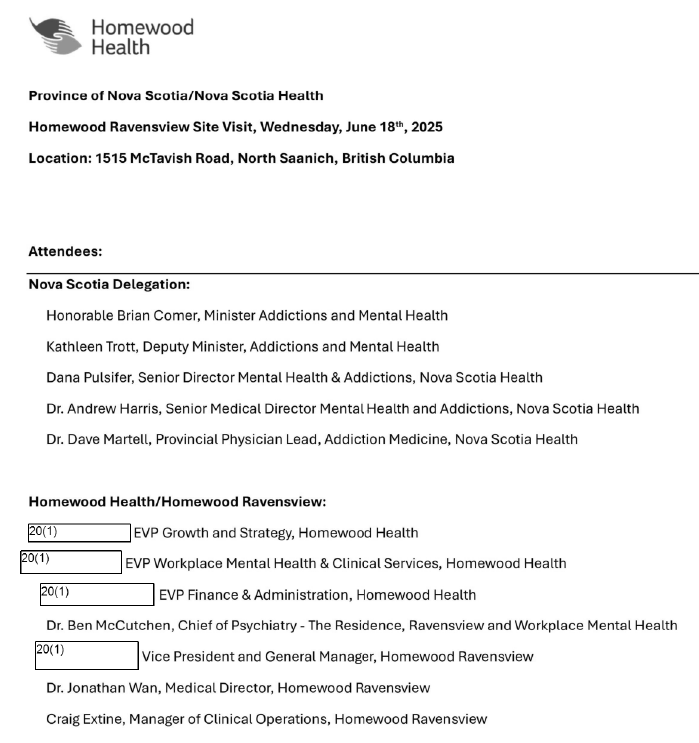
In June, 2025, two months after being pitched by Alberta government officials on the Compassionate Intervention Act, Nova Scotia's Minister and Deputy Minister of Mental Health and Addiction toured a private recovery facility in British Columbia run by Homewood Health as part of a trip to learn "about the various recovery programs out west."
Homewood Health operates private hospitals in Guelph, Ontario and North Saanich, BC, and is owned by Ontario-based RBJ Schlegel. Homewood's Ontario facility is where health professionals struggling with substance use are frequently sent by their employers. One such worker was Byron Wood, the atheist nurse who won a court battle in 2019 against Vancouver Coastal Health, after its contracted 'return-to-work' company forced him to attend Homewood's Guelph facility for a five-week program and then attend religious 12-Step group sessions. (Correction: see bottom of story.)
It is unclear how many facilities were toured during this visit, but it is likely that one or more provincial governments facilitated the connection with Homewood. Two of the trip delegates, Deputy Minister Kathleen Trott and Dr. Dave Martell, were asked on April 14 if they see Nova Scotia subsidizing private inpatient rehab facilities. They did not respond in time for publication.
Provinces across the country are deciding between nurturing public health rooted in human rights and welcoming in carceral vampires who profit from stigma toward people who use drugs. As the upcoming series from Drug Data Decoded will untangle, Nova Scotia is already on a steady march down the latter path. But, taking lessons from Alberta, the opportunity remains for sober second thought.
Documents used in this story are posted to Nova Scotia’s freedom of information request site.
CORRECTION (April 16, 2026, 5:29PM AST): A previous version of this story stated that Homewood Health is owned by a UK-based subsidiary of a US-based insurance brokerage. This is inaccurate and related to a different "Homewood Health." The Homewood Health in this story is owned by RBJ Schlegel, whose other subsidiaries include housing rentals, long-term care, and poultry.
An early version of this story was shared with Paid subscribers on April 15.
Thanks to over 100 Paid subscribers for making this work possible.
Drug Data Decoded provides analysis using news sources, publicly available data sets and freedom of information submissions, from which the author draws reasonable opinions. The author is not a journalist.
This content is not available for AI training. All rights reserved.