Alberta's only expert witness against consumption sites was an American economist in Italy. Here's how that went.
As provinces like Manitoba resume harm reduction as usual, the Alberta government's coup against supervised consumption appears to be crumbling underfoot with no medical or public health experts coming to bat. Can an American economist in Italy save the government's case against consumption sites?

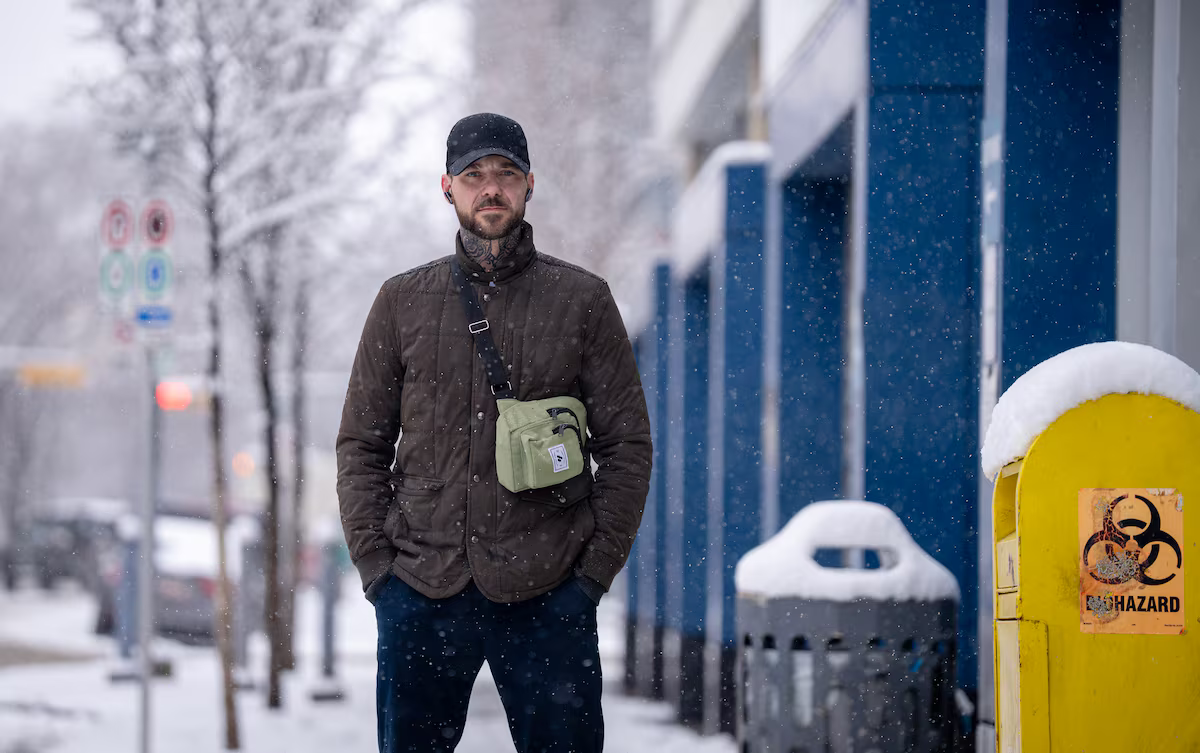
NOTE: Travis Peddie is in court against the Province on June 8 at Calgary Courts Centre, [likely] 9:30am — open to public.
Alberta media have largely handled the closure of supervised consumption sites in Calgary and Lethbridge as a given. But, like previous provincial government efforts to close these sites, the deal is far from done.
And as Travis Peddie reaches for an injunction to keep the Calgary and Lethbridge sites open, the province has made an unusual strategic decision: hiring a freshly minted, Italy-based American economics PhD, Zachary Porreca, as its only expert witness in the case.
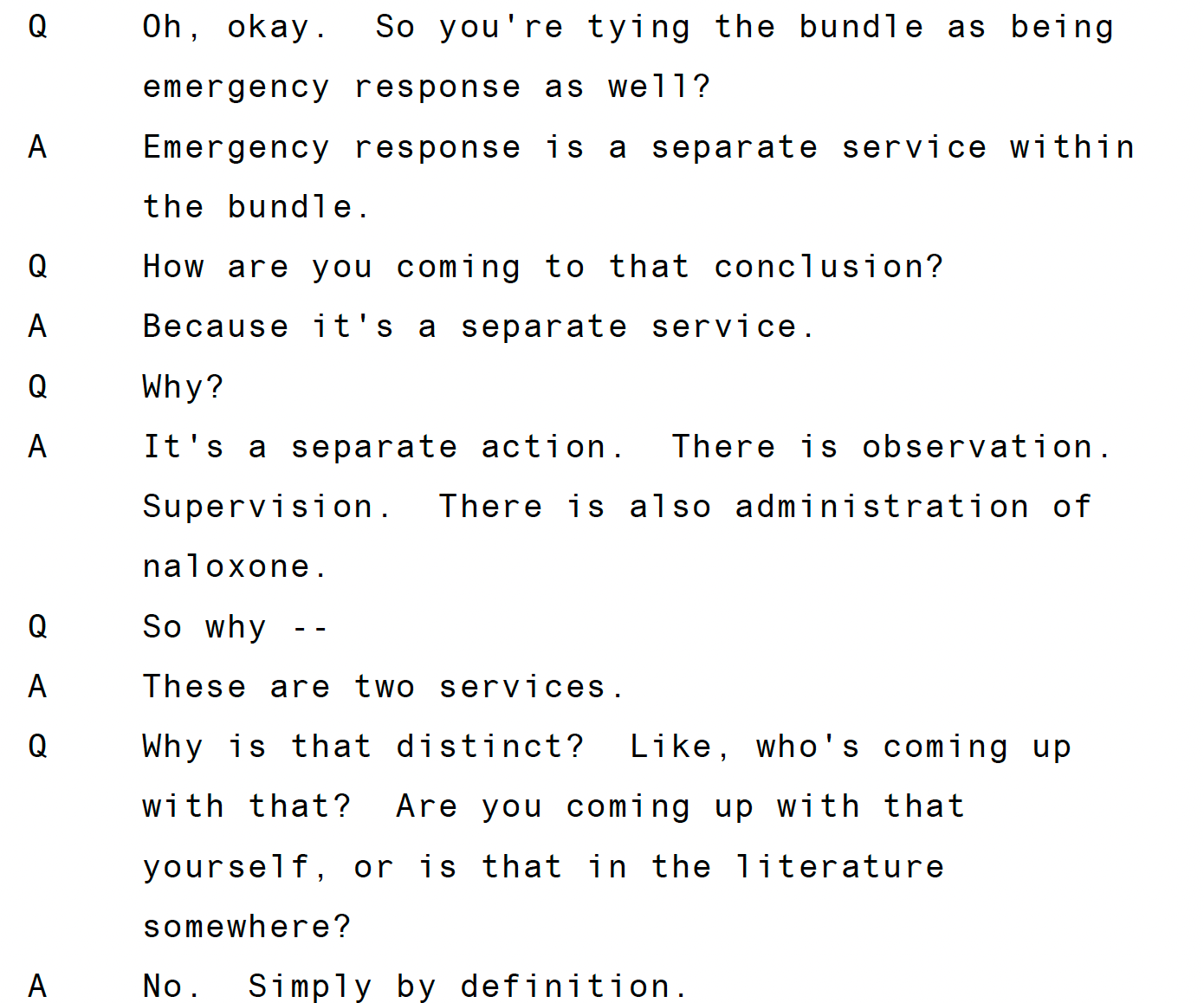
Court records obtained by Drug Data Decoded reveal the government's central argument: that supervised consumption sites can be boiled down to a "bundle of services" that can be analyzed individually. The fatal flaws in Porreca's reasoning were agonizingly drawn out in a May 21 cross-examination by Peddie's lawyer Avnish Nanda.
Porreca acknowledges that each component service "have really positive benefits for the individuals." However, if broken down into its component parts, the economist explained, he "simply cannot state with full confidence that bundling these things together at a fixed site is a superior option to delivering these services individually."
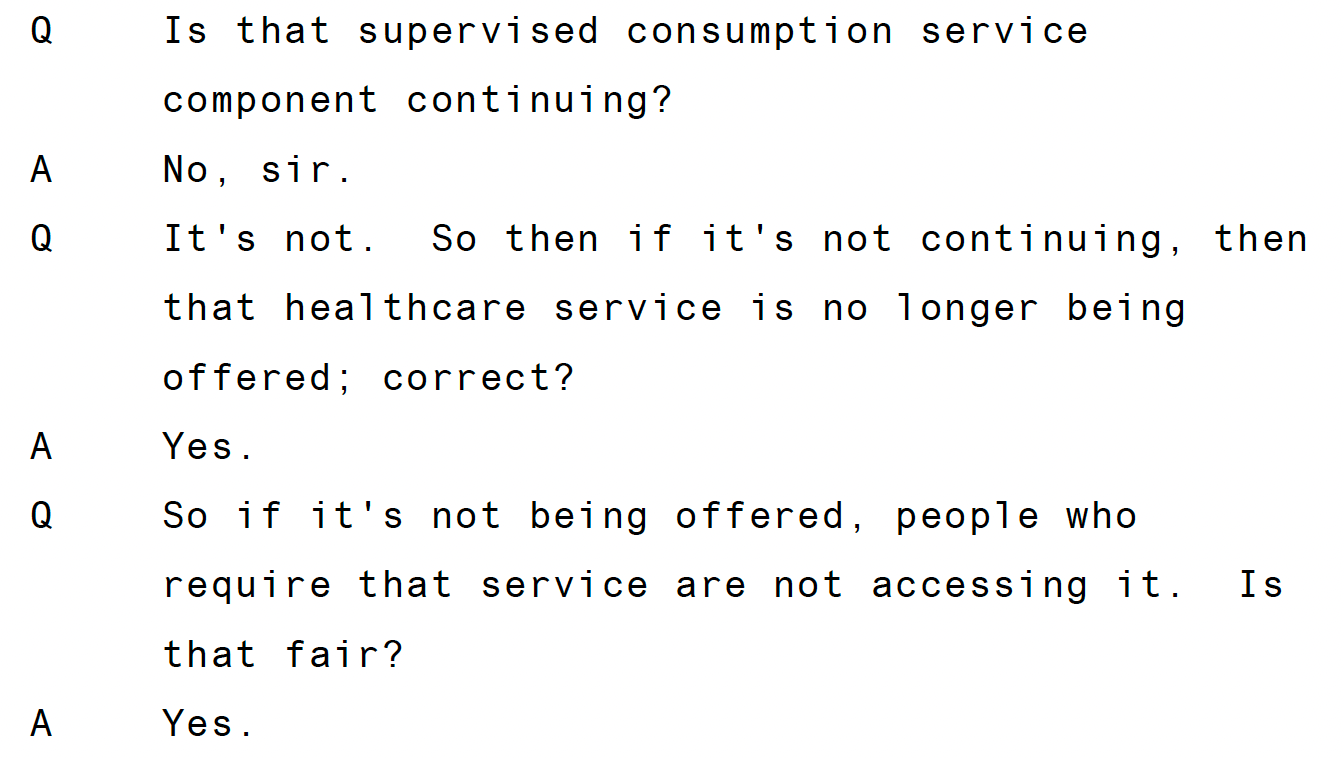
As Porreca explains, "the physical supervision, the eyes on the user, is one of the services existing within this bundle provided at this site," before admitting that this portion of the services would be "not be offered" in the Alberta government's plan to close the sites.
"Sir, I'm not an ethicist."
Nanda's line of questioning led to a dead-end argument frequently employed by criminalization advocates. Porreca repeatedly stated that data showing overdose reductions in areas with supervised consumption relative to areas without are not sufficient because they don't isolate the variable of supervised consumption on its own: the observation of drug use, without the wraparound services and without even the emergency response that follows an overdose. That is – just observation of drug use without the "bundle of services."
Porreca admits that he is building off arguments advanced by Dr. Jonathan Caulkins in a 2019 opinion piece in Addiction Journal, which recently published the highly questionable Alberta government supervised consumption study. Caulkins claimed that because consumption sites "emerged from local initiatives aimed at reducing the harms of public drug consumption, they were not designed or implemented in ways that permitted randomized controlled trials (RCTs)."
(Caulkins closely collaborates with Dr. Keith Humphreys, a Stanford University psychiatrist and chair of Alberta's Recovery Expert Advisory Panel. Notoriously, they penned a 2024 opinion piece in The Atlantic titled "Destigmatizing Drug Use Has Been a Profound Mistake, say scientists." Humphreys is deputy editor-in-chief at Addiction Journal as well as a board member and heavy investor in Indivior, which owns patents on Suboxone and Sublocade opioid agonist medications. After lobbying by Indivior, Sublocade is being aggressively pushed into Canadian prisons, displacing other treatment medications.)
Caulkins attributing the development of consumption sites as primarily an effort to reduce the "harms of public drug consumption" was and remains historically disingenuous. It is established fact that the sites were primarily created "in response to under-addressed epidemics of HIV infection and overdose," first by communities of people who use drugs and later by public health institutions.
Adopting Caulkins' argument to suggest that RCT evidence be produced for supervised consumption services is a profound own-goal by the Alberta government's expert witness.
The RCT is a specific tool regulated by a careful ethical framework endorsed by Canadian scientific bodies. It requires informed consent and must explore an area of genuine uncertainty within the expert medical community. Broadly, RCTs randomly sort human subjects into treated and untreated groups, from which outcomes are measured. Part of its duty to report is that the moment a benefit to the treated group over the untreated group is demonstrated, participants must be informed.
RCTs have not been carried out for supervised consumption because they would not pass ethics approval. In keeping with Porreca's logic – that the supervision of drug use is a "separate service" from overdose reversal – an ethics committee would need to approve an experimental design proposing that observed overdoses not be reversed. Inversely, ethics approval could not be granted to demonstrate that overdose reversal is more likely under supervision by conducting experiments on people using drugs unsupervised.
Both of these would not work for the obvious reason that these experiments would allow people to die. This is the main basis for which RCTs are not used in this context, and, more fundamentally, a central argument favouring supervised consumption: there is no "genuine uncertainty" among experts about the intervention of observing and responding to overdoses. Any effort to claim otherwise delivers an ouroboros of ethics, logic, and health policy.
Notably, the Alberta government's 2022 safe supply committee that resulted in the dismantling of opioid prescribing for harm reduction across the province also made liberal use of the RCT strawman. Cohort data demonstrated shortly thereafter that people accessing prescribed opioid supplies experienced up to 90 percent lower risk of death. Notably, no undisclosed conflicts of interest were flagged among the study authors.
When asked to explain the ethics of conducting an experiment to "isolate the impact" of supervised consumption without overdose response, the government's expert witness Porreca told Nanda: "Sir, I'm not an ethicist."
The questioning took a morbid turn when Nanda asked if Porreca knew how long it takes for someone to die or succumb to an overdose. Porreca responded, "I've seen one of my best friends die within about seven minutes. He went blue."
When pressed to connect this anecdote with the necessity of reading an overdose situation and reacting quickly to rescue a victim, Porreca responded that he does not believe that rapid response "requires supervision, no. This is the value of mobile response units, which have currently been gaining prominence."
People who were in Alberta in the spring and summer of 2023 would be familiar with the shortcomings of mobile response. In a now-legendary incident, a small outreach team working near the Calgary Drop-In shelter successfully found and responded to eight overdoses in a single hour. However, it was a drop in the ocean – that period was the deadliest on record for the city and the province, with upwards of 200 people not discovered in time to revive nearly every month that year.
Outreach worker Brandy Myette told the Calgary Herald in May of that year, “people are hiding to avoid police and then being found passed away or in a near-death state by the time outreach finds them due to not having a safe spot to be able to consume substances." The importance of decriminalized space is routinely overlooked in discussions of drug safety. So are the impacts on outreach workers having to respond to overdoses in such chaotic settings, where anything that can go wrong often does.
Porreca, who completed his PhD in 2023, leaned heavily on the recent Alberta government study on the closure of the supervised consumption site in Red Deer in his testimony. That study was interpreted in multiple government communications as showing that the closure of the site had only positive impacts.
Porreca admitted under cross-examination that he was unaware of any of the study's numerous critiques. These included that no fewer than eight conflicts of interest should have been declared by authors, but went unmentioned.
Porreca's most recent published paper promotes law enforcement "dispersing" of the drug trade in Philadelphia, using cell phone data to show reductions in traffic to the city's main centre of drug distribution. It is increasingly accepted that drug enforcement temporarily increases local overdose risk. Porreca's findings reaffirmed the pattern – that overdose deaths in the area of strict enforcement remained higher than surrounding regions.
Nonetheless, his paper concludes that drug enforcement "accelerated a downward trend in overdose mortality present in the region." To accomplish this acrobatic feat, he drew from patterns in Baltimore, 100 miles away from the study site. In the paper's final words, Porreca stated that "law enforcement effort may be an underutilized resource in quelling the ongoing opiate epidemic in America."
In his expert witness testimony, Porreca revealed that he has accepted nearly $200,000 USD from Arnold Ventures, an American "philanthropic giant" that Keith Humphreys describes as “the most influential funder of criminal justice innovations and research.” Arnold Ventures came under fire in 2023 for hiring economist Jennifer Doleac to lead its criminal justice portfolio. Doleac is perhaps best known for suggesting in a 2018 Brookings paper that the availability of naloxone and sterile syringes drive increased "opioid abuse" and mortality while questioning their overall effectiveness. In his affidavit, Porreca names Doleac as a personal reference and lists his position as Arnold Ventures Criminal Justice Innovation Fellow since 2024, meaning his funding is likely overseen by Doleac.
In his glowing review of Doleac’s new book, Humphreys promotes widespread remote monitoring and drug testing of released prisoners — interventions that could also happen to funnel more people into treatments sold by Indivior. His review, titled “Where Left and Right Both Go Wrong on Crime,” re-frames this pro-surveillance tech carceralism as “factivism,” praising Doleac‘s “intellectual humility that factivists rightly celebrate.”

Having driven his point about Porreca’s copy-and-pasting of American drug policy into his study of Alberta, Nanda closes off his examination by supplying Porreca with the definition of supervised consumption used by the Alberta government. Porreca admitted to skipping this in his research review:
"Services provided to individuals in which the consumption of drugs that have previously been obtained by those individuals is supervised in person by the service provider or employee of the service provider, and emergency care is available and provided in response to an adverse reaction to a drug but does not include opioid agonist treatment services."
In Alberta, supervision and emergency response are not bundled and not separate, but one service — regardless of how its government is trying to rewrite the rules in the image of the United States.
Meanwhile in Manitoba, after a brief pause in proceedings, Wab Kinew's government has resumed the opening of the province's first consumption site, in Winnipeg. The holdup was apparently to satisfy the business community that more funding would be made available for security, and around $1.5 million in new funding was allocated to non-police, nonprofit outreach patrols, in addition to half a million more for unidentified business association activities.
Despite the opportunistic fallout of the Alberta government's new angle of attack on harm reduction through the academic literature, with mass site closures scheduled across Ontario and Alberta in June, the national consensus appears to be that the cohort study was bogus. This week, its authors published a response to a controlled criticism in Addiction published last month. The response failed its second opportunity to name the many undeclared conflicts of interest among authors in the original study publication.
Both the critique and response also failed to name the most fundamental flaw in the personal health number data – that people who use consumption sites frequently provide fake personal health numbers to access them, information the study authors have held since its conceptualization in early 2024.
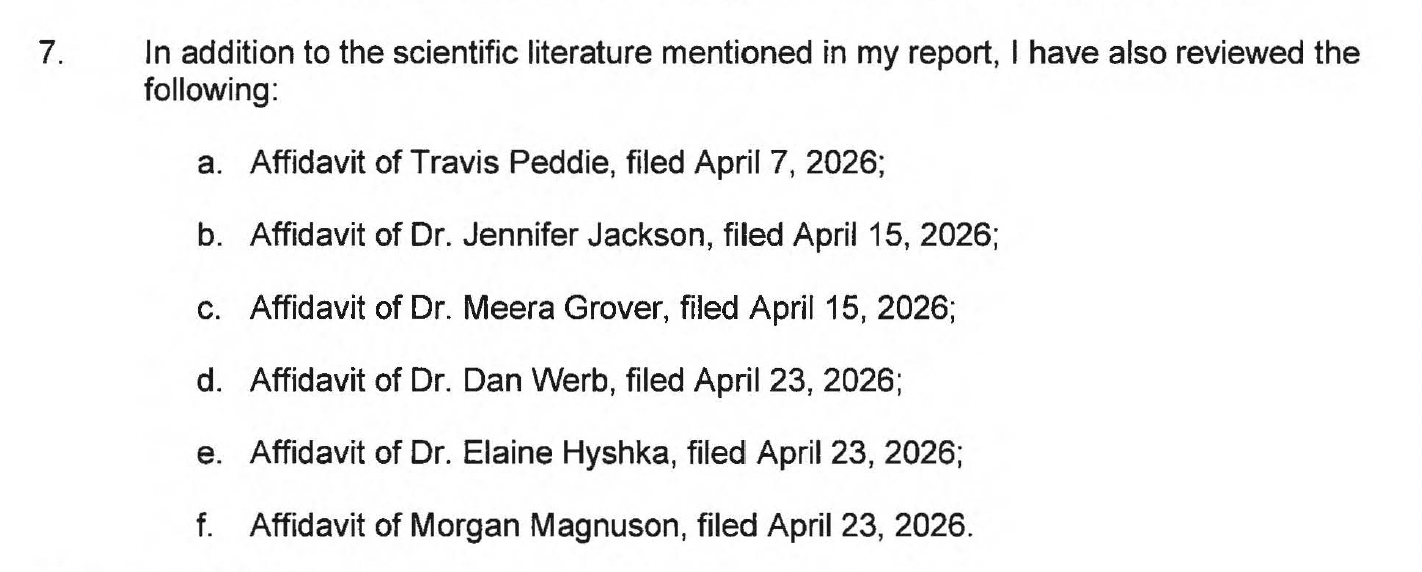
The lead study author, Dr. Nathaniel Day, was an expert witness in the Government of Ontario's 2025 offensive on supervised consumption sites. But at the eleventh hour, his own government appears to be throwing the match as plaintiff Travis Peddie produces no fewer than five qualified experts.
Where are Alberta's experts trained in the rigorous science of shutting down sites?
Documents used in this report:
An early version of this story was shared with Paid subscribers.
Thanks to nearly 120 Paid subscribers for making this work possible.
Drug Data Decoded provides analysis using news sources, publicly available data sets and freedom of information submissions, from which the author draws reasonable opinions. The author is not a journalist.
This content is not available for AI training. All rights reserved.