Out in the Cold, Part 2: Shelter staff "treated like criminals" by politically motivated police
Out of the Cold staff were criminalized while running low-barrier shelters in Halifax, until they were terminated. This hit a crescendo as Halifax police were 'alerted' to union organizing – by the agency getting their contracts. Why and how did police help dismantle Out of the Cold?


This is Part 2 of a multi-part series. Click here to read Part 1 on manoeuvring inside the Nova Scotia government to remove Out of the Cold Community Association as operator of two Halifax harm-reduction shelters.
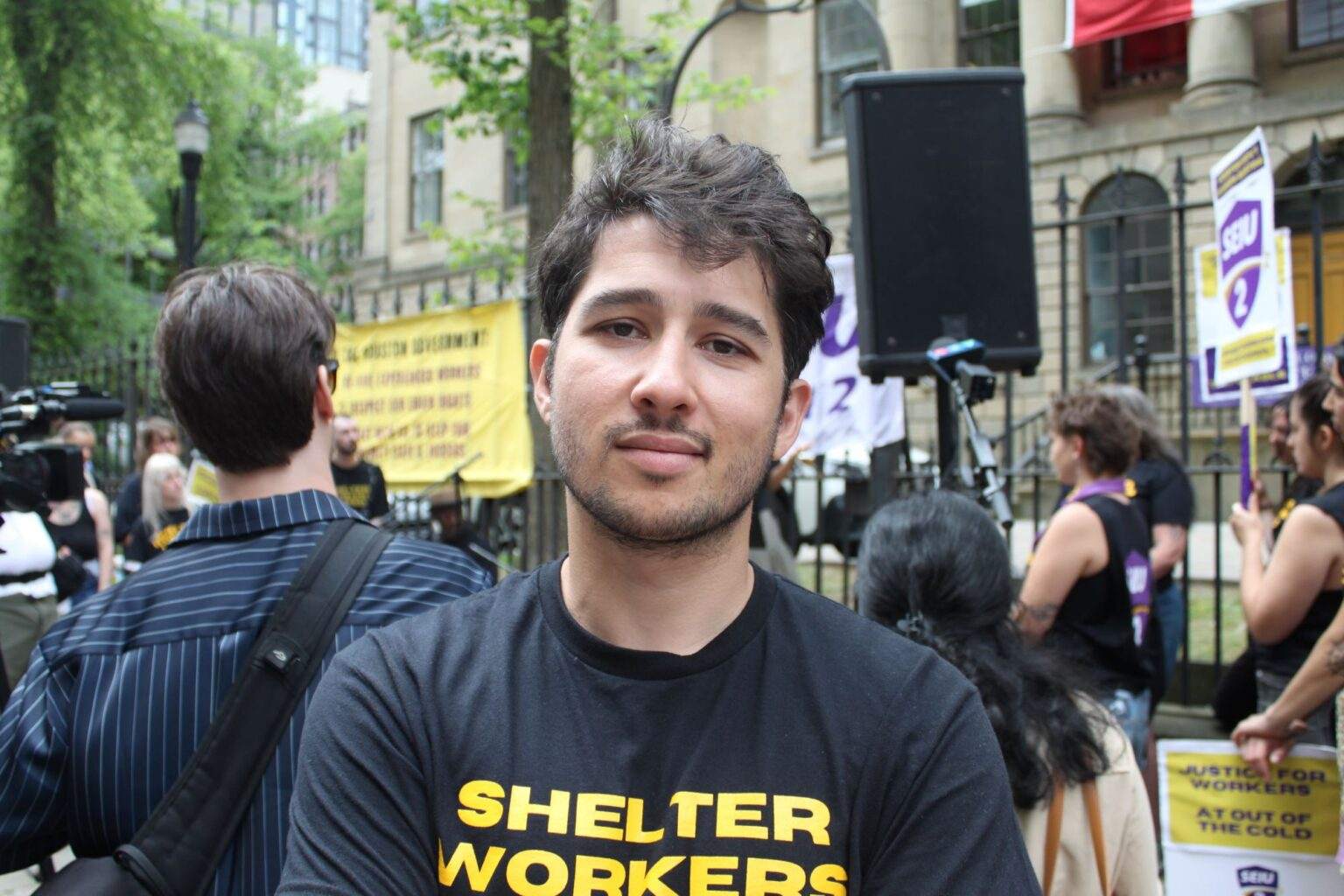
When Carlo Cininni got his termination notice last July, he already had plans to temporarily leave his frontline job at Out of the Cold Community Association's Halifax shelter that fall. He had learned solidarity activists were welcome in the West Bank to help resist Israel's genocide of Palestinians. As Carlo told Drug Data Decoded in May. "I'm not a medic or a doctor, so Gaza is not going to be a thing, but I was like, 'this is probably the most I can do.'"
Carlo connects his shelter work with his motivation to travel to the West Bank. "I guess it ties into why anybody would work at Out of the Cold, in the sense that there is active participation against systemic wrongdoing," he says. "I don't want to be a passive participant, knowing that my government is complicit."
Carlo's Brazilian mother lived through the US-backed fascist coup in 1964, while his close friend is Lebanese and "grew up hearing Israeli jets bomb his fucking community," so connecting geopolitics with local politics comes naturally.
His plan was to return to Out of the Cold when he got back, though he could feel the toll the work was taking on his body. In any case, that never happened: on July 8, 2025, he was among forty-two unionized employees terminated after the Nova Scotia government's manoeuvring to replace his employer. It cost him months of anticipated wages. He describes the events around the organization's eviction as "humiliating" and "completely unprofessional."
Since July, the active role that Halifax police played in those events – and their motivations – have remained largely unexamined in media reports.
Motive
The introduction to a heavily redacted 2023 site safety audit by Halifax police affirmed that Out of the Cold provided “low barrier, people-centred support rooted in anti-oppressive harm reduction practices." But despite the endorsing tone, Halifax police video-surveilled the organization for weeks that same year and the next, as detailed in Part 1 of this series. Additional documents obtained through freedom of information and allegations from former staff strongly suggest that Halifax police took an adversarial stance with the organization.
Two reasons may explain why Halifax police appeared eager to get Out of the Cold out of the picture.
First, as recently as February 2026, Halifax police were eyeing up the land that houses the modular shelter and Centennial Pool as one of three possible locations for their new headquarters – and the only option on the Halifax peninsula. The city councillors representing the local wards have been clear about their support for preserving the pool, which has received a groundswell since the initial 2022 council motion to close it. The current police headquarters is across the street, and recent reporting in the Halifax Examiner appears to confirm the Centennial-shelter site remains a contender – with a $180 million budget.
Second, in the government's August 14, 2023 email to Out of the Cold leadership threatening to withdraw funding, an executive director in the Department of Community Services, Joy Knight, referred to evidence that Out of the Cold staff had "obstructed police responses to emergency calls" at the Halifax shelter and demanded a more "collaborative" relationship with Halifax police.
In its August 25 reply, Out of the Cold denied this as a "serious allegation that goes against our police policy," asked the government to provide evidence, explained that Halifax police have a "fraught relationship with homeless people," and expressed concern that its residents could be "further criminalized, injured, or killed by violent police action."
The organization met with Halifax police twice to address the issue, on August 23 and November 20, 2023.
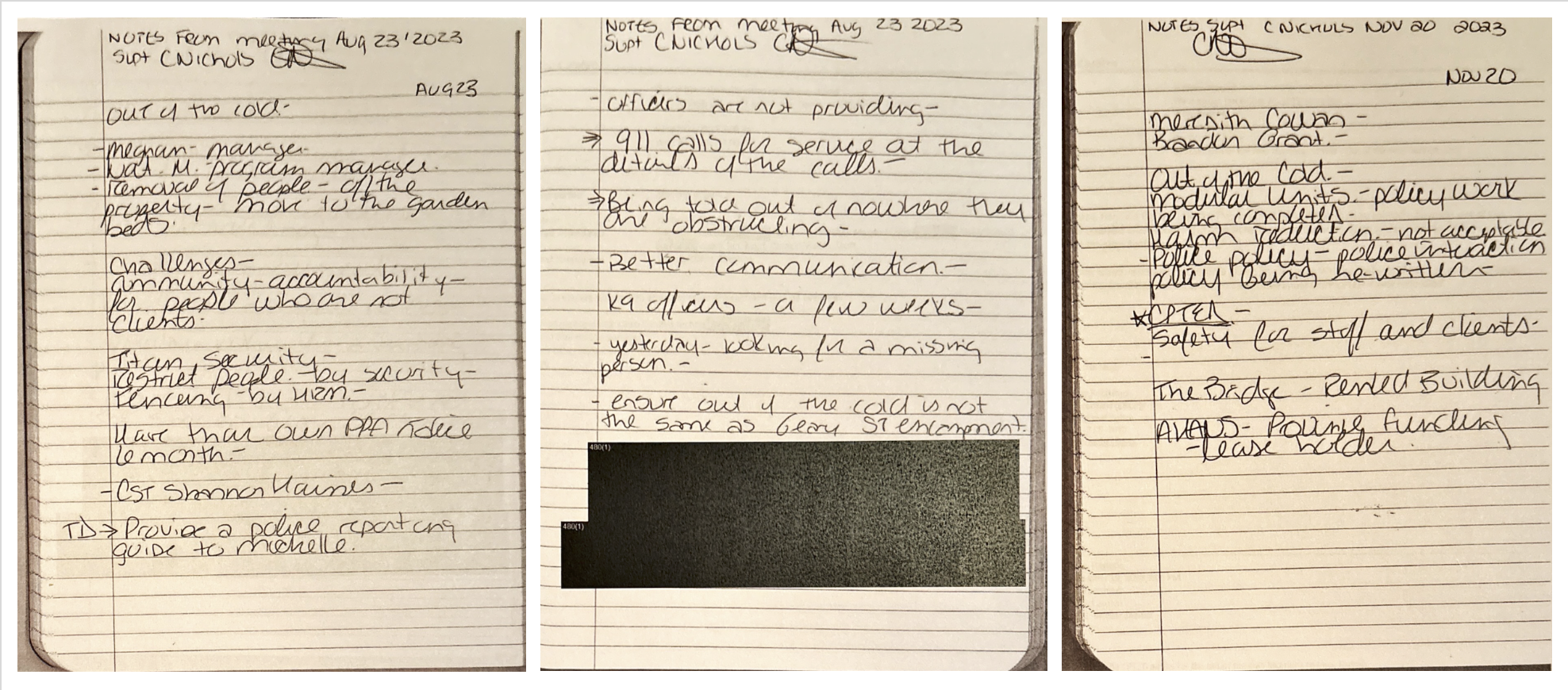
Halifax police superintendent Carolyn Nichols' notes from those meetings were obtained by Drug Data Decoded through a freedom of information request. The August meeting discussed Protection of Property Act (PPA) notices being issued – presumably to remove "people who are not clients" from Out of the Cold property when "challenges" arise – as well as complaints from Out of the Cold that staff were "being told out of nowhere they are obstructing."
The November meeting, which included provincial government officials, centred on Out of the Cold policies. One of Nichols' notes from that meeting simply stated "Harm Reduction – not acceptable," while another referenced Out of the Cold's "police interaction policy being re-written."
On June 3, Halifax police and Knight were asked to provide evidence that Out of the Cold staff "obstructed police responses to emergency calls" at the Halifax shelter, as claimed in Knight's August 2023 letter. Halifax police were also asked if the Centennial Pool location remains a candidate for the new police station. Neither responded.
“We are not allowed to impede in an active investigation, and staff knew that," says Steph Mullin, the former Out of the Cold employee introduced in Part 1. "We always let the tenant or the resident navigate their own legal matters and we would support them in how they wanted to do that."
But, she says, "the big-ticket item the police really hated was our ‘cannot consent to confirm or deny' policy." This was a legally vetted practice at Out of the Cold whereby staff would avoid volunteering details about a resident's location where possible. According to Steph, it was necessary because “the police have an escalating impact on our people – they tend to become more heightened, more activated. They need extra support because they are [often] experiencing PTSD… The atmosphere of the space became more difficult because of the cops."
She recalls one incident where an officer asked if she was denying her entrance into the facility. "I told him, ‘You can go knock on doors – I can't deny somebody with a baton, a gun and a bulletproof vest access to anything – but I cannot confirm or deny this person is here.'"
Carlo confirms that he's "never seen someone say, 'you can't go in that door' or anything like that. At most it would be [telling the police], 'I can't tell you if they're here or not.' But... toward later years, we had to start working with the police more."
In one situation, Carlo had to de-escalate outsiders who had brought guns onsite. "It was policy – we had to call the police. The people ran off. No one was hurt, there were no gunshots."
But, when Steph would apply the 'cannot confirm or deny' policy, she says on several occasions "the police would take our names and our birth dates and all that other stuff."
Drug Data Decoded asked lawyer Asaf Rashid if this police activity seems in line with Charter rights. He responded that ”if police compel, through threats, violence or implied threats of violence someone to give information to police or be subjected to a search of their person, home, car, or phone,” then it could be a Charter section 8 violation (unreasonable search and seizure).
Carlo attributes this overzealous policing to its institutional culture. "I've reported on City Hall and I've seen police records... Any minor annoyance can be exaggerated," he says. "You create an excuse and then the local business council gets all, like, ‘Oh, our men in blue are not being able to work efficiently.'"
This matches a framing advanced by Carlton University researchers Andrew Crosby and Jeffrey Monaghan in their new book, Thin Blue Rage, officially launching in Halifax on June 12. They explain how as a social movement, "police are partisans... they campaign relentlessly to shape the world around their ideological worldview, and they demand loyalty and deference internally (and externally) in their efforts to control and advance their political opportunities."
On June 3, Halifax police were asked if they considered Out of the Cold's policy to not confirm or deny resident presence onsite as obstruction, and if demanding identification of staff applying that policy aligns with Charter section 8, reasonable search and seizure. The police did not respond.
“Our people came from ten-plus years unhoused, ten-plus years institutionalized in foster care and in the carceral system… Our approach to their [behavioural complexities] was very accommodating. It meant we could be yelled at, we could be postured at, we would have to find ways to de-escalate and regulate people who are consistently left out of the process of their own well-being.”
-Steph Mullin, former Out of the Cold case manager
Method
Like the 'drug and human trafficking' narrative detailed in Part 1, the 'police obstruction' narrative was formalized through high-level communications in the provincial government. As its second of two secret SCAN investigations of the shelters approached in November 2024, Department of Opportunities and Social Development senior official Suzanne Ley said in an internal email, "while not in the official report, we understand the camera footage also showed first responders (police, EHS) not being allowed on the property after a call was made for support."
Because the police are responsible for reviewing the video evidence in a SCAN investigation, this complaint either originated from Halifax police or never happened. The SCAN investigation summaries obtained by Drug Data Decoded made no mention of emergency responders being refused entry.
Drug Data Decoded submitted a freedom of information request for all evidence supporting Ley's claim. The Department responded that it "does not have custody or control of records" responsive to that request, revealing that Ley’s allegation was either fabricated or hearsay from the police. In either case, it likely served a key role at a pivotal moment to reinforce the central complaint that Out of the Cold's policy to 'not confirm or deny' a resident's location was obstructive.
On June 3, Ley was asked directly by Drug Data Decoded if she could substantiate the obstruction claim. She did not respond.
In November 2024, Charcy Marchand, a senior official at the Department of Justice, threatened to Ley that she would seek a legal order to evict Out of the Cold under the SCAN Act, as discussed in Part 1. This was a wildly unlikely outcome, but Ley appeared to take it seriously.
In December 2024, a month after disseminating the unsupported obstruction claim, Ley replied to Marchand with the first recorded mention of "changing the service provider" at the shelters.
Out of the Cold's forty-two unionized staff were out of a job seven months later.
Despite the "no-contact order" barring staff from reaching out to residents, Steph and Carlo have run into former clients. “A lot of them cried when they saw me – most cried," Steph says. "But, no matter how long you support someone... as a worker, you always have to remember that you are still institutionalizing people. So there's definitely some blame on Out of the Cold [by residents], and then some compassion.” She says some report feeling more supported nowadays, others less.
Carlo agrees. To him, "OTC wasn't perfect. I think, because it was running on fumes and operating in a grey area, there were things that perhaps weren't ideal."
"But how traumatizing would it have been," he wonders, "if you were a resident, to see all these people who have been working with you for two years, gone? There's a lot of trauma with institutions, the idea that, ‘I'm just cycling through government programs and housing.’ But OTC was at least stable for a time.”

Accomplice
That stability may have been disrupted in part by the organization that took over the contract. Since the transition, Steph has heard reports that a "lot of people" were evicted. On June 8, Drug Data Decoded asked two senior members of the new service provider, Atlantic Community Shelters Society (ACSS), to provide figures on resident evictions since taking over. They did not reply.
But the afternoon before Out of the Cold staff were ordered off the job, an email was sent by Dolly Mosher, the Halifax police Victim Services Coordinator, to Superintendent Greg Robertson – the fourth-highest ranking officer.
Mosher also chairs the board of the ACSS. The email was sent from Mosher’s Halifax police account.
"In my capacity as Chair of the Atlantic Community Shelter Society (nothing to do with my position at HRP)," Mosher explained, "in consultation with our [executive director, Joe Rudderham], we felt it necessary to alert HRP as we don't know what reaction will be from the present staff or residents. Residents are not being asked to leave at this point. While we hope it will go smoothly, the union representing the workers may be on hand as well."
Robertson forwarded this email to the chief and other executives of Halifax Regional Police, "for WCOM awareness... Please keep confidential until tomorrow as staff will not be made aware until tomorrow."
The top brass was officially on alert.
Among that group was Central Division Commander Mo Chediac. Less than three years after commanding the disastrous 2021 Memorial Library decampment, Chediac had been promoted to Inspector. His second-in-command at the decampment, Joanne Sweeney, was promoted to Staff Sergeant at the same time.
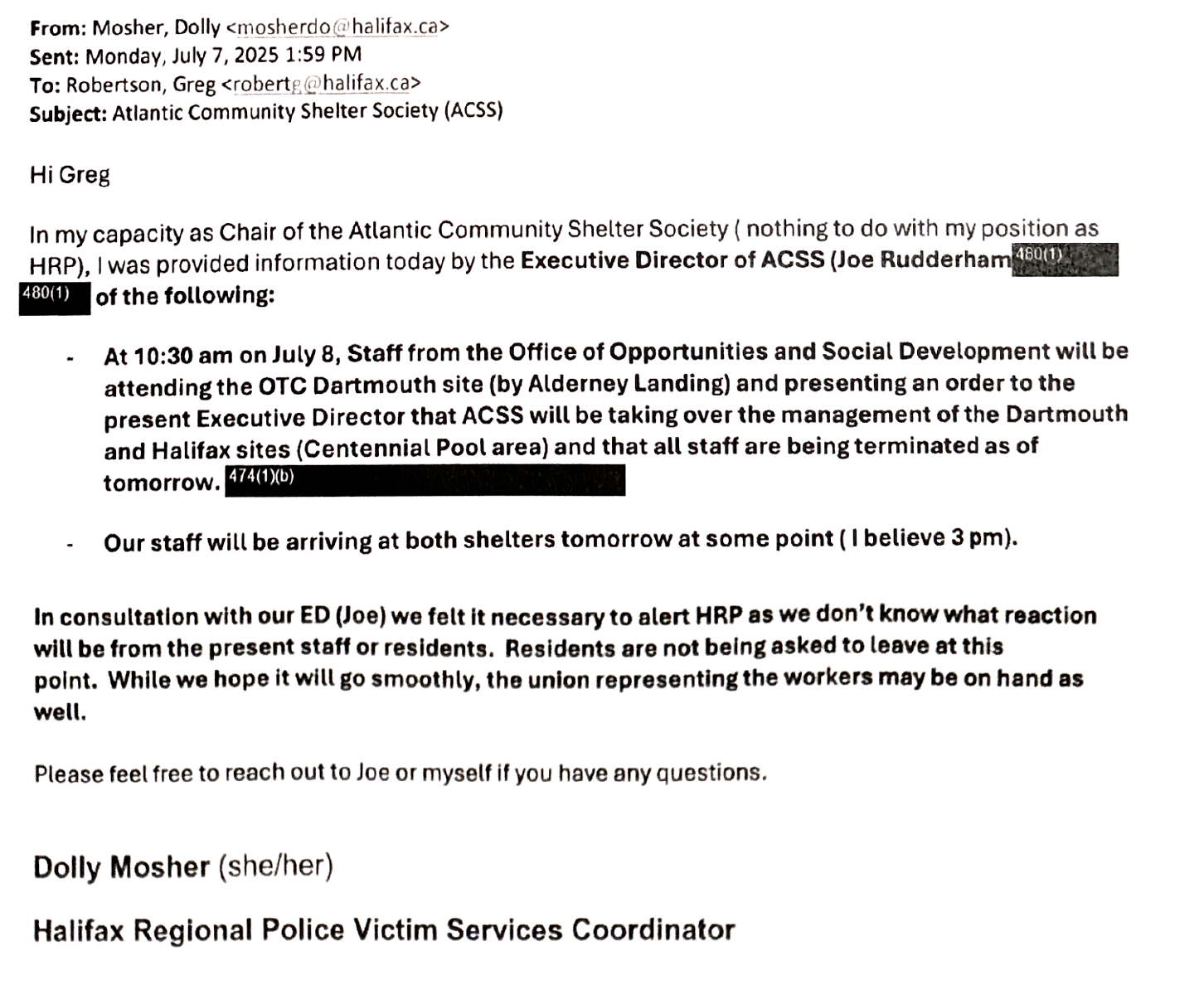
After being shown the communication between Mosher and the police executive, Steph is shocked. “So they were just kind of primed for potential violence when they went to evict us," she says.
Carlo reacts similarly: "Maybe we were a barrier to the police being able to do whatever they wanted, but to conflate that with any form of threat is absurd and insulting."
"I guess we're getting treated like criminals then."
Three hours after Mosher sent her email, Deputy Chief Matthews was similarly warned by Department of Justice official Charcy Marchand, who asked him to "please share this information in confidence with your colleagues."
Matthews replied, "Thanks Charcy. Will pass it on to my team."
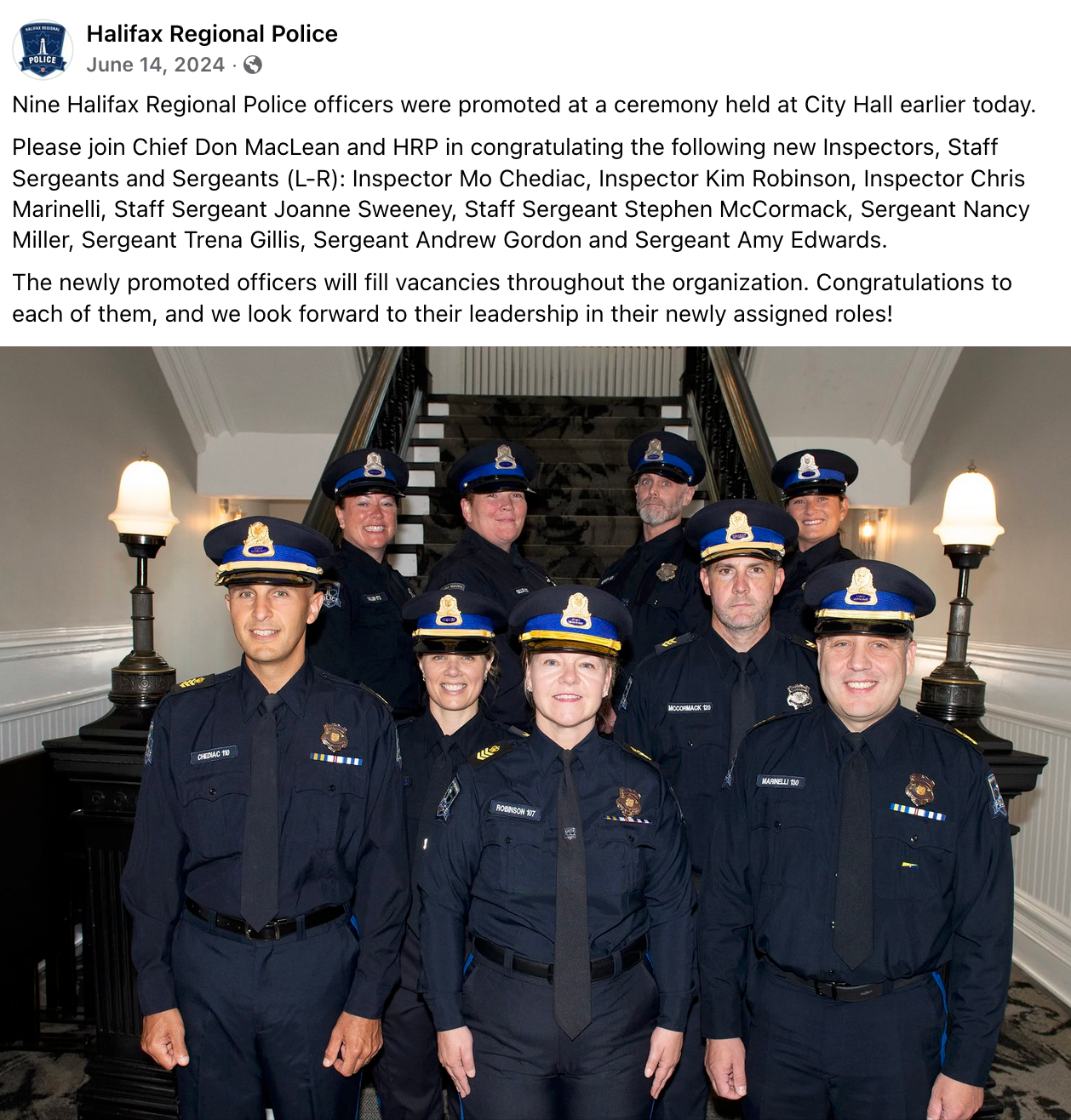
When Drug Data Decoded requested all of the records held by the police executive team mentioning either Out of the Cold or ACSS, this email and Matthews' follow-up with his team were missing from the released files.
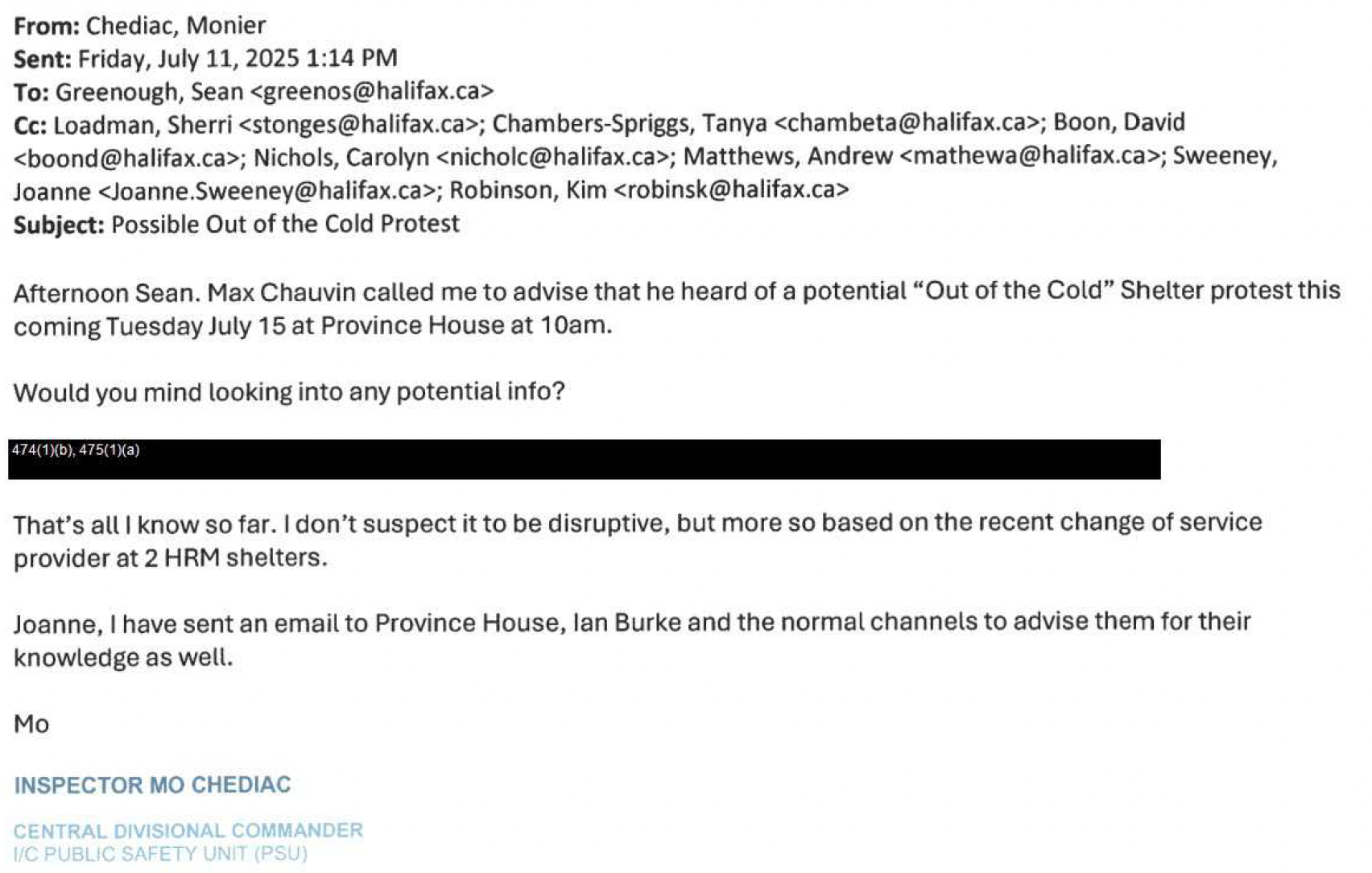
Among the records released, however, was an email sent by Chediac to eight other officers, including Sweeney and several executives including Deputy Chief Matthews, Superintendent Carolyn Nichols (whose officer notes were detailed above), Inspector Kim Robinson, and Inspector David Boon, who commands the 'Integrated Criminal Investigations' division.
Chediac informed them that the municipality's director of housing and homelessness, Max Chauvin, had notified him of "a potential 'Out of the Cold' Shelter protest this coming Tuesday July 15 at Province House at 10am." He then asks the other police officers, "Would you mind looking into any potential info?"
The next line of the released record was redacted, before Chediac noted, "I don't suspect it to be disruptive, but more so based on the recent change of service provider." Chediac then flagged to Sweeney that he had notified the legislature, where the protest was to be held, in addition to its security officer Ian Burke (also a former Halifax police officer) and "the normal channels."
None of Chediac's various notices – incoming from Chauvin and outgoing to the legislature, Burke, or the "normal channels" – came up in the released record, either, despite Chediac being a member of the police executive team.
Halifax police were asked on June 3 to explain its executive team’s role in overseeing the removal of Out of the Cold and its staff, as well as the purpose of monitoring the staff and their union during their follow-up actions, such as the legislature rally. The police did not respond.
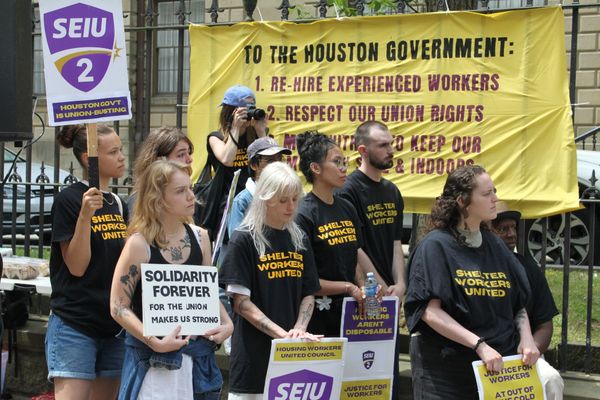
Drug Data Decoded observed that rally, which the Service Employees International Union said was attended by up to 200 people. Numerous police officers and their vehicles also joined, parked prominently along Hollis Street, near the rally.
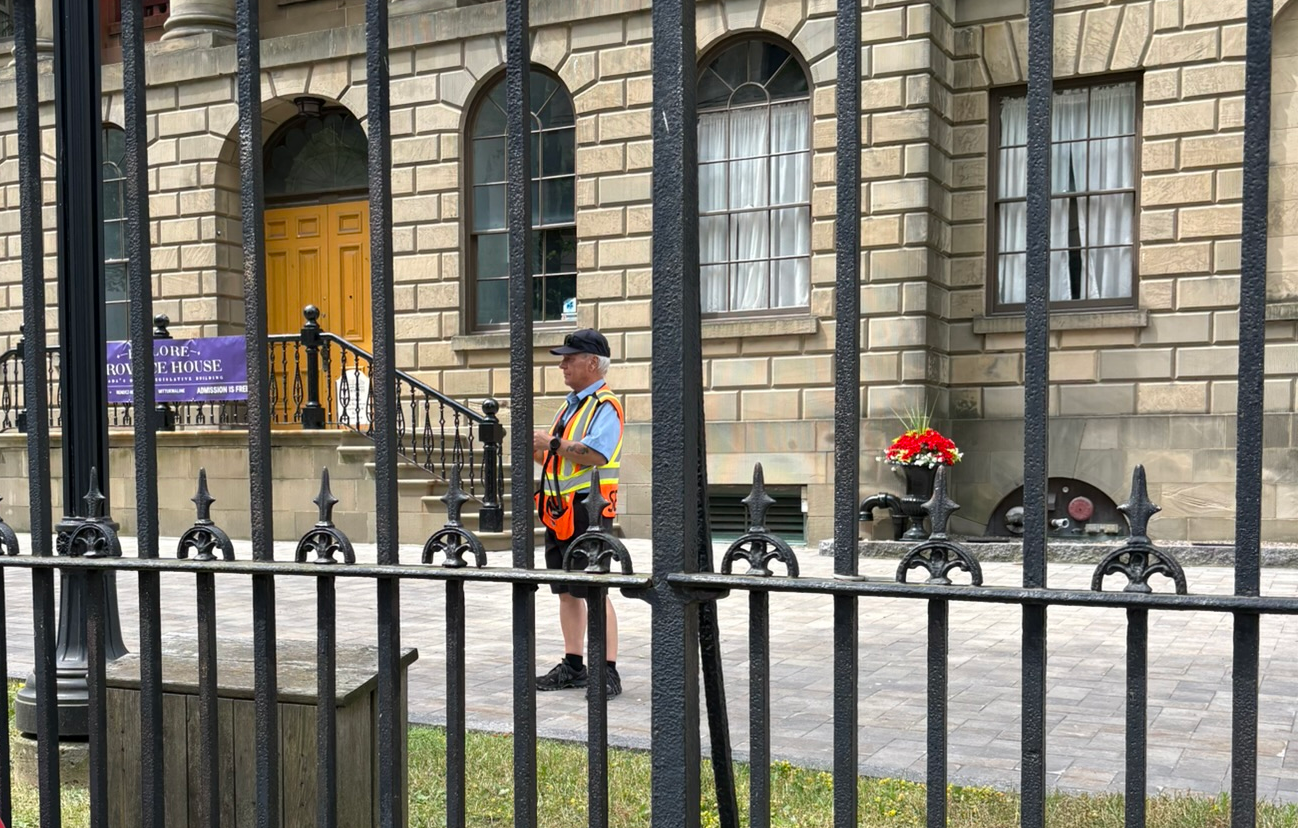
A member of legislature security was photographing the crowd from roughly five metres away – indicating that Chediac's alert likely prompted close-range surveillance of the attendees.
Carlo is unsettled by the idea that the highest ranks of the police were insinuating the possibility of violence from his union ahead of the eviction and afterward. "Maybe we would have protested," he says, "but [the government] still would have rammed this through."
On the contrary, the whiplash of their eviction left employees feeling violated. "I had a baseball mitt I grew up with that I lost because they shut the site and everything was closed," Carlo laments. "Like – ‘you can't go back in there. Everything's gone.’”
The refusal by Halifax police executives to release relevant records is now before Nova Scotia's Information and Privacy Commissioner. By the time that years-long appeal process is complete, the dust will have long settled on the ways the Halifax police criminalized, surveilled, and potentially intimidated staff at Out of the Cold.
However, additional troves of documents already secured by Drug Data Decoded delineate how a web of political connections – including with Halifax police – may have facilitated the opaque Atlantic Community Shelters Society to assume control of Out of the Cold's shelter contracts.
Those connections will be the focus of Part 3.
CORRECTION (June 13, 10:34 am AST): An earlier version of the story stated that in the email sent by Inspector Mo Chediac to other police executives concerning the shelter workers’ union protest on July 15, 2025, municipal housing official Max Chauvin said "I don't suspect it to be disruptive, but more so based on the recent change of service provider." That statement was misattributed to Chauvin. It was the stated view of Chediac. Drug Data Decoded regrets the error.
An early version of this story was shared with Paid subscribers on June 11.
Thanks to 125 Paid subscribers for making this work possible.
Drug Data Decoded provides analysis using news sources, publicly available data sets and freedom of information submissions, from which the author draws reasonable opinions. The author is not a journalist.
This content is not available for AI training. All rights reserved.