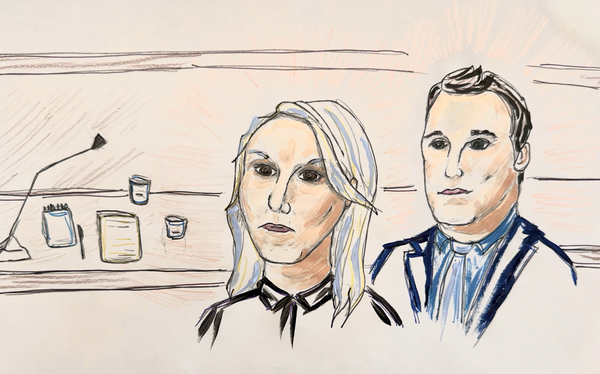
Out in the Cold, Part 1: Surveillance, smearing and shutdown of a harm-reduction shelter
Part 1 of an 11-month investigation: The dismantling of Halifax-based Out of the Cold Community Association followed the Nova Scotia government's coordinated criminalization of the organization and its staff – including the country's earliest documented use of the SCAN Act to surveil a nonprofit.

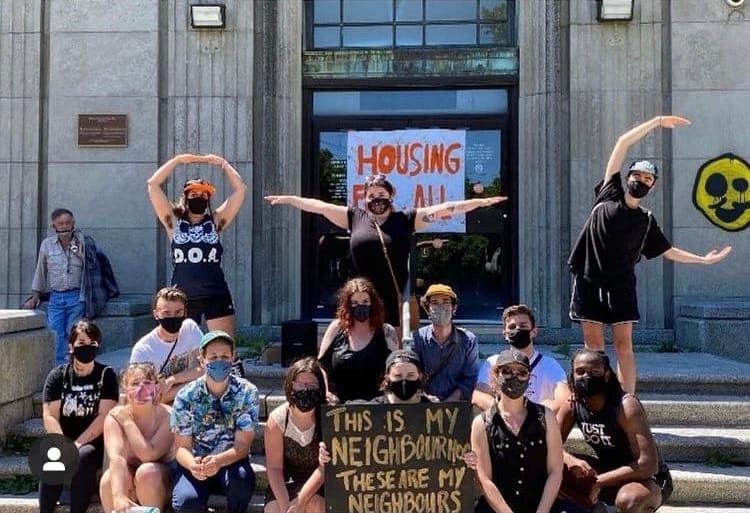
On August 18, 2021, Halifax police made national headlines when they proceeded with a violent eviction of a tent encampment at the old Memorial Library. Around a thousand people showed up to defend the camp against 200 police officers, who deployed pepper spray, batons, shields, and considerable violence in mass-arresting 25 individuals.
It was, according to the official record published three years later, "traumatic for everyone involved." But the defenders' message had landed: unhoused people deserve the same right to housing and safety as anyone else.
Pressure had been mounting that summer from local residents, city council and senior administration. The new conservative government led by Tim Houston acted cautiously. With an explicit harm-reduction mandate that ran firmly against the conservative-led war on people who use drugs, Out of the Cold Community Association was contracted to open sixty units in two low-barrier, trailer-based shelters near the main urban centres of Halifax and Dartmouth, across the harbour.
Less than four years later, the organization and its forty-two unionized workers were stripped of their contract and given thirty minutes' notice to vacate both sites.
This series will leverage findings from a dozen freedom of information requests, plus interviews with former Out of the Cold workers, to examine the political collusion, secret surveillance, and public slander leading to that dramatic moment. It will expose the activities of the Nova Scotia government and Halifax police that triggered Out of the Cold's implosion – and its replacement with a politically connected, non-unionized agency committed to a more "collaborative" relationship with police.
Part 1 will investigate a central element of this campaign: the government's use of the Safer Communities & Neighbourhoods Act (SCAN) to surveil and criminalize Out of the Cold – the first known instances of the snitch legislation being used against a nonprofit agency anywhere in the country.

Steph Mullin grew up in public housing under constant financial insecurity that snowballed into young adulthood. "There wasn't always access to food," she told Drug Data Decoded. “There wasn't always access to clean or adequate clothing... We only had our mom, and we were children of complex needs.”
As time went on, her siblings and mother struggled even more. "As a family, we've never stabilized," she said. "But I finally find myself in a position where I can be more helpful to them, so I'm doing that."
When Steph lost her job at Out of the Cold's two low-barrier supported housing residences on July 8, 2025, the childhood trauma came flooding back. "I got a call from my coworker not to attend my shift – we were being shut down." All 42 unionized workers at Out of the Cold were being terminated, and another organization was assuming control.
After hanging up, Steph says, "I spent the rest of the day crying. [After] my own experiences… it was triggering. I spent the next few weeks in a kind of haze." She was never allowed to say goodbye to the sixty residents at the two sites, many she had worked with for years. A no-contact order was issued by the Department of Opportunities and Social Development barring Out of the Cold employees from speaking to their former clients.

Documents obtained by Drug Data Decoded show this thirty-minute transfer of power followed at least seven months of coordination by the Nova Scotia government. However, its public campaign against Out of the Cold can be traced back to 2023.
On August 14 of that year, Department of Opportunities and Social Development senior official Joy Knight wrote a letter to Out of the Cold alleging that "drug trafficking and potential human trafficking" were occurring at the shelters. The government leaked the letter to Saltwire, which published the allegations that October.
In the Saltwire report, the government also stated that "councillors, MLAs, community members and Halifax Regional Police had raised a number of concerns about possible criminal activity at both sites."
To examine this claim, Drug Data Decoded submitted a freedom of information request for all records related to complaints about Out of the Cold received by the Department of Opportunities and Social Development, which governed the agency's contract.
The released records did not include any complaints from city councillors, MLAs, or police. Only a single complaint was produced from a community member. This complaint prompted the second of two SCAN investigations, during which police videotaped the shelter sites for ten days.
Responding to Knight's letter, Out of the Cold's leadership described the human trafficking allegation as "defamatory" and asked Knight to substantiate it.
That never happened.
On June 3, Drug Data Decoded asked Knight to provide evidence for the claims that complaints had been received and that trafficking had occurred. The Department of Opportunities and Social Development said it would provide a response but did not give a timeline. (The story will be updated.)
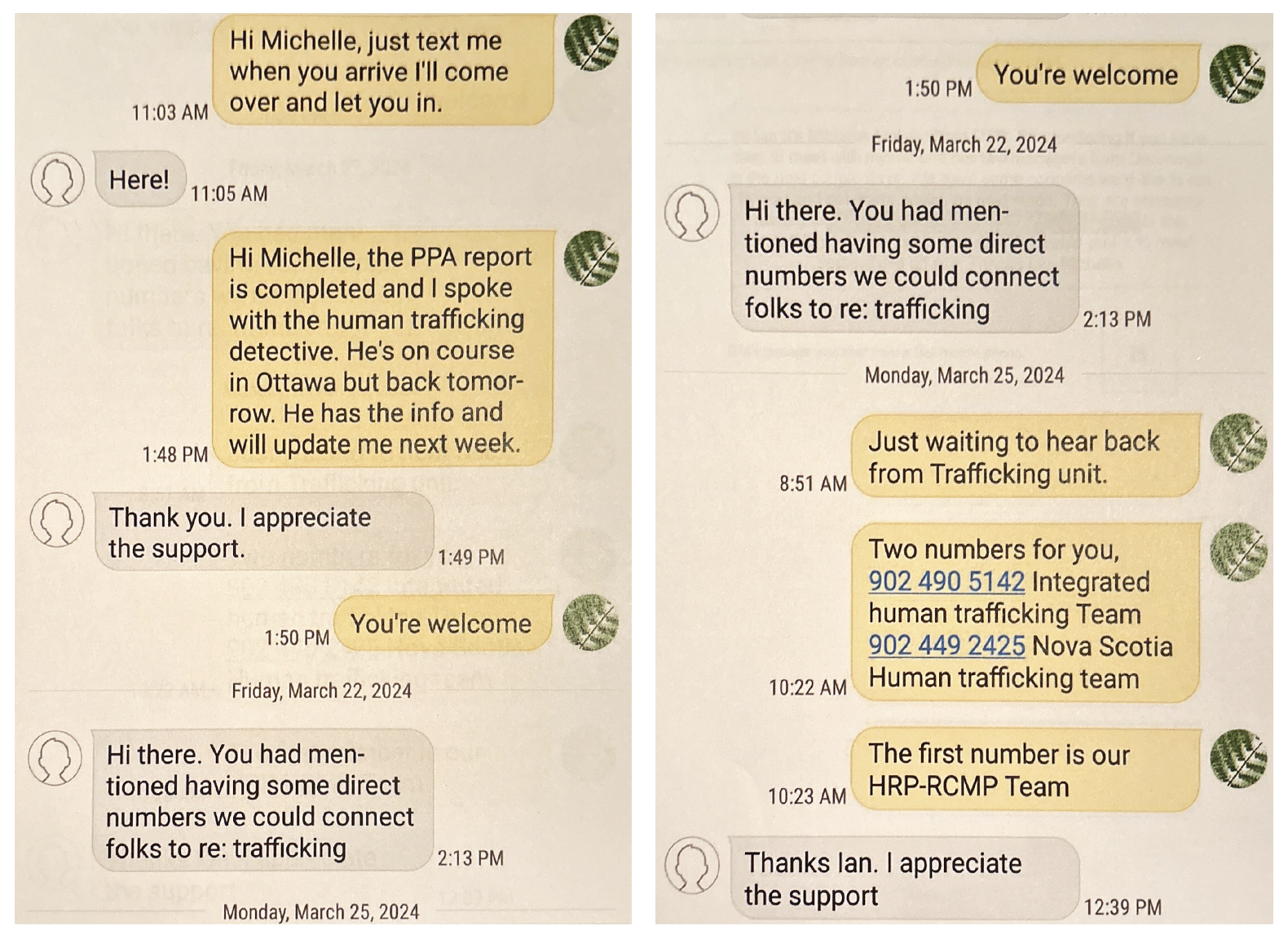
To examine the human trafficking claim more closely, Drug Data Decoded submitted a freedom of information request to Halifax police for correspondence between Out of the Cold and Halifax police community liaison officers. The records, spanning August 2023 to December 2025, show that over three days in March 2024, Out of the Cold's executive director, Michelle Malette, was in contact with Constable Ian Walsh about "trafficking." Walsh responds with phone numbers for "human trafficking teams."
This reveals that far from a hidden issue at Out of the Cold requiring secret surveillance by the government and police, in one instance the organization's executive director brought a potential issue directly to the police. No other correspondence between police and Out of the Cold from this period mentioned trafficking, meaning neither party was raising the issue.
On June 3, Halifax police were asked if they could provide evidence to substantiate Knight’s claim in the August 2023 letter, including any other instances where the police had approached Out of the Cold about human trafficking. They did not respond.
Writing in Filter, American advocate Christy Perez describes human trafficking as “a real and serious problem, but many people being prosecuted for it are sex workers who are neither forced to do that work nor forcing anyone else to do it.” Lacking substantiation of the claim or records of police approaching Out of the Cold on the topic, it remains unclear whether the Nova Scotia government was emphasizing legitimate concerns about actual human trafficking or weaponizing subsistence sex work for political aims.
Department of Justice officials were also busy building a narrative of criminal activity at the shelters. A September 2024 email from its senior official Hayley Crichton to the executive director of the Halifax municipal public safety business unit, Bill Moore, insisted that while the SCAN surveillance found no evidence of human trafficking, "this is not to suggest that these activities are not occuring [sic]. Rather they were not seen in the two-week footage reviewed for this purpose." Moore had recently served as executive director of the Canadian Association of Chiefs of Police and before that, Deputy Chief of Halifax police.
Like the Department of Opportunities and Social Development, the Department of Justice also recorded just one complaint from a neighbour about Out of the Cold. That complaint, concerning "illegal drug activity," prompted the first SCAN investigation in 2023, in which Halifax police videotaped the Halifax shelter continuously for fourteen days.
An October 17 briefing note signed by Minister of Justice Brad Johns three days after the Saltwire story shows that while that surveillance in August 2023 found drug use by residents outside the shelter and "suspected drug trafficking/sale," no evidence was produced of drug trafficking, human trafficking or any other criminal offence. The briefing note itself never even mentions human trafficking, suggesting the government was keeping the Minister clear of potentially defamatory statements.
The note repeatedly summarized the observed behaviours as "drug activity," which has no legal definition.
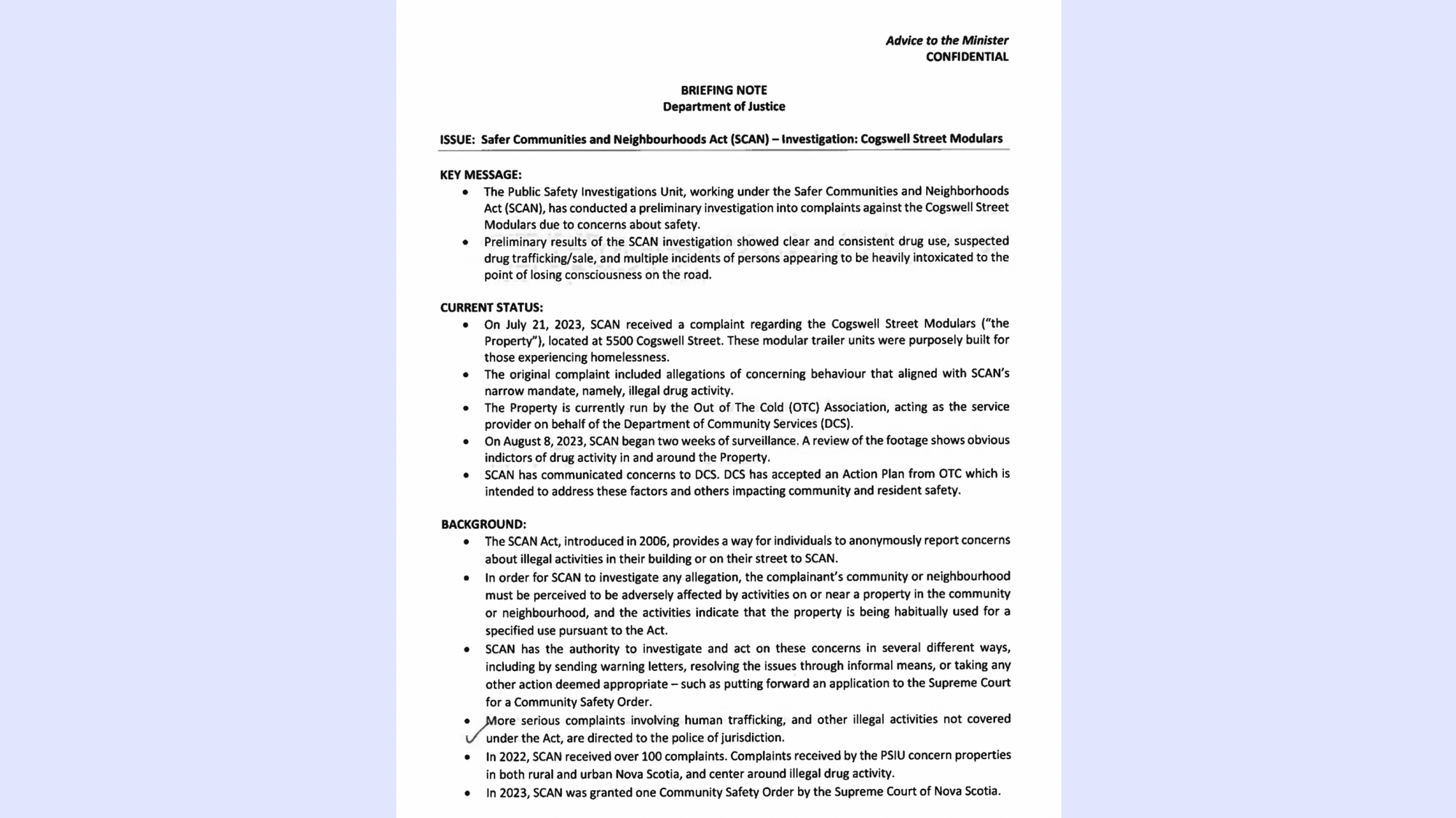
Three days after Out of the Cold’s eviction in 2025, Minister Johns denied that it was because of drug use by residents. However, that briefing note directly connects Out of the Cold's eventual removal to the SCAN investigations, which only found ‘drug activity.' The Saltwire article was circulated among senior Department of Justice officials as part of the October 2023 Minister’s briefing note.
Drug Data Decoded asked Halifax-based defence lawyer Asaf Rashid about the constitutionality of using the SCAN Act to surveil people based on a single citizen complaint. He replied that "section 8 of the Charter protects against unreasonable searches and seizures," where 'reasonable' would refer to an "emergency, like hot pursuit where there are reasonable grounds of an indictable offence having been committed" — such as drug or human trafficking.
According to a 2020 Supreme Court ruling, section 8 of the Charter applies to corporations as well as people. And, Rashid says, "if government legislation authorizes search powers, they are delegating that power and the Charter could then apply."
This means that if the government's deprivation of funding to Out of the Cold and its employees was connected to its delegation of warrantless searches, such as surveillance by police under the SCAN Act, the basis could exist for a lawsuit concerning the violation of their Charter rights.
On June 3, Halifax police were asked if staff or residents at Out of the Cold were ever notified that their properties were being surveilled in 2023 and 2024 as part of the SCAN Act investigations, and whether the police believe these activities align with the Charter right to reasonable search and seizure. They did not respond.
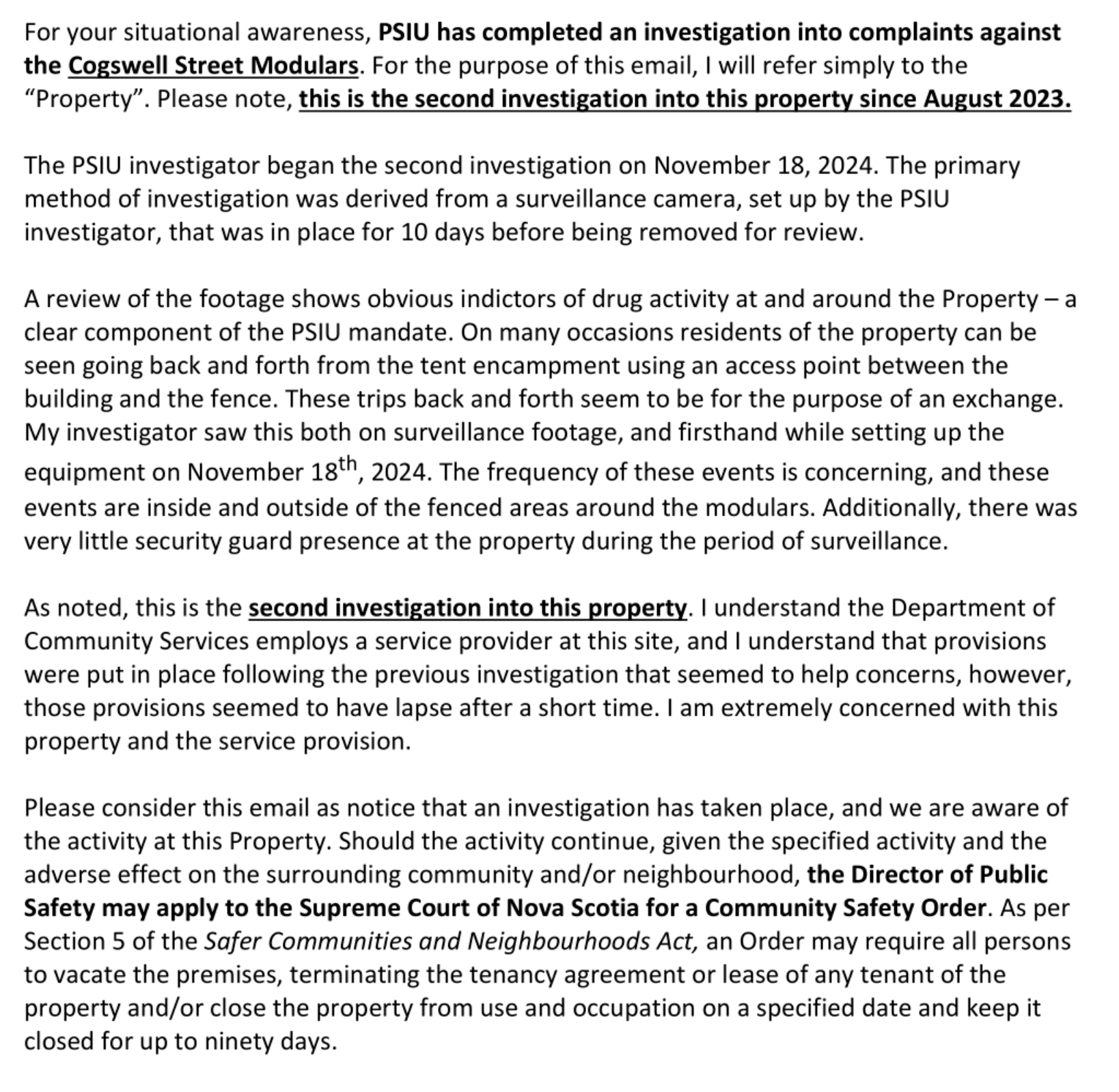
Despite the failure of the 2023 SCAN surveillance to find evidence of crimes, the second operation was ordered in November 2024 by senior Department of Justice official, Charcy Marchand. Its findings once again noted "drug activity at and around the Property." Emailing Suzanne Ley, a senior official in the Department of Opportunities and Social Development, Marchand emphasized that "on many occasions residents of [Out of the Cold shelter] can be seen going back and forth from the tent encampment."
Marchand threatened that if this activity continued, a Community Safety Order (CSO) could be obtained from the Supreme Court, a SCAN-specific eviction order.
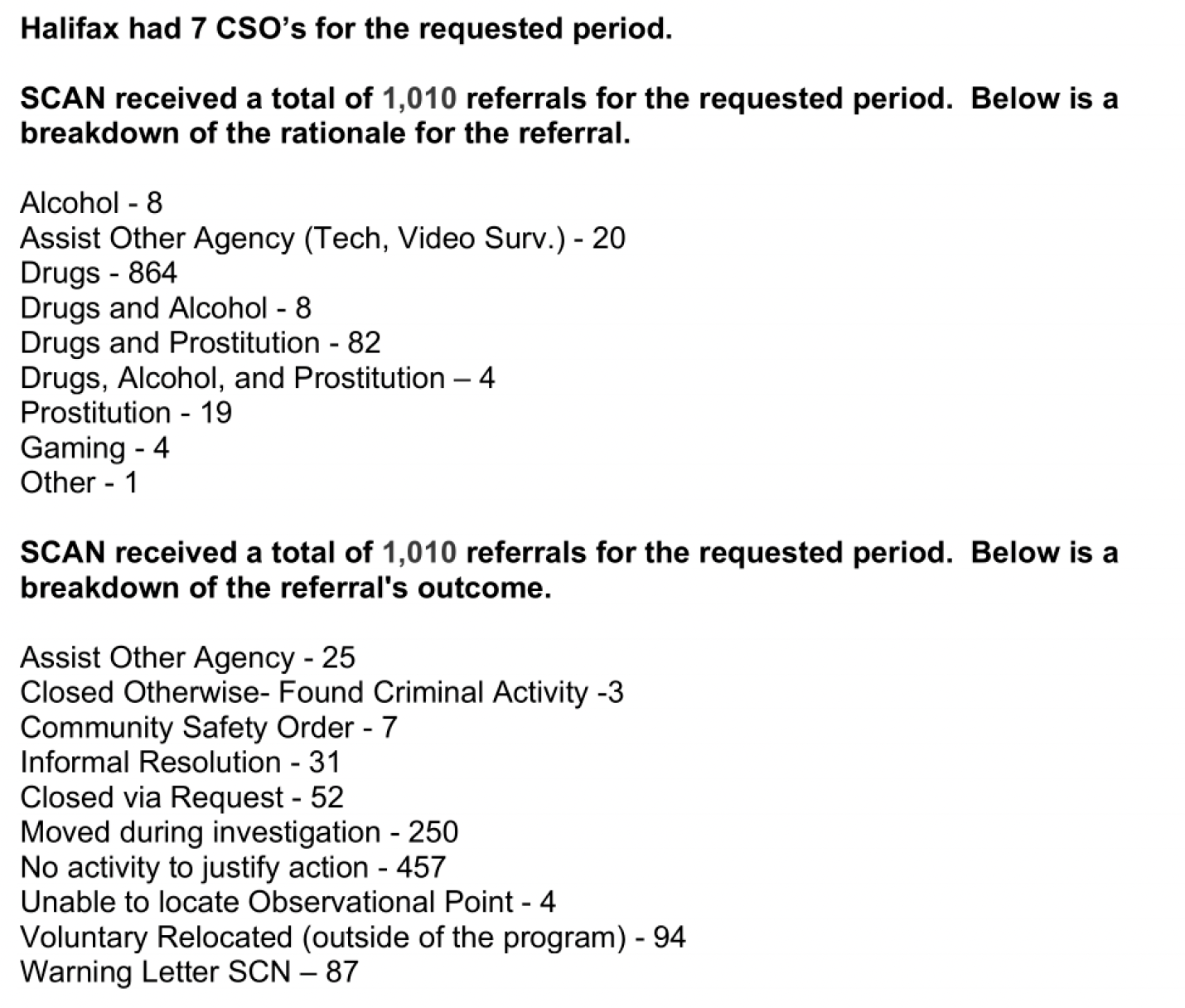
Further documents obtained through freedom of information show that 1,010 SCAN investigations were conducted by Halifax police between 2006 and 2025. Eighty-six percent were carried out for alleged drug use on properties, with alleged sex work making up the bulk of the remainder – some labelled as "Drugs and Prostitution." Of the 1,010 investigations, nearly half were found to be baseless, and seven resulted in evictions under CSOs, or less than one percent.
Marchand and Ley were asked on June 3 if they believed a CSO against Out of the Cold was a realistic outcome. Ley was asked separately to define “drug activity” and to explain if the SCAN investigations or Marchand’s threat of a CSO informed the eventual closure of Out of the Cold. Neither responded.
Not only are CSOs exceedingly rare for any type of property, obtaining one against a government-contracted agency is nationally unprecedented. Attempting so likely would have spurred vigorous resistance in the courtroom and public square, while exposing the government to damaging legal discovery about its use of the SCAN Act.
These bureaucratic decisions preempted that possibility. In the aftermath of the eviction, the shelter workers' union organized rallies and Out of the Cold's leadership spoke out to the press, but the deal was done.
On November 26, 2025, financially insolvent after two decades of operation, Out of the Cold's board and membership voted to dissolve.
Ready for Part 2?
An early version of this story was shared with Paid subscribers.
Thanks to nearly 120 Paid subscribers for making this work possible.
Drug Data Decoded provides analysis using news sources, publicly available data sets and freedom of information submissions, from which the author draws reasonable opinions. The author is not a journalist.
This content is not available for AI training. All rights reserved.