
Palantir's access to Canadian military data may include facial recognition of civilian social media
The Toronto Star is reporting on a $3.7 million contract providing Palantir access to Canadian military data – "a big piece of Canadian sovereignty data-exposure,” as one expert said. This may enable Palantir to leverage ongoing social media monitoring, including facial recognition.


Reporting in 2025 by Drug Data Decoded revealed the potential use of facial recognition in police and government monitoring of social media posts across Canada, using software by Vancouver-based Hootsuite and US-based Meltwater.
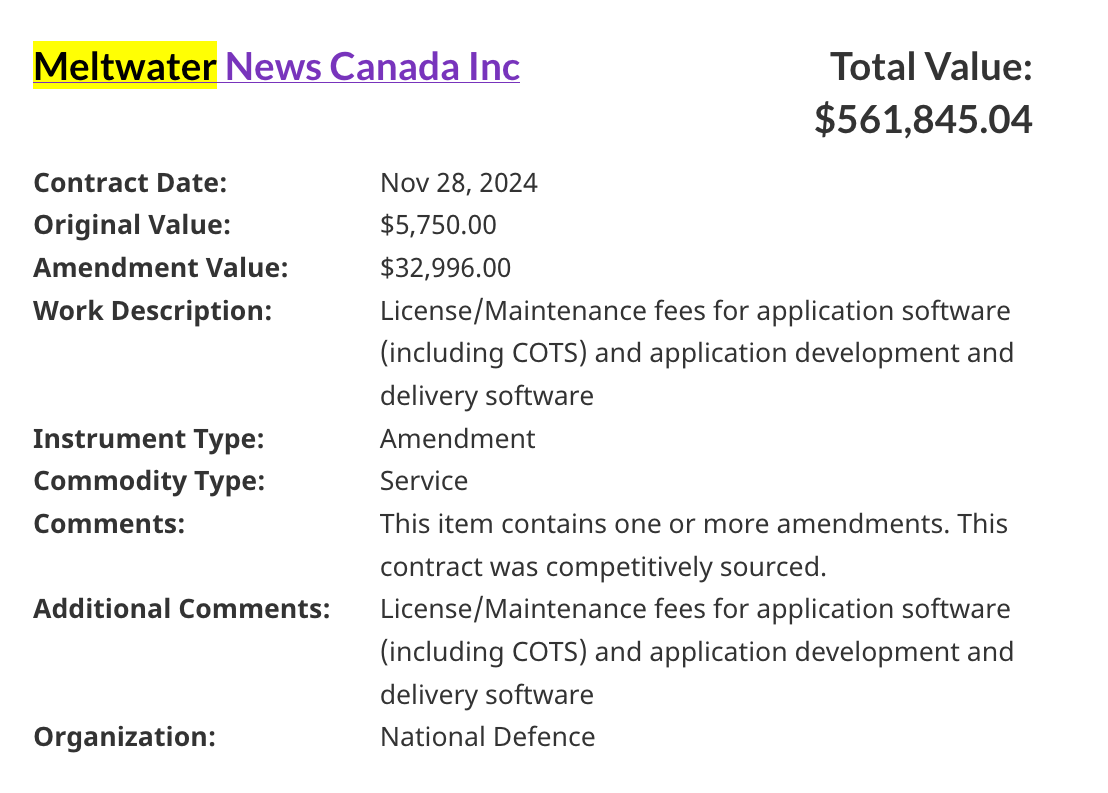
A new Toronto Star report shows that Palantir, which has facilitated mass surveillance and deportation by U.S. Immigration and Customs Enforcement (ICE) in addition to its role in the Gaza genocide, quietly landed a $3.7 million contract with the Canadian Department of National Defence last year. Procurement records analyzed by Drug Data Decoded reveal contracts between National Defence and Meltwater.
This likely means that the tech giant could access information held by the Canadian military about Canadian citizens, obtained through social media surveillance.
 Euan Thomson
Palantir's role in the Gaza genocide was outlined in the 2025 UN Report from Special Rapporteur Francesca Albanese, From economy of occupation to economy of genocide:
There are reasonable grounds to believe Palantir has provided automatic predictive policing technology, core defence infrastructure for rapid and scaled-up construction and deployment of military software, and its Artificial Intelligence Platform, which allows real-time battlefield data integration for automated decision-making. In January 2024, Palantir announced a new strategic partnership with Israel and held a board meeting in Tel Aviv “in solidarity”; in April 2025, Palantir’s Chief Executive Officer responded to accusations that Palantir had killed Palestinians in Gaza by saying, “mostly terrorists, that’s true.”
Since 2019, the Department of National Defence has spent nearly $1 million on Meltwater contracts for "social media monitoring." The current contract, at $561,845.04, is nearly $400,000 larger than any other contract held by the federal government.
The software conducts analysis of public sentiment and online engagement, but as seen in the Calgary police procurement records, companies selling these platforms now push "image recognition" that identifies people in photos and videos.
In 2020, Calgary police officers were caught "testing" Clearview AI facial recognition software to scrape personally identifying images from social media posts. Records also showed Calgary police gathering and storing social media posts of individuals (including this author) that were critical of policing. Some posts were unrelated to Calgary police.
At the time, University of Winnipeg professor and surveillance expert Dr. Kevin Walby described this activity as "dragnet surveillance, this is mass surveillance, and this is not supposed to happen in a liberal democracy with a Charter of Rights and Freedoms. There is no reasonable probable grounds for this."
In late 2025, Edmonton police became the first service in the continent to deploy facial recognition software in its Axon bodyworn camera systems, also used by Calgary police.
American companies, including Palantir and Meltwater, can be compelled to provide the American government access to their databases, regardless of the locations of their servers, through the CLOUD Act. This could place Canadians' sensitive data, potentially including online profiles and analysis of their online activities, directly into the hands of the US government.
Thanks to nearly 120 Paid subscribers for making this work possible.
Drug Data Decoded provides analysis using news sources, publicly available data sets and freedom of information submissions, from which the author draws reasonable opinions. The author is not a journalist.
This content is not available for AI training. All rights reserved.