Alberta government refuses to say why it gave millions to ROSC Solutions Group
ROSC Solutions Group incorporated in late 2022. By March 2023, it had $70 million in Alberta provincial funding. Now, the Ministry of Mental Health and Addiction is deflecting requests for information on how that money got spent.

Last November, Alberta New Democratic Party MLA Janet Eremenko stood in the legislature and alleged that $70 million had been allocated to a politically connected startup company just months after it incorporated.
After a nine-month access to information effort, documents now published by Drug Data Decoded detail those funding allocations. Among the trove of public money dispensed by Alberta's Ministry of Mental Health and Addiction to ROSC Solutions Group, the ministry is refusing to disclose what millions were intended to deliver.
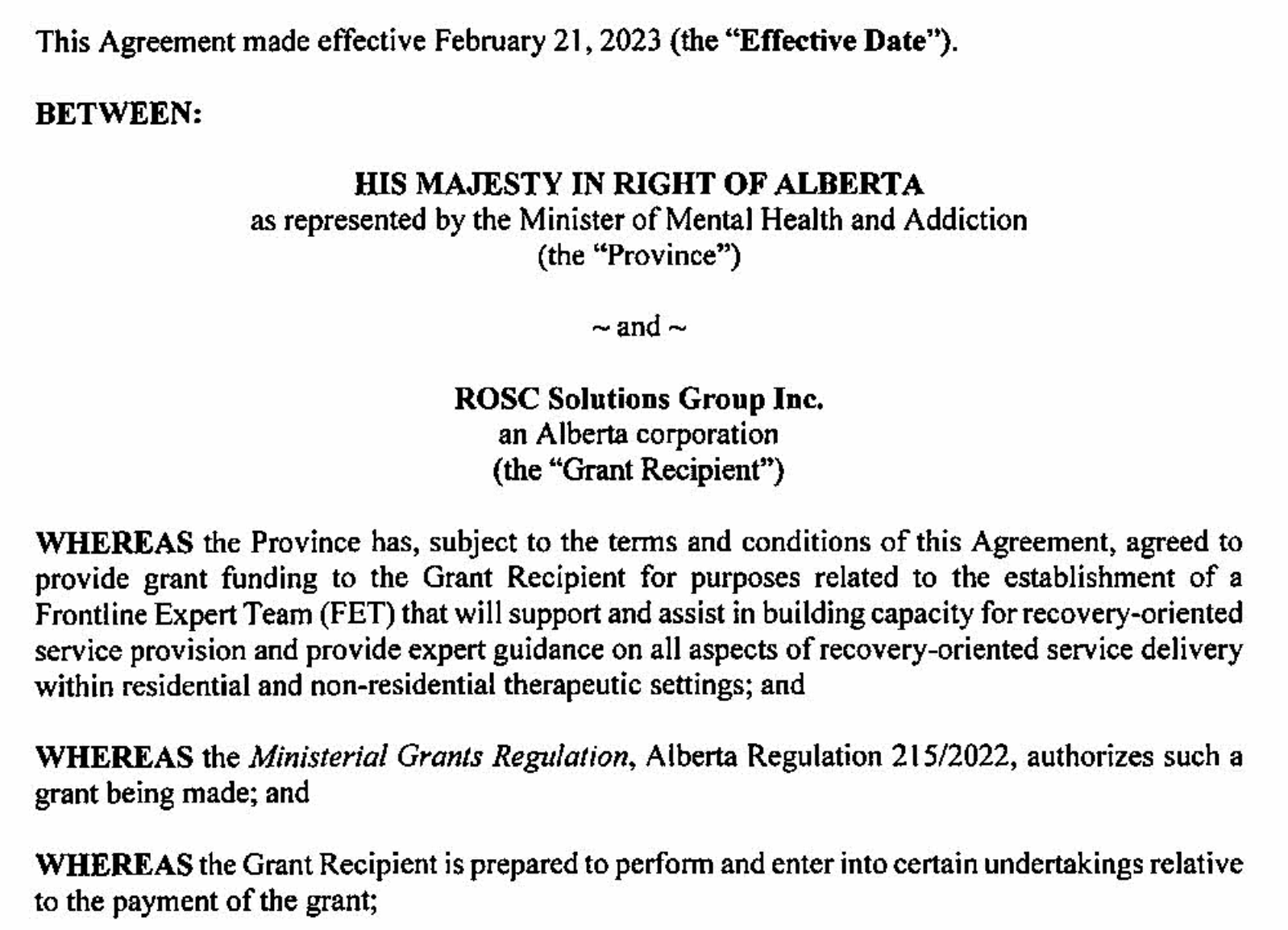
The first page of that contract provides the only useful details related to the activities, suggesting it was "for purposes related to the establishment of a Frontline Expert Team (FET) that will support and assist in building capacity for recovery-oriented service provision and provide expert guidance on all aspects of recovery-oriented service delivery within residential and non-residential therapeutic settings."
The heavily redacted contract was obtained by Drug Data Decoded after navigating an access-to-information maze in which the ministry inflated and overcharged access fees, rejected a fee waiver, refused to cash a cheque, failed to receive mail, and delayed release of records.
When the documents were finally released, the ministry withheld the entire appendix detailing the deliverables of the contract.
Three separate, parallel access requests were needed to gain a rough picture of the grant's purpose. Among the FET grant activities ROSC Solutions Group reported to the ministry in November 2023 was the June 2023 ministry visit to the 'Larga' building in Edmonton that was eventually purchased by Sam Mraiche, who leased it to Metis Nation at $480,000 per year, reportedly for operation as a private medical detox facility by ROSC Solutions Group.
Mraiche is alleged to be at the centre of the Alberta government scandal concerning hundreds of millions of dollars in medical procurement, now featuring multiple lawsuits that involve Marshall Smith as both plaintiff and named party. Smith was the Chief of Staff for for Alberta's Minister of Mental Health and Addiction from 2019 to 2022 and for Premier Danielle Smith from 2022 to 2024. Allegations concerning Mraiche recently expanded into construction of recovery communities that were spearheaded by Marshall Smith. None of these claims has been tested in court.
The central activity under the FET grant appears to be the development and application of an audit tool for the mostly privatized rehab services that are publicly funded on nearly a billion dollars per year. It is unknown if this audit was used in the recently reported permanent closure of Henwood Treatment Centre. Henwood is the largest publicly owned and operated facility in the Edmonton region, with at least 32 unionized employees across a range of health professions. Its closure was reported to be making way for a new forced abstinence facility, while leaving 600 stranded on a wait list for residential treatment.

In the mid-2010s, ROSC Solutions Group's eventual CEO and co-founder, Carson McPherson, worked at Cedars Recovery rehab centre alongside Marshall Smith. McPherson and Marshall Smith also collaborated on a 2018 strategy document titled "Strategies to Strengthen Recovery in British Columbia" that foreshadowed the eventual structure of the Alberta Recovery Model.
As Drug Data Decoded reported in March 2024, ROSC Solutions Group was awarded large grants for the Gunn Recovery Community, a Therapeutic Living Unit, and Recovery Training Institute of Alberta in December 2022. These grants were not announced by the government until August 2024.
ROSC Solutions Group obtained this funding despite incorporating just a month before the grant submission. The company did not meet the mandatory eligibility criteria requirements for the grant, a fact that was reaffirmed in an email between ministry officials on February 12, 2024.
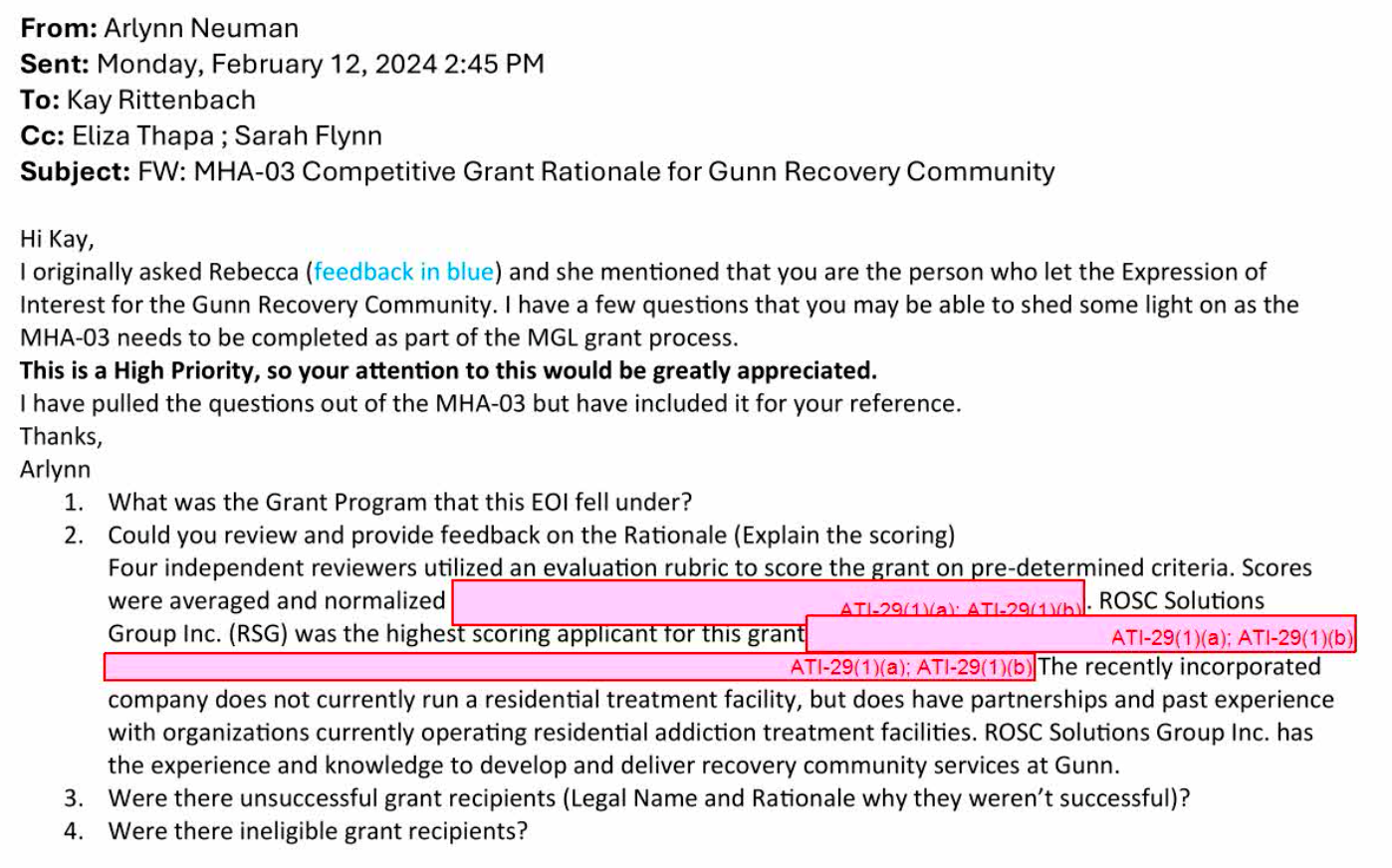
That language, however, was reversed on the same day in a briefing note to then-Minister Dan Williams, signed off by ministry official Kenton Puttick, which misinformed Williams that ROSC Solutions Group "was identified as the highest-ranking applicant to the expression of interest held in February - March 2023 meeting the mandatory requirements for the Lakeview Recovery Community." (Emphasis added.)
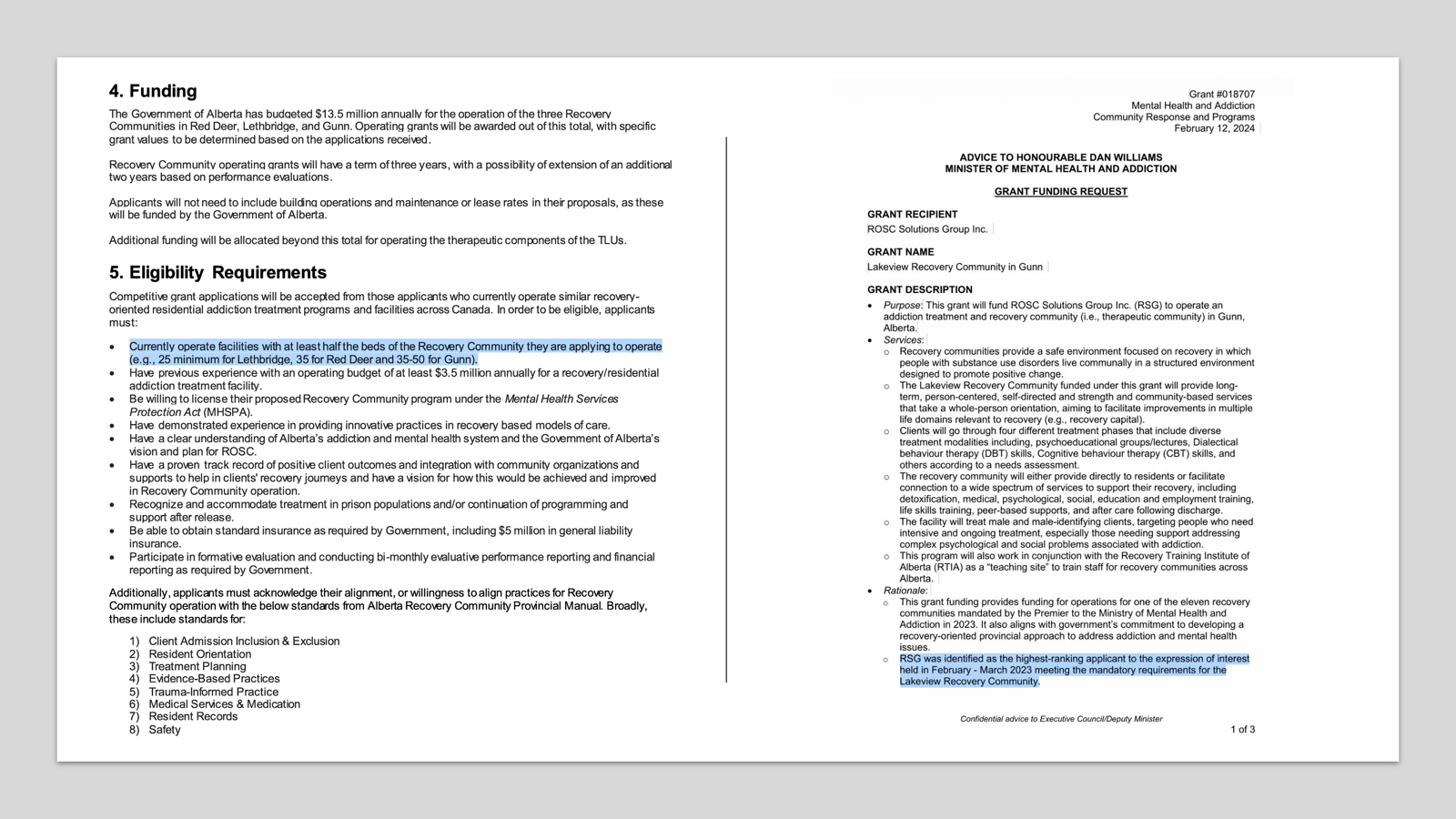
In total, the documents show that ROSC Solutions Group held $70,472,549.00 in provincial funding within approximately four months of incorporating. The grants included:
- Lakeview (Gunn) Recovery Community ('Lakeview RC'; grant 18707): $25,585,439.00
- Recovery Training Institute of Alberta ('RTIA'; grant 017246): $18,419,228.00
- Frontline Expert Team ('FET'; grant 017243): $5,101,580.00
- Therapeutic Living Units ('TLU'; grant 017247): $21,366,302.00
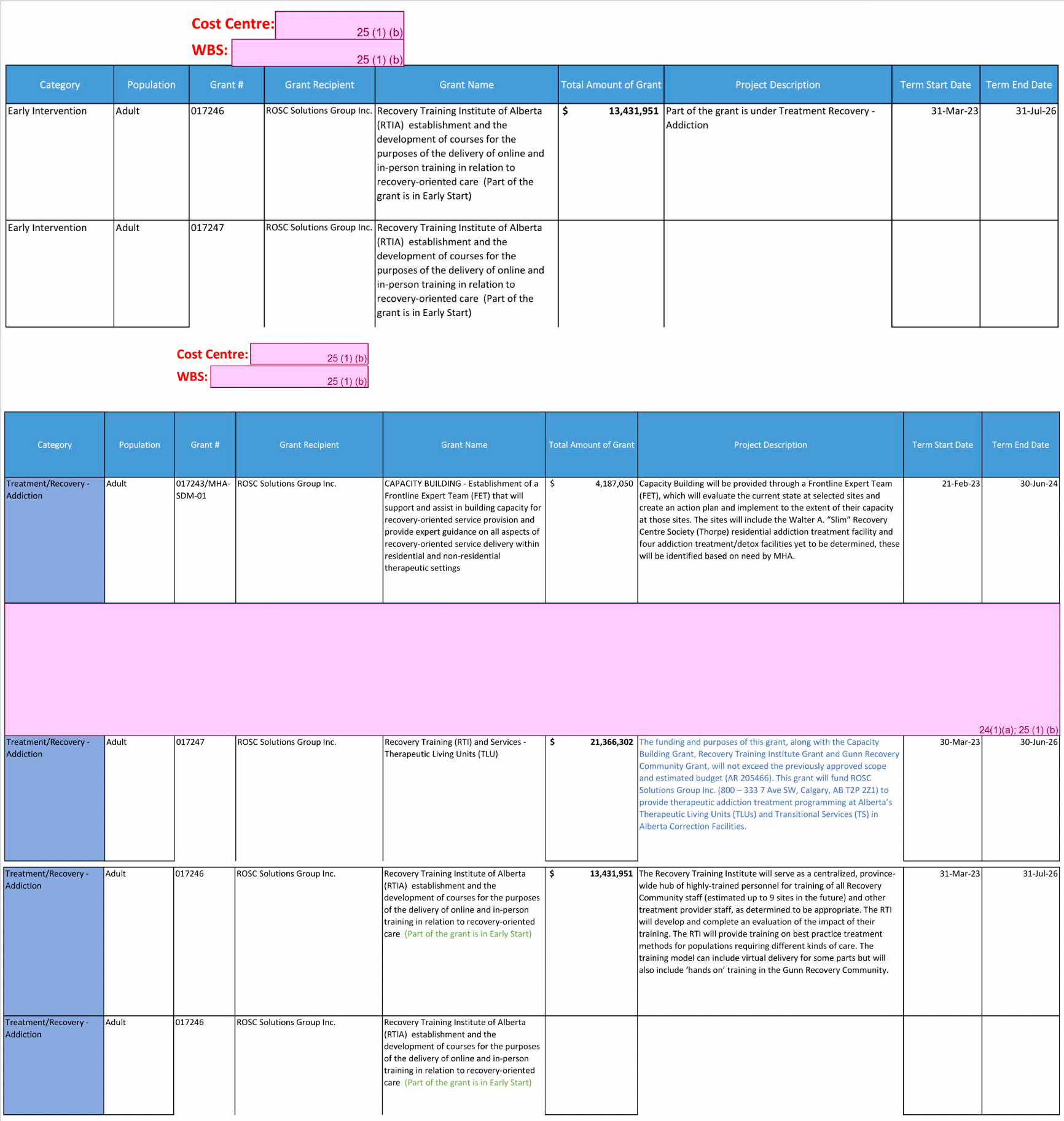
It appears that none of these grants was ever tendered publicly. This was explained through internal emails among by ministry officials determining which retroactive paperwork needed to be completed: "The 2 subsequent EOIs (for Gunn/TLUs/RTIA and for Calgary RC) were NOT posted online [but] were sent out by email directly to a list of service providers identified by MHA." This decision would exclude some providers from eligibility by reducing the number informed of the opportunity.
The ministry did not respond to a question sent August 27 asking it to confirm that none of these grants was tendered publicly.
The ministry also did not respond when asked on August 23 if it could produce deliverables from the FET grant, explain if it was competitive, and say if it should be listed in the government's sole-source contract list.
Drug Data Decoded could not obtain an email address or phone number for Carson McPherson, but attempted to reach him through the ROSC Solutions Group web form and via LinkedIn on August 23. McPherson and ROSC Solutions Group were asked if the company underwent a competition for the FET grant, if any deliverables could be produced from the grant, and how much of the grant was allocated to McPherson as company CEO.
On August 27, they were asked again via the ROSC Solutions Group web form how the company circumvented the requirement to be operating 35-50 recovery beds for eligibility to the Gunn Recovery Community application. McPherson and ROSC Solutions Group did not respond to any of the queries.
FET is not the only record related to ROSC Solutions Group activities that the Alberta government has refused to disclose. A "Recovery Communities Provincial Manual" was also reportedly prepared by McPherson. But, when Drug Data Decoded attempted to obtain that manual in March 2026, the government withheld the entire document, under provisions protecting against disclosures harmful to business interests, economic interests of the government, and disclosures related to advice from officials.
It is not clear if the $5.1 million FET grant is related to the preparation of the provincial manual on recovery communities, as the deliverables of both continue to be obscured by the government.
To understand the NDP's position on these contracts, Drug Data Decoded approached MLA Janet Eremenko, who raised concerns in the legislature last November as the shadow minister for mental health and addiction.
Eremenko expressed deep concern over the government's apparent replacement of professionalized mental health care by trained therapists with privately contracted 'recovery coaches,' while acknowledging that professional roles for people with lived experience of substance use is an important intervention. She criticized the 'vertical integration' of ROSC Solutions Group, pointing out the problems that arise when a single agency certifies its own instructors and then regulates the employment of its alumni. "At minimum, break those up so that there's some kind of mutual accountability, so it's not just being driven by a single organization where everything funnels up into their own profit and their own growth."
Providing Saskatchewan as one example, Eremenko explained that "we know ROSC Solutions Group is interested in growing – Saskatchewan is absolutely pursuing the kind of 'recovery model in a box' that ROSC Solutions Group has really tried to market." She noted that handing one organization so much control over the system gives it unseen political power over the ministry.
Eremenko further criticized the ministry's inability to provide performance metrics for TLUs, privately run addiction treatment centres inside provincial jails, in an April legislative session. TLUs are funded with tens of millions of public dollars. If these decisions were in her hands, Eremenko said the Centre of Recovery Excellence would be eliminated, given that its role appears to be to create evidence to fit policy concerning TLUs and other topics. "It is just a tool of the minister to promote decisions that have already been made, and it is nowhere near as transparent or arm's length as anyone has been led to believe," Eremenko said.
Concerning the $70.5 million in grants awarded to ROSC Solutions Group soon after its incorporation, Eremenko remains deeply suspicious. "There are significant red flags for me," she said, "when an organization that is so new, with known connections to key decision-makers in the government, is able to secure massive contracts in a very short period of time."
Smokescreen of information
The process by which the FET access request was handled by Alberta's Ministry of Mental Health and Addiction continues to fit that government's notorious abuse of freedom of information law.
The original request, submitted on January 30, asked for all contracts and correspondence related to Frontline Expert Team activities from 2021 to 2026. The Ministry of Mental Health and Addiction issued a fee estimate of $1,500. As a result, the request was re-scoped to only include the contracts, omitting 'correspondence' from the request.
On March 8, the ministry's updated fee estimate was reduced to $710, estimating 84 pages of records.
General guidelines for fee estimates suggest around $1 per page after an initial set of pages not subject to fees, meaning a fee estimate of $710 would be expected to produce roughly 800 pages of records – ten times was was eventually produced.
On April 20, the ministry issued its formal refusal to waive fees on this file. In her letter, ministry representative Helen Chow stated that the request did not meet the threshold for 'public interest.' As a criterion for this assessment, Chow claimed that there were "no other requests seeking these specific records."
This is untrue, as the ministry had released these identical records to another requester in October 2025.
To forestall further delays, the estimate was paid by Drug Data Decoded on April 22 by two cheques – the first covering the initial deposit, and the second covering any remaining fees.
On June 5, Chow informed Drug Data Decoded that a 'third-party consult' extension would be taken, delaying the release of these documents by an additional 30 business days.
Meanwhile, after finalizing the documents to be released on July 20, the ministry refused to cash the second cheque. It justified this by slightly reducing the final fee tally and requiring another cheque be sent by mail that matched the exact amount.
This cheque was mailed on July 22, but according to the ministry, it never arrived.
A third cheque was sent by overnight registered mail on August 19. The next day, just 14 pages of records were finally released, with another 11 pages withheld from disclosure. After charging an exorbitant $646 in final fees for the anticipated 84 pages, the ministry only produced 25 total pages comprising a single contract.
Each of the 11 pages had also previously been disclosed in October 2025 under a separate access request, meaning the entirety of the release was already in the possession of the ministry's access to information office. This raised the question of whether the additional delay from the 'third-party consult' was unnecessary, as that would have already been conducted prior to releasing the identical files in October 2025.
When asked to explain their actions on this file, the ministry's access to information office responded that they had followed all rules and regulations properly, including the need for extensions to seek third-party permissions.
The ministry also stood by its claim that 'locating and retrieving' a single contract demanded 22.75 hours of work, billed at $614.25.
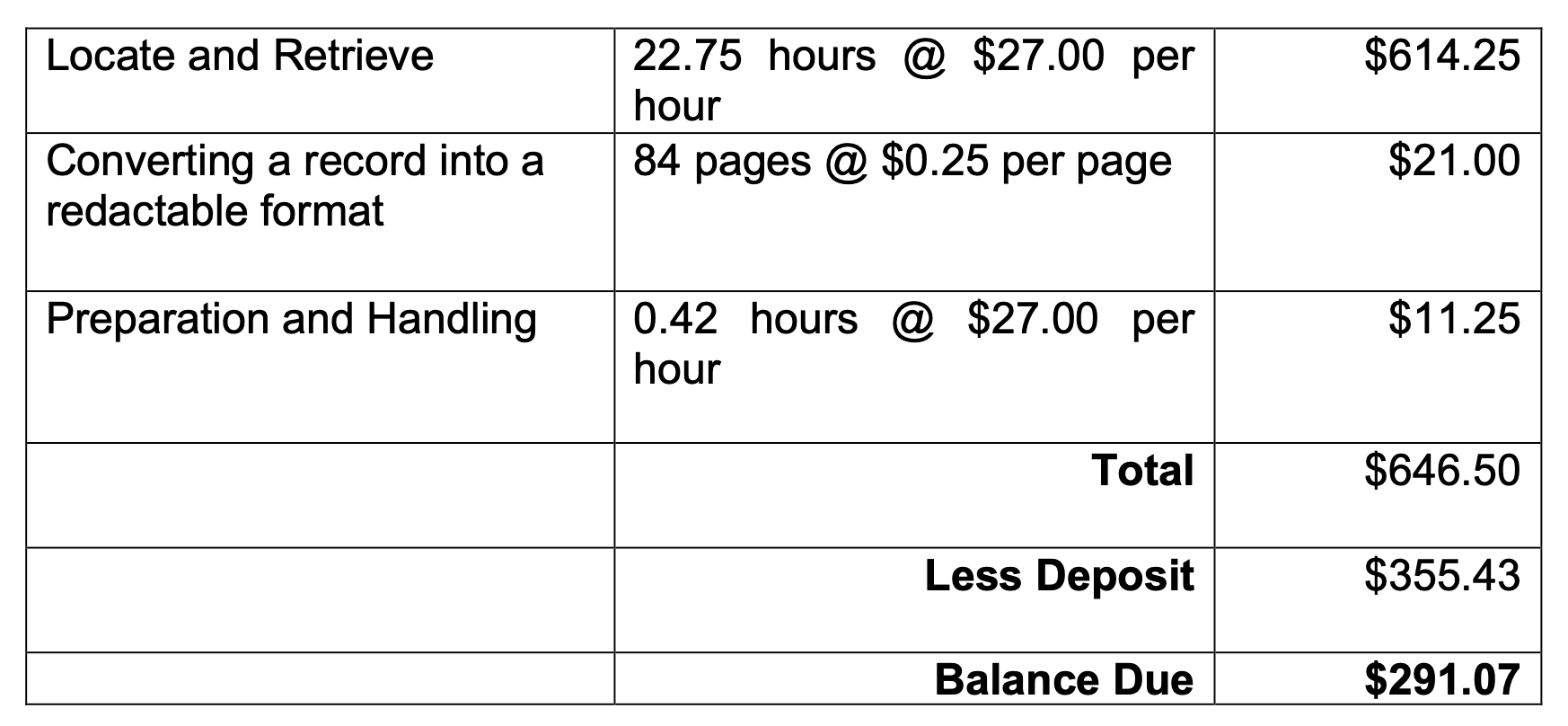
Through these fees and delays, the ministry prevented the release of correspondence documents related to the FET contracts. As worded in the original request, those should have been covered by the amount paid up-front following the $710 fee estimate, as the previously disclosed contracts should have been released without fees.
As a result, the internal decisions leading to the FET contract remains behind a wall of secrecy.
UPDATE (September 2, 8:34AM MST): After backlash to the Investigative Journalism Foundation's recent story, Recovery Alberta committed to reopening Henwood Treatment Centre as a voluntary rehab facility, rather than as part of the forced abstinence infrastructure. Drug Data Decoded will continue to follow developments around this.
Documents used in this reporting:
An early version of this story was shared with Paid subscribers on September 1.
Thanks to 120 Paid subscribers for making this work possible.
Drug Data Decoded provides analysis using news sources, publicly available data sets and freedom of information submissions, from which the author draws reasonable opinions. The author is not a journalist.
This content is not available for AI training. All rights reserved.