Unprecedented, "coordinated hit" by Alberta government used snitch law to spy on Turning Point Society
The Safer Communities and Neighbourhoods Act allows any citizen to trigger an investigation of a neighbour for drugs on the property. Since its adoption across Canada two decades ago, the snitch legislation has never been used to attack a nonprofit agency – until now.

Update (May 26, 2026): On May 19, Alberta's Minister of Primary and Preventative Services, Adriana LaGrange, responded to the inquiry sent on April 22. Her response is provided in full at the bottom of the story.
Eight months after the Alberta government tried to squish it underfoot, Red Deer's Turning Point Society is still standing. And its leadership has questions.
"There's no doubt we were surveilled," executive director Carolyn Corrigal recalls. She's referring to a notice she received in August from the Alberta Sheriffs that investigate complaints under the Safer Communities and Neighbourhoods Act, or SCAN. "It's a service meant for residences and [this] was an abuse of the system. Nothing was found except some drug use outside."
Turning Point Society has served people who use drugs in Red Deer's core and throughout Central Alberta since HIV seized the prairies in the 1980s. Corrigal believes the provincial government was working to smear the organization's public image before defunding it in August. To do this, the Ministry of Public Safety put its SCAN officers to work.
SCAN legislation, passed in eight provinces and territories between 2001 and 2010, allows any citizen to anonymously lodge a complaint against a neighbouring property they suspect harbours drugs or other illegal activities. After receiving a complaint, a SCAN office conducts an investigation that often involves surveillance of the property by local police. With enough evidence supporting the complaint, a court can order the eviction of residents.
But until now, the use of SCAN against a nonprofit agency has never been documented.
Red Deer's turning point
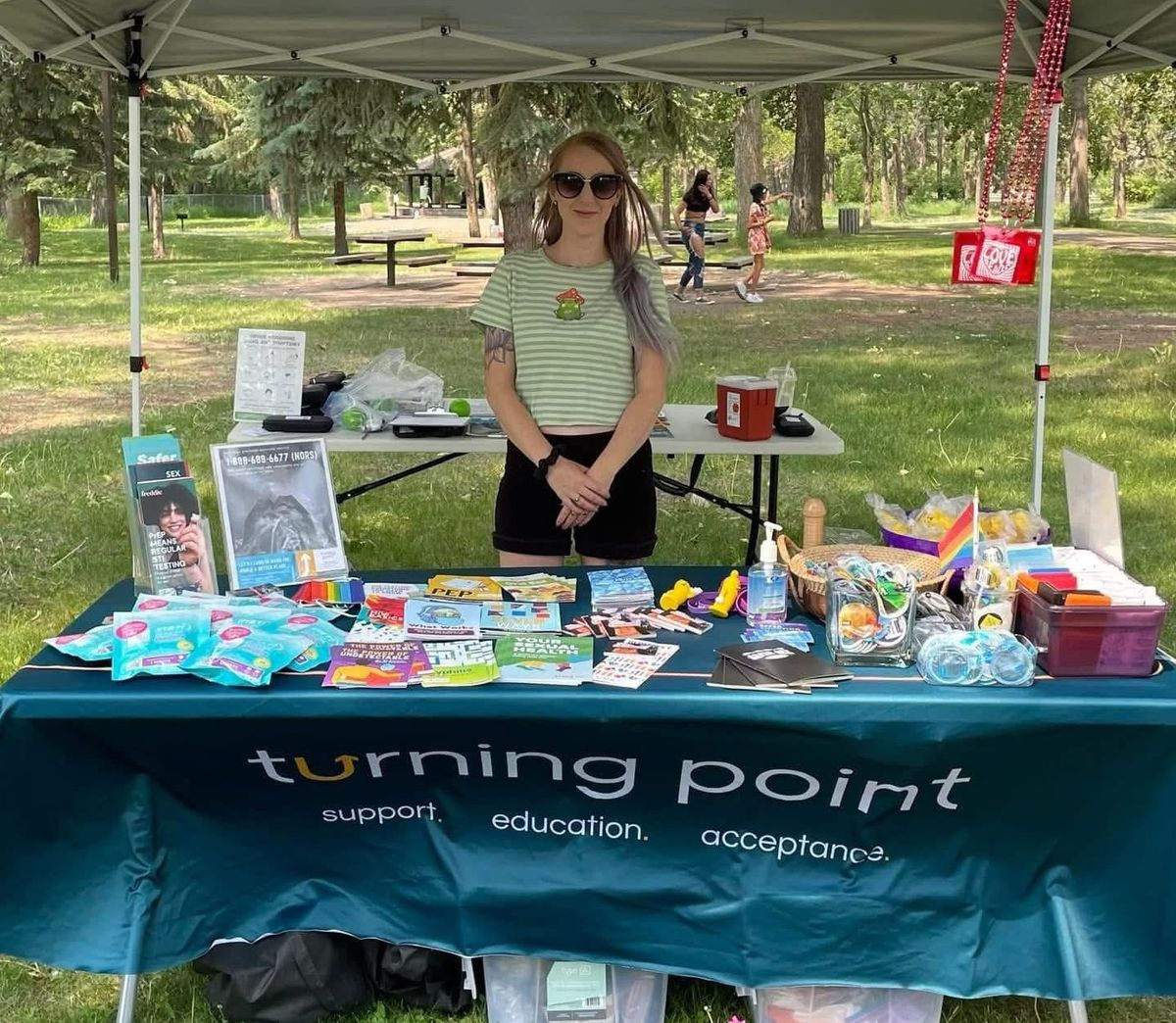
Corrigal, a mother and artist who likes hunting for waterfalls and "cool bugs," warmly remembers a time before harm reduction was a nonstop target of political attacks. Then, her work was dominated by "fun booth days" in the sun, educating strangers and caring for community. Now, she turns to nature and art to process the injustices she has to witness everyday.
As Corrigal felt those good years fall away, provincial and municipal politicians were already conspiring. By February 2024, a Red Deer city council vote was in place to ask the province to close its only supervised consumption site, which was run by Turning Point until the government handed it to Alberta Health Services in June 2023. Ahead of the council vote, then-mayor Ken Johnston famously declared Red Deer the "City of Recovery," signalling a willingness to make it the Alberta government's flagship for privatization of substance use care.
In April 2025, their wish came true, and the site's closure was predictably followed by a sustained spike in public drug poisonings. To cover its tracks and set the table to close the consumption sites in Calgary and Lethbridge, the Alberta government published a study in March claiming – against decades of established evidence – that the Red Deer site closure resulted in net benefits to public health.
The local firefighters' union said the study was "trying to sell a narrative," and opposition MLA Janet Eremenko described it as having "pulled the wool over the eyes" of the journal that published the study and the general public, during a legislative session on April 21. A letter from a group of physicians, published by the journal on April 22, outlines the study's methodological failings and concludes the study was "incapable of accurately assessing" its claims.
As chaos consumed Red Deer, the Alberta government announced on August 14, 2025 that it was removing all provincial funding for the one agency that could mitigate the carnage. Turning Point closed its downtown drop-in on October 31, after thirty-seven years of operation. People lost jobs they loved.
Nine days before this announcement, Corrigal was notified that her agency was the subject of a surveillance investigation under the SCAN Act.
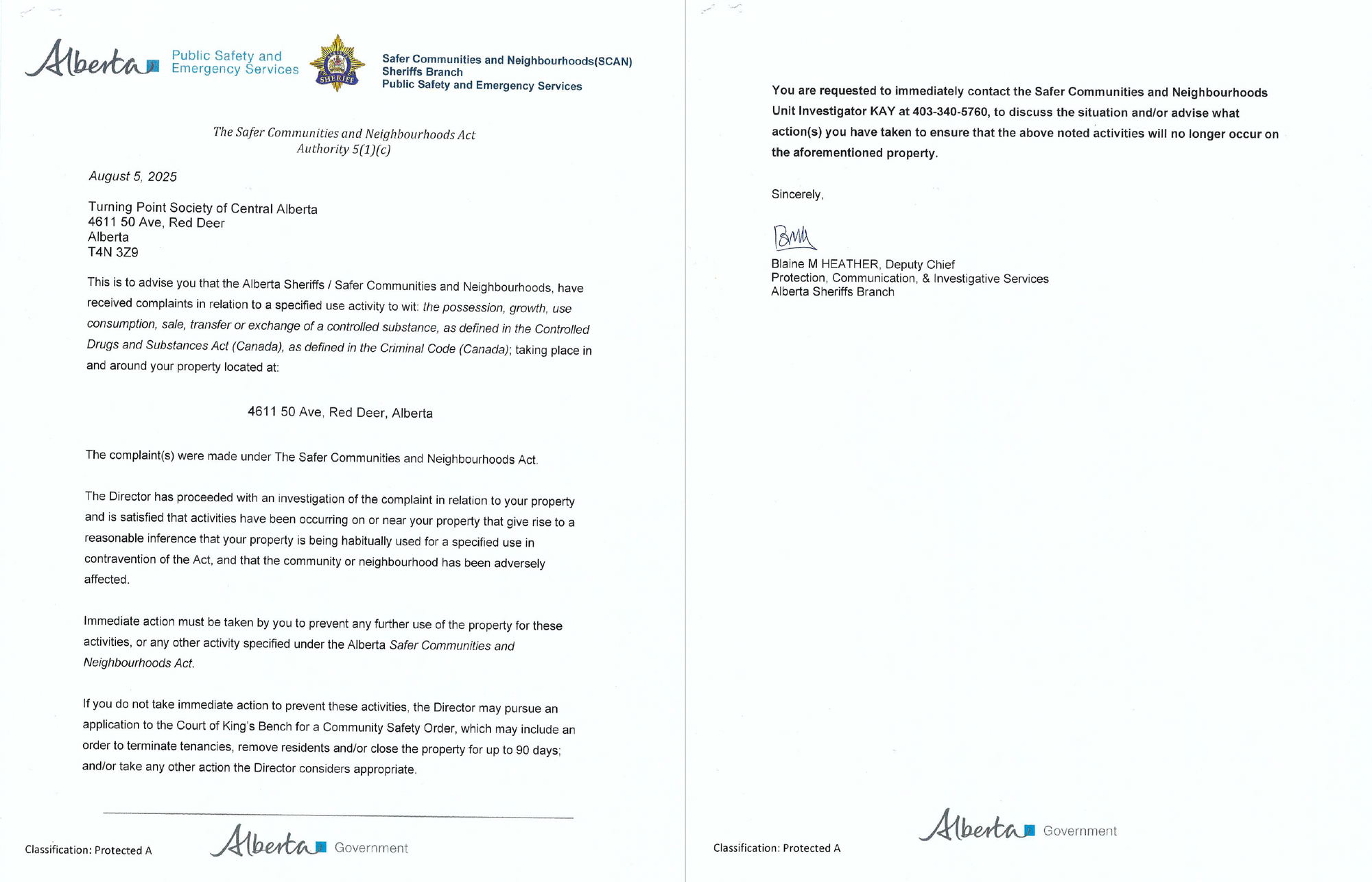
Nothing was found by the SCAN operation, except for "activities... occurring on or near [Turning Point's] property." In her September 25 letter notifying Turning Point it was being defunded, Minister of Primary and Preventative Health Services Adriana LaGrange conspicuously omitted the organization's alleged misdeeds and instead pointed to a need for "broader health system refocusing."
Two surprise site inspections were also conducted by Alberta Health Services or the Ministry of Health, along with a fire code inspection, each of which failed to uncover operational wrongdoing by Turning Point. According to Corrigal, none of the agencies responsible for these investigations produced reports for Turning Point. "I don't understand how processes like this would occur without reporting and documentation," she says.
"It was all a coordinated hit on the Agency."
-Shawn Pickett, Turning Point board chair
Drug Data Decoded asked LaGrange on April 22 if her letter, sent forty-two days after the government's initial announcement about Turning Point's funding cut, was timed in the hope of using any final results of these investigations as more convincing reasons for the termination. LaGrange did not respond.
"When they discovered we ran a clean ship, LaGrange had no choice but to say it was because of 'restructuring,' as they found nothing on us," Turning Point board chair Shawn Pickett told Drug Data Decoded.
As Pickett reveals, there is even more to that story. He provided text messages he exchanged with Janet Scott, a Red Deer realtor who is also the spouse of the Red Deer-South UCP Constituency Association president and unsuccessful 2025 mayoral candidate Gareth Scott.
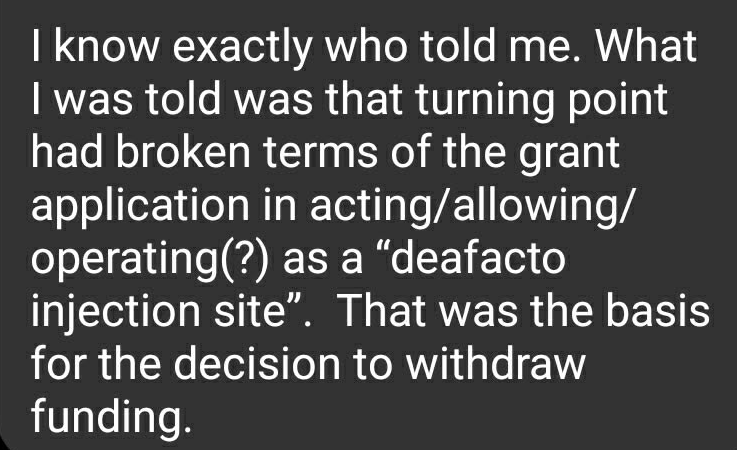
Janet Scott states in a message sent to Pickett on September 29 "that turning point had broken terms of the grant application in acting/allowing/operating(?) as a '[de facto] injection site'. That was the basis for the decision to withdraw funding."
The MLA for the Red Deer-South constituency overseen by Gareth Scott is Jason Stephan. Between 2023 and 2024, Stephan facilitated the coordination of city councillors and the provincial government to dismantle Red Deer's supervised consumption site. Until its closure, Stephan was vocal about eliminating the site, inviting his constituents to speak against it at a city hall hearing in January 2024.
Pickett told Drug Data Decoded that he believes that the SCAN investigation was also coordinated by Stephan, as upwards of twenty SCAN complaints were reportedly filed by citizens around the same time. Pickett was told by the SCAN officer that during the October 2025 municipal election, "Stephan and an unnamed woman emailed Mayor Johnston to have [Turning Point] shut down." Cindy Jefferies, who was vocally supportive of the supervised consumption site, won the mayoral election by a wide margin over Gareth Scott.
 Euan Thomson
Drug Data Decoded is following up with the City of Red Deer to determine if Stephan was agitating for Turning Point's closure during that period.
Pickett maintains that his issue is not with the sheriffs or police, saying that "SCAN and RCMP both agreed with us that outdoor drug use is a policing issue" – not one Turning Point could have controlled. He even insists that "SCAN was very good to deal with."
Corrigal reinforces this point, saying that "SCAN understood we didn't have enough staffing funded to constantly monitor outside." She says the investigators insinuated to her that "an [unnamed] MLA made special efforts to have those processes facilitated. I think he had both those things coordinated and it didn't turn out how he thought, but it still did huge damage."
"It was all a coordinated hit on the Agency, in my opinion," says Pickett.
On April 22, Drug Data Decoded asked Scott where she learned about the unstated reason for Turning Point's defunding and whether she knew if Stephan had coordinated constituents to submit the SCAN complaints. Stephan was also asked if he coordinated the complaints, triggered health or fire inspections, or pressured city council to close or relocate the agency. Neither responded to these questions.
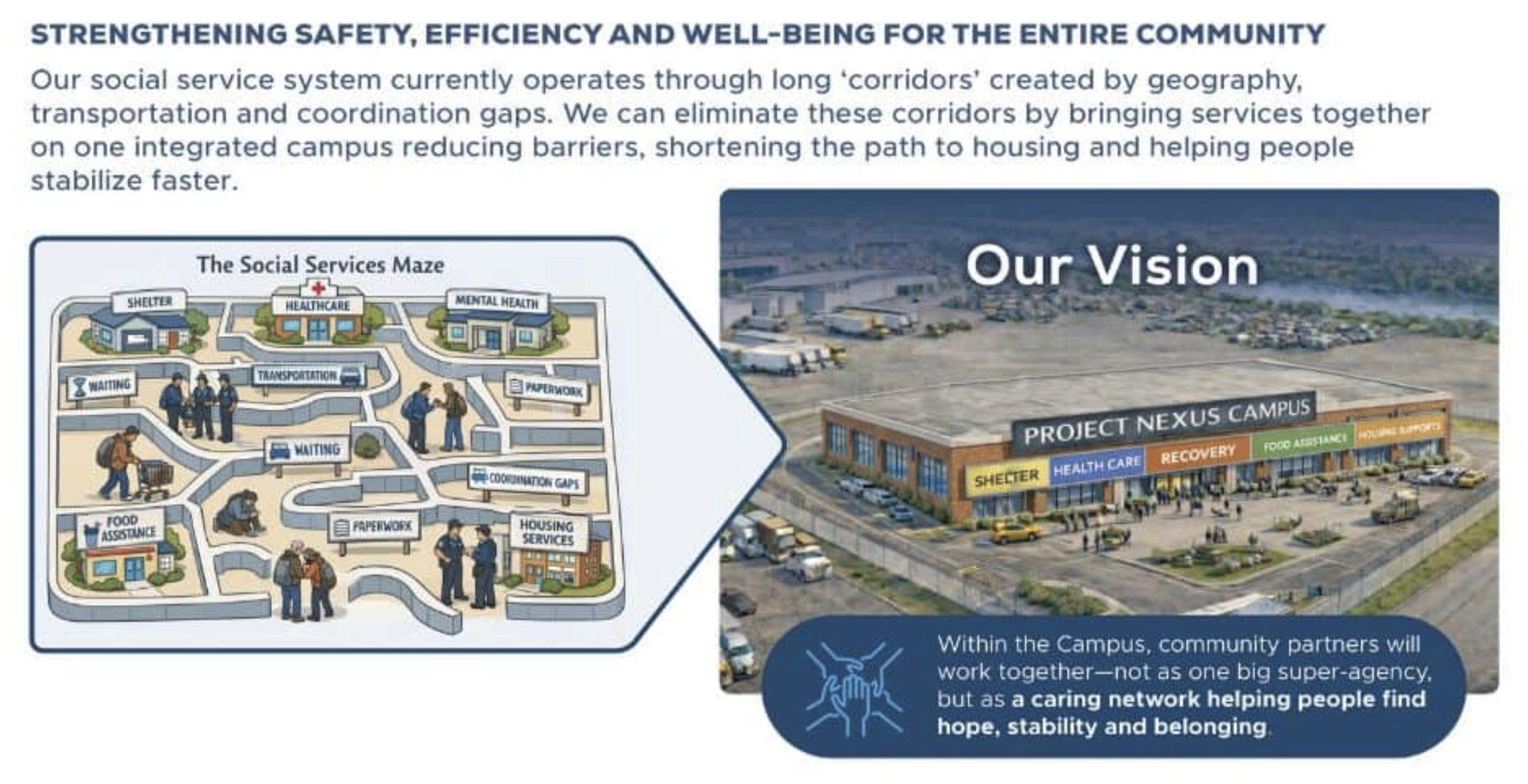
With Turning Point physically removed from the picture, the newly formed Red Deer Homeless Foundation is moving fast on the city's downtown. Packed with members of the Red Deer Chamber of Commerce, the foundation has launched a plan to relocate the shelter and other key social services out of the downtown core. These will be concentrated in a "single, integrated campus," also known as a ghetto, inside the Riverside Heavy Industrial Park. The foundation is calling this initiative "Project Nexus."
Echoing a similar plan hatched and abandoned three years ago, nearby residents are pushing back against its location, five kilometres from the downtown streets where its unhoused targets currently reside.
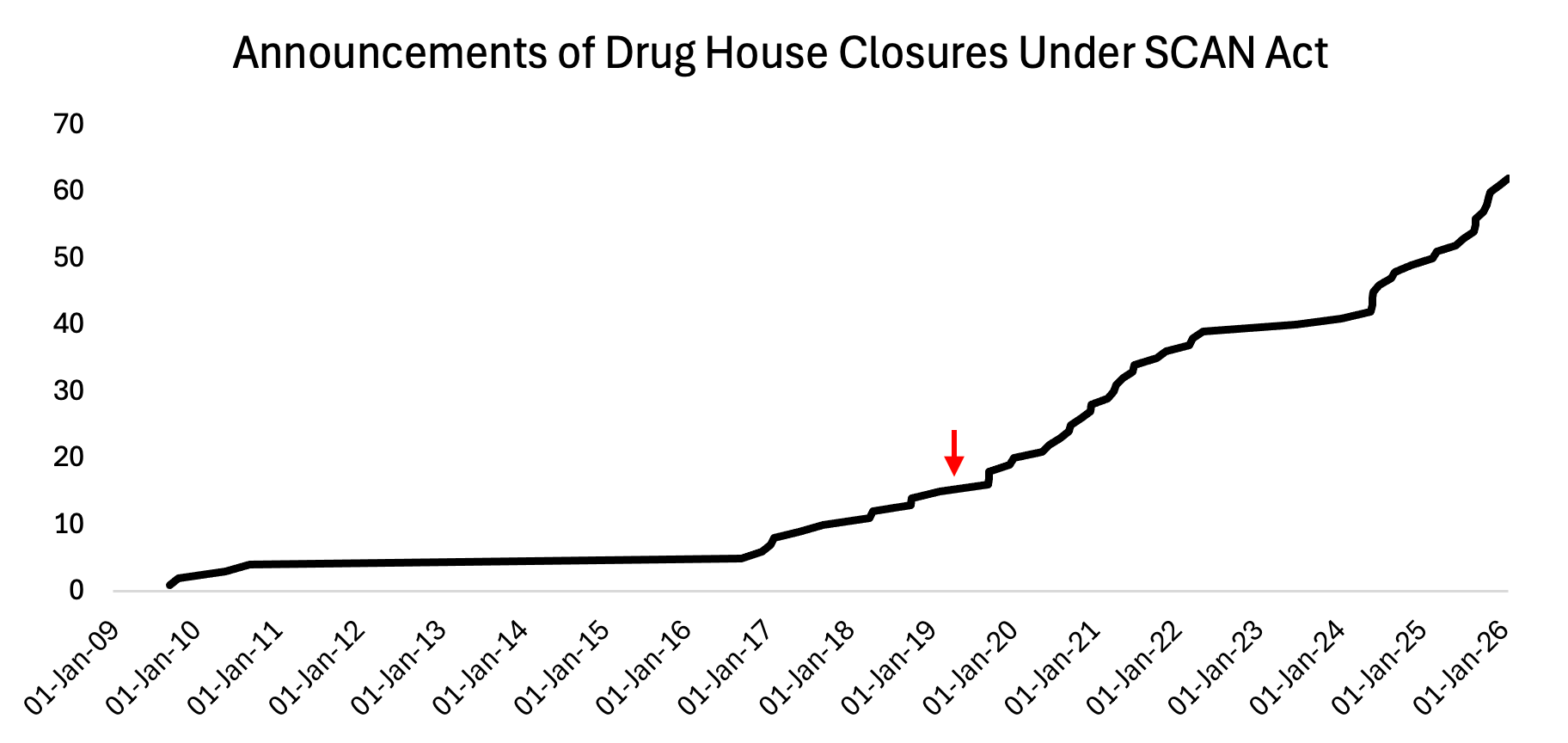
Since 2008, the Alberta government has documented more than 10,000 complaints under the SCAN Act. Its news bulletins have registered the closure of sixty-five "drug houses" across the province – fifty of these since the United Conservative government took power in 2019. Many announcements about drug house closures feature stigmatizing language from senior officials or describe them as “hotspots of crime.”
These “hotspots” are rarely proven out and generally, no charges are made against the occupants. Instead, the press releases refer vaguely to "drug activity" and state that while an eviction order remains active, "the SCAN investigation is ongoing."
Research on drug houses by Maryellen Gibson, a PhD candidate at the University of Saskatchewan, is countering their demonization by governments. Gibson is uncovering the important role drug houses play in filling unmet needs of people struggling to survive criminalization – particularly as supervised consumption sites are closed.
For people lacking other options, Gibson told Drug Data Decoded, “drug houses can be a place to have a shower, do laundry, have a meal and a rest, connect with people who have shared experiences, find power and purpose in leadership or familial roles, or create protection for others.”
Seen from the outside, a drug house is a tear-down with strange people coming and going, where erratic behaviours play out on the front lawn. Seen from the inside, it can be a lifeline in a minefield of criminalization and a place where family finds itself.
In Gibson's home province, the Saskatchewan government has taken SCAN to an extreme by removing the complaint process altogether. Officers no longer have to wait for a complaint to be filed – a nuisance property can now be targeted if officers perceive "unsafe living conditions, squatters or excessive vandalism."

Since 2008, more than half of Alberta government announcements about drug house closures were in Calgary and Lethbridge, with Lethbridge leading the province since the UCP took power. Lethbridge has also led the province in drug death rates – frequently doubling the provincial average – through this latter period. The southern city of 100,000, historically matched with Red Deer's fatality rate, diverged from Red Deer and the rest of the province after the government closed the busiest supervised consumption site in the country – Alberta's only site allowing drug inhalation or smoking.
Lethbridge has seen a large decrease in drug fatalities in the last two years. This may be related to the fact that in just six years, the city has lost more than 389 people to drug toxicity – roughly one of every two hundred residents.
In January, Drug Data Decoded began working to obtain records from the Ministry of Public Safety about the closure of drug houses through SCAN as well as the events leading to the unprecedented investigation of Turning Point. In each instance, the ministry stonewalled the requests by setting fees over $2,000 and refusing to reduce them, even when the requests were reduced in scope or an appeal for a fee waiver was submitted.
Ominously, on April 17, the ministry notified Drug Data Decoded that it was abandoning the request for records about SCAN surveillance of Turning Point, despite two letters informing them that official complaints were proceeding on this file. Abandoning the request could allow the ministry to legally delete responsive records – except the complaint process would normally prohibit this.
On April 18, Drug Data Decoded asked the ministry to reopen the request immediately, but as of publication has not received a response.
While the SCAN Act confers enormous power to police, governments, and landlords, the law can be made to backfire. In 2020, Celia Wright, a member of the Ta’an Kwäch’än Council in Yukon, was given five days to vacate a rental property she inhabited with her her eight children, her partner, and her mother-in-law, after an anonymous complaint was made and their house was raided by the RCMP. She and her partner were charged in November 2022 with drug, weapon and stolen property-related offences.
The notice to vacate was facilitated by SCAN officers of Yukon's territorial government. The charges were never tested in court, because in 2023, Wright mounted a Charter challenge. She claimed that her eviction violated her right to life, liberty, and security. She won, and Yukon's supreme court struck down part of the territory's SCAN Act that allowed for five-day eviction notices, stretching these to thirty days.
Despite this setback, the SCAN Act is alive and well in Yukon. In 2024, the government received 195 SCAN complaints – a record number. Thirteen resulted in eviction notices.
Turning Point's is the first public account of a non-profit agency being investigated under the SCAN Act in any province or territory. And yet, through a separate investigation, Drug Data Decoded has discovered that Turning Point was not alone among harm-reduction agencies in facing this heavy-handed surveillance.
Five thousand kilometres east in Halifax, troves of evidence indicate that a similar operation was launched by the Nova Scotia government and local police in 2023. The fallout was the 2025 disintegration of Out of the Cold Community Association, which had operated two shelters near that city's downtown.
Given fifteen minutes' notice to vacate, Out of the Cold's forty unionized workers were escorted off the job. That story will be told in an upcoming series.
UPDATE, May 26 – response to April 22 queries from Minister Adriana LaGrange, received May 19:
Thank you for your email regarding correspondence from the Ministry of Primary and Preventative Health Services (PPHS) to the Turning Point Society. I hope the following addresses your questions.
I would like to clarify the timeline which you have referenced. PPHS provided Turning Point Society with written notice on July 24, 2025, advising that PPHS’ grant funding for Turning Point would end effective November 1, 2025. This provided more than 90 days’ notice, consistent with the terms of the grant agreement.
With respect to your question on investigations, the decision to end PPHS’ grant agreements with Turning Point was not contingent on the outcome of investigations, nor was it based on findings of unlawful activity or failure to meet health service standards. The funding changes were part of broader efforts by Alberta’s government to explore alternative delivery models that better align with provincial health priorities and long‑term sustainability.
We recognize that changes to funding arrangements can raise concerns, particularly given the impact on vulnerable populations in Red Deer and surrounding communities. Be assured that Alberta’s government remains committed to supporting vulnerable populations and to ensuring that services continue through appropriate and sustainable models of care.
An early version of this story was shared with Paid subscribers on April 22.
Thanks to over 100 Paid subscribers for making this work possible.
Drug Data Decoded provides analysis using news sources, publicly available data sets and freedom of information submissions, from which the author draws reasonable opinions. The author is not a journalist.
This content is not available for AI training. All rights reserved.