
“A shared vision”: Public money funnelled through conference sponsorships may line pockets of UCP policy pushers
From 2021 to 2025, the Alberta government gave at least $745,000 in conference sponsorships to Last Door Recovery Society. The deliverables were redacted but appear linked to conflicts of interest among authors of a recent government study attempting to justify supervised consumption site closures.


Each year, the Recovery Capital Conference held in Calgary features a significant government announcement. The 2024 conference showcased the mental health and addiction ministers of Alberta, Saskatchewan and Ontario joining to "build interprovincial partnerships on recovery," a nod to Alberta's abstinence-based drug policy.
On March 13, Ontario advanced its commitment to that partnership by announcing the closure of all remaining supervised consumption sites in the province. Two days earlier, the Alberta government celebrated the publication of a peer-reviewed study on supervised consumption sites using personal health numbers of people who use drugs. The government used the study, conducted by its own researchers, to claim that the 2025 closure of the Red Deer site had only beneficial outcomes and no adverse impacts on people who used the sites.
On March 16, Ontario premier Doug Ford linked his government’s planned site closures to that government study. In his announcement, Ford incorrectly cited the University of Alberta as the source of the study.
As reported by Drug Data Decoded, both governments have grossly misinterpreted the study, which contained numerous undisclosed conflicts of interest and a fatal flaw in to the data that went unmentioned in the study's limitations.
Now, documents obtained by Drug Data Decoded reveal Recovery Capital Conferences as a possible channel through which public dollars have flowed to ideological allies of the government, including authors of that study.
The documents show that from 2021 to 2025, Alberta's Ministry of Mental Health and Addiction provided $745,000 in previously undocumented conference sponsorships to BC-based Last Door Recovery Society, which runs the conference. The request asked for "all sponsorship agreements from 2019 to 2025 between the Government of Alberta and Recovery Capital Conference, Recovery Capital Summit or Alberta Recovery Conference."
Each funding allocation was signed off by the minister at the time, beginning with Jason Copping for the 2021 grant and its 2022 amendment, Dan Williams for the 2024 grant and amendment, and Rick Wilson for the 2025 amendment.
The ministry withheld 53 of 84 pages in its freedom of information response, including all project activities and deliverables.
However, an amendment to the second of these grants clarifies their purpose. In 2024, a $250,000 grant to Last Door for "Building and Sustaining Momentum for a Shared Vision of Recovery in Alberta" was authorized by Deputy Minister Coreen Everington. The next year, Everington amended the grant to increase the amount to $500,000, and the grant title was changed to "Recovery Capital Conference."
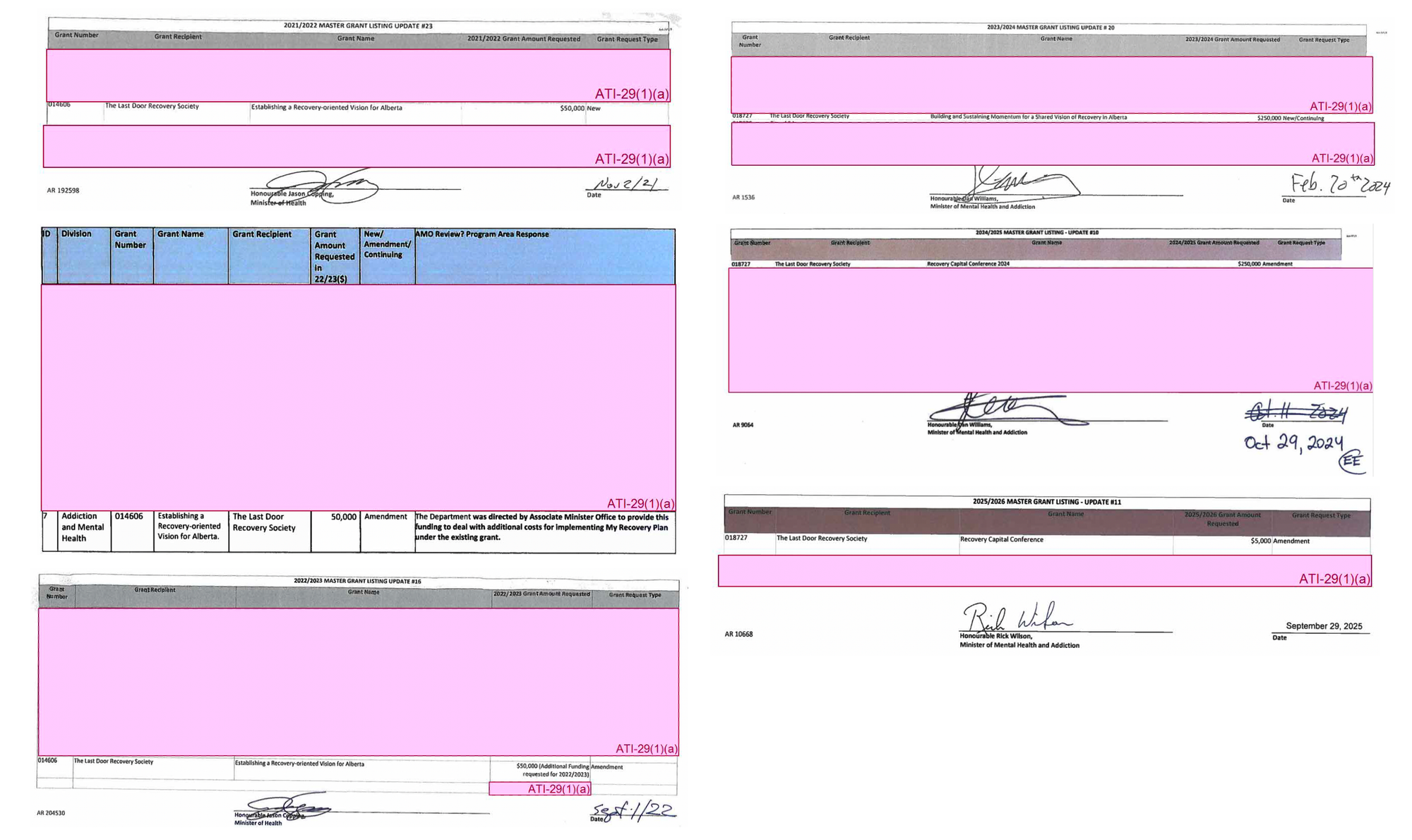
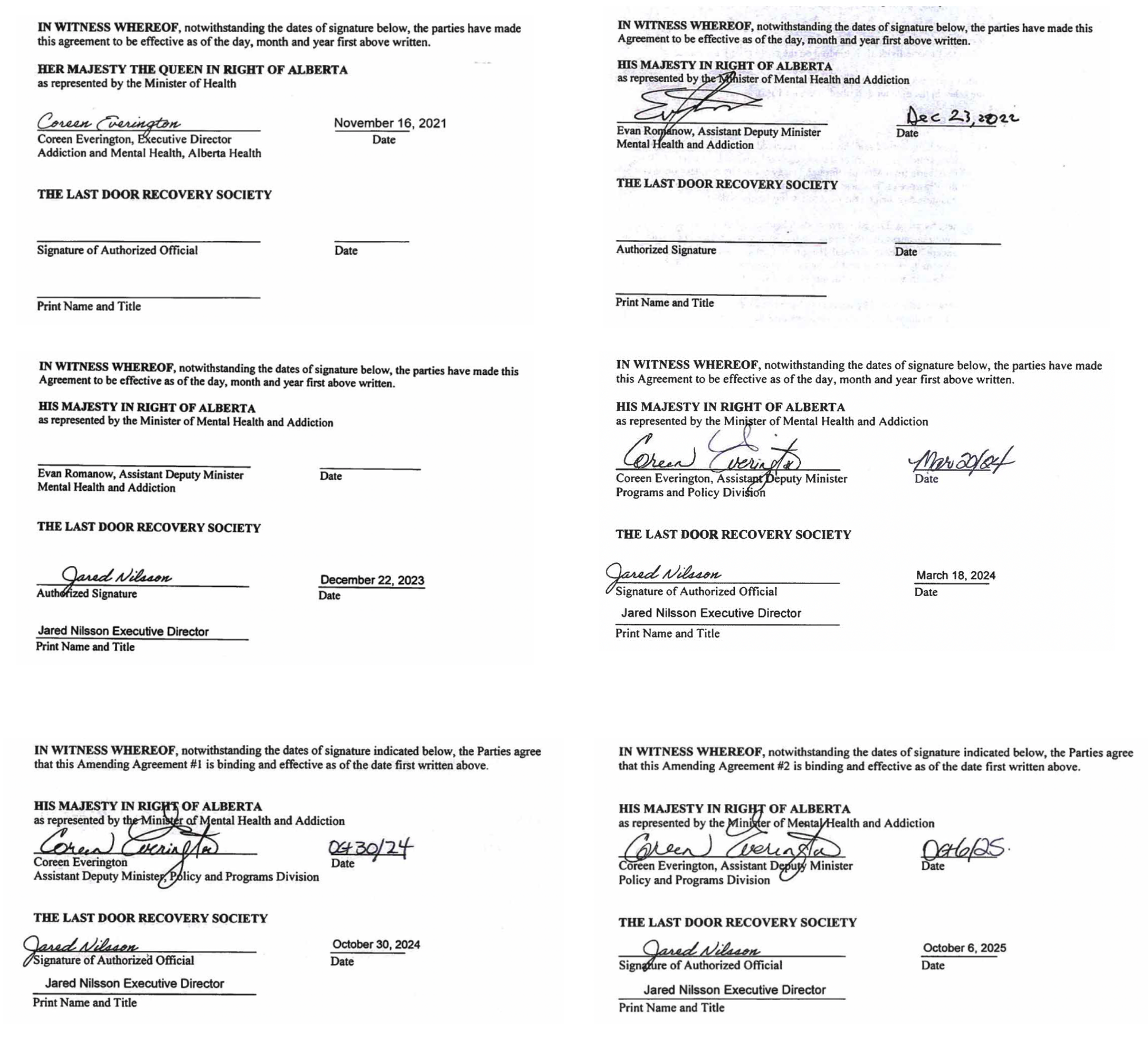
Combined with the responsiveness of these documents to the wording of the freedom of information request, this change in grant title makes it clear that the funding was initially intended to support the Recovery Capital Conference. The grants are not listed among the Ministry's sole-source contract list.
The provincial Charitable Fund-raising Act governs the rules around charitable organizations receiving and using funds from government sponsorships. While the Act is unclear around rules concerning government contributions, it dictates that organizations can be compelled to make proper use of contributions by donors.
To determine if additional government bodies provided donations to Last Door conferences, a second freedom of information request was submitted by Drug Data Decoded to Alberta Health Services for details of its conference sponsorship in 2023. The health authority replied that it held no responsive records. Recovery Alberta and the Centre of Recovery Excellence were not asked.
On March 11, Drug Data Decoded asked the Ministry of Mental Health and Addiction to explain if these grants to Last Door were produced through a competitive process. The Ministry did not reply. On March 16, Drug Data Decoded asked Last Door the same question and asked for an explanation of where the money was allocated. Last Door also did not reply.
The first of these 'grants' to Last Door was authorized by Everington in 2021 for $50,000, but was increased by Evan Romanow in 2022 to $240,000. At that time, Everington and Romanow were serving as Assistant Deputy Ministers. They have since been promoted to Deputy Ministers. In December, they were appointed as government representatives to the Mental Health and Addiction Wisdom Council.
Whose Recovery Plan?
In November 2025, Everington and Romanow were called to the provincial Standing Committee on Public Accounts to answer questions concerning expenditures including My Recovery Plan (MRP), owned by Last Door. MRP is an app that collects personal health information of people entering substance use programs, including detox and residential rehab facilities. Previous reporting by Drug Data Decoded showed that collection of personal information by the app does not meet criteria for informed consent.
In January 2024, Romanow circulated a memo to all publicly funded service providers in the province emphasizing that they must be "consistently using MRP with every client… [as] a requirement of your funding." Two months later, the MRP implementation team repeated this statement, saying "MRP is a funding requirement for receiving public funding... Service providers must introduce MRP to all clients and use its features."

To accelerate uptake of the app among service providers, Alberta Health Services introduced a "privacy workaround" by replacing the written consent form with a "privacy notice" read by the service provider to the client.
At the Public Accounts committee, Everington was encouraged by Romanow to respond to whether or not facilities were threatened with funding loss if they did not use MRP. Everington told the committee, "We weren't looking to penalize organizations for not using it, we were trying to encourage them to use it by providing training."
Everington's statement is misleading, as not only were service providers sent the veiled threats described above, clients at detox facilities were even told that access to services was conditional on their MRP usage. A January 2025 intake document at Calgary Drop-In, titled “Recovery Transition Program – External Referral Form,” asserted that “all clients are required to participate in My Recovery Plan while in the program.” (Emphasis theirs.)
In August 2025, Drug Data Decoded reported that the Auditor General was investigating MRP. Shortly thereafter, the ministry revealed that the app was being decommissioned under questioning around that coverage by CTV Calgary.
This may have come too late to protect people's personal health information, because Romanow revealed to the committee that "more than 7,480 individuals" had uploaded their data to MRP. Drug Data Decoded recently showed that in late 2024, members of the CoRE began obtaining individually identifying health information from MRP, ostensibly for 'research' on recovery outcomes. The CoRE's governing law dictates that it can "collect, use, and disclose" individually identifying health information for any purpose that falls within its broad mandate.
Internal correspondence from 2024 showed that all six First Nation service providers in Alberta explicitly refused to implement MRP, citing concerns around data sovereignty and the app's failure to include culturally safe content. Everington downplayed this as a matter of "phased implementation," and told the Public Accounts committee she did not "have the number on hand" for how many First Nation service providers refused to implement MRP.
Despite his involvement in pushing the app into facilities, Romanow described Everington to the committee as the person "leading this work" on My Recovery Plan. From 2021 to 2025, Last Door received four sole-source contracts from the Ministry totalling $3,827,535.77, unrelated to the contracts signed by Romanow and Everington for Recovery Capital Conference. The stated purpose of those sole-source contracts was to "implement," "implement and facilitate," "facilitate implementation," and "support" MRP. The most recent of these contracts ends on May 31.
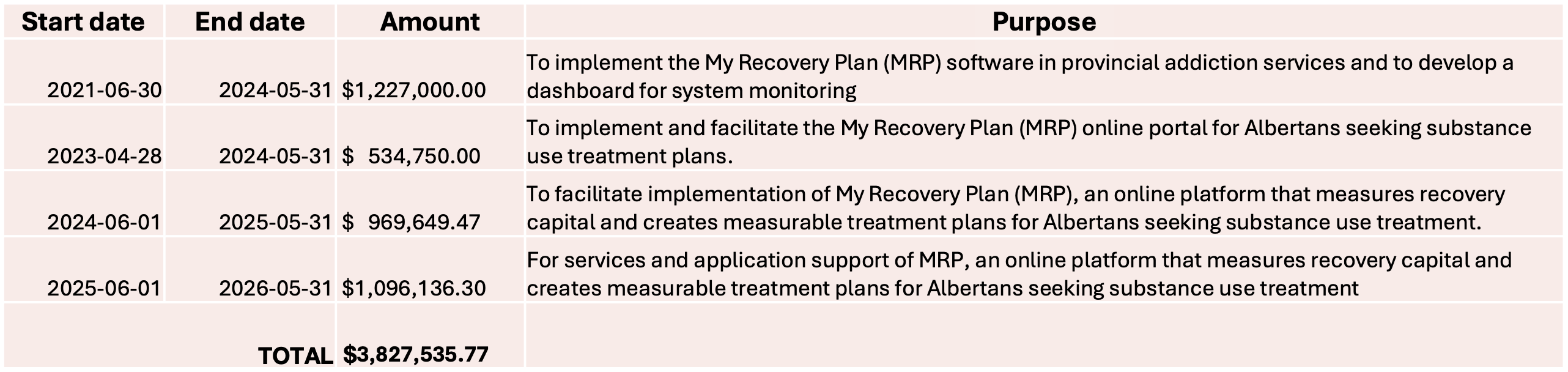
MRP has been central to Ministry announcements since 2021 and and its business plans since 2023 as an ostensible way to measure outcomes of its recovery programming. Its decommissioning likely means these data will never be publicly reported, but they remain in the hands of Last Door and the Ministry.
The Ministry also gave Last Door the contract for Calgary Recovery Community, worth undisclosed millions per year. A freedom of information request by Drug Data Decoded for the grant agreement and associated correspondence was heavily redacted, with 445 of 485 pages withheld. The grant competition, which appeared rushed in the documents, was decided in March 2023, and Last Door was not announced as the recipient until July 2025 – eight months after Drug Data Decoded uncovered it as the likely recipient.
Diminishing returns
Two months before the Calgary Recovery Community grant was being awarded to Last Door, sexual assault allegations concerning long-time Last Door employee Adam Haber were made public. Haber faced charges on three counts of sexual assault by New Westminster Police after at least eleven women brought allegations. In 2024, he was convicted and sentenced to three years in prison.
As the allegations surfaced, sponsorship of Last Door's conference appeared to evaporate. From 2022 to 2024, the number of non-government organizations lending their logos to the front page of the conference that were not involved with organizing it shrunk from ten to four.
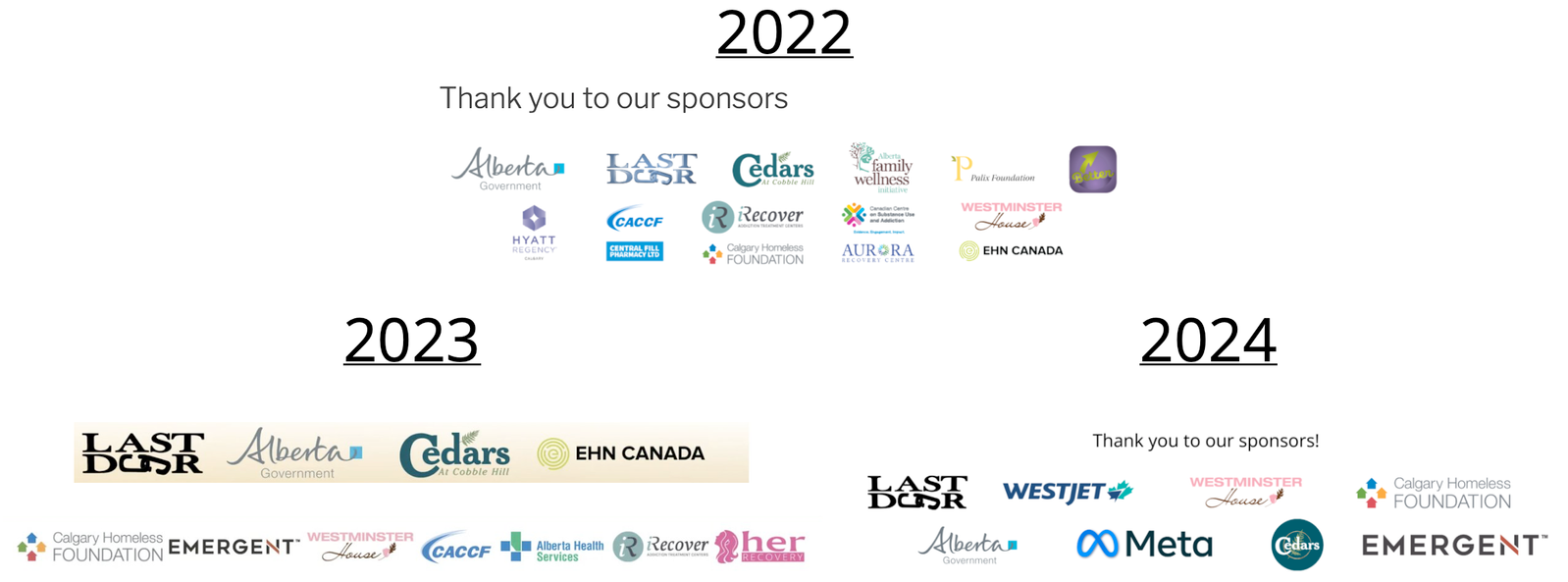
By 2025, the sponsor list for the conference had mostly dwindled to government entities, including Recovery Alberta, CoRE, and the Government of Alberta, as well as companies receiving Alberta government funding. These included Last Door and all five ROSC Solutions Group subsidiaries: Beccarian Correctional Care, Recovery Training Institute of Alberta, Bowline Health, Lakeview Recovery Community, and Recovery Coach Academy of Canada.
Since 2017, the conferences have been organized by members of Last Door, Cedars, and what eventually became ROSC Solutions Group. Conference tickets cost over $600, and additional revenue is generated from trade show booths and program advertising.
A slush fund for policy advancement?
On March 11, the Alberta government published its study evaluating the 2025 closure of a supervised consumption site in Red Deer. The study's lead author was Dr. Nathaniel Day.
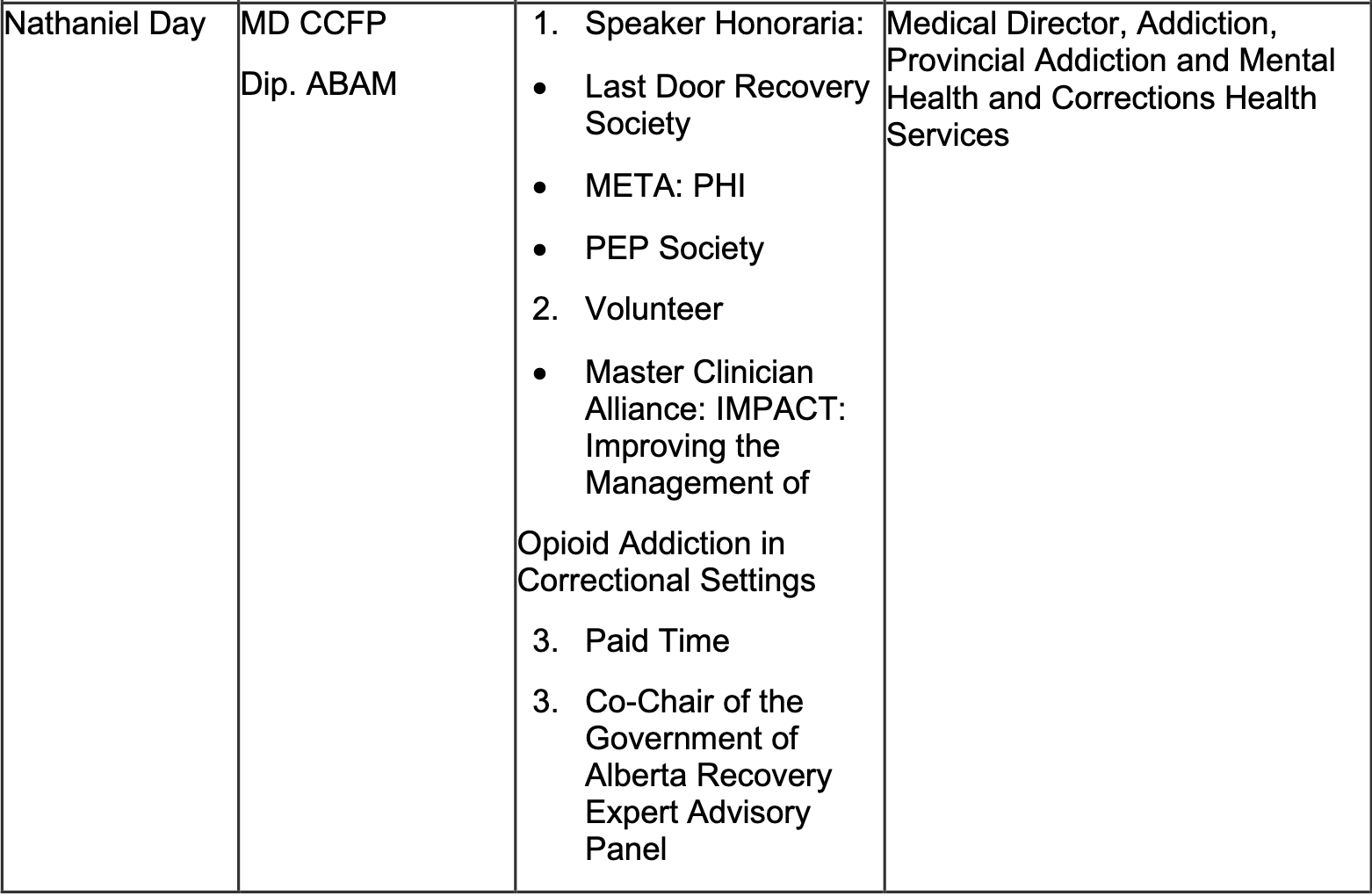
Before joining the Canadian Centre of Recovery Excellence (CoRE) as its Chief Scientific Officer, Day was Medical Director of Recovery Alberta's Addiction and Mental Health and Corrections Health services.
Day also took speaking honoraria from Last Door Recovery Society for conference talks in 2022. At the 2025 conference, Day co-presented with Romanow, Recovery Alberta CEO Kerry Bales, and CoRE CEO Kym Kaufmann.
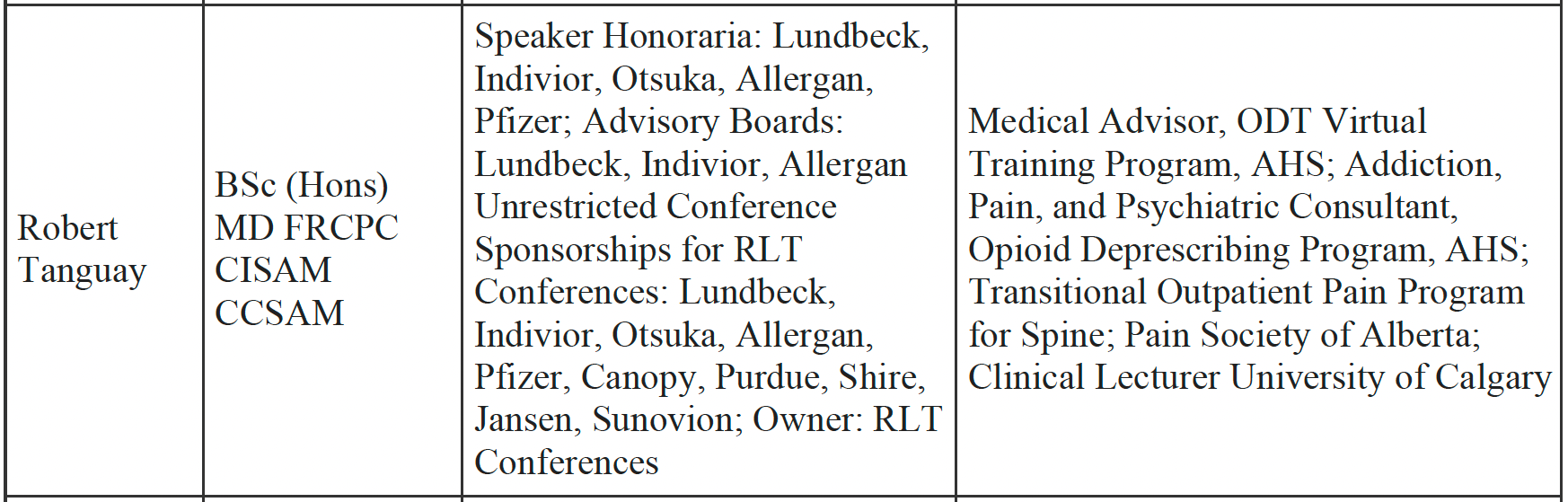
Another author of that study, Dr. Rob Tanguay, has also received conference sponsorships from companies that stand to benefit from Alberta Recovery Model. His competing interest disclosures from 2019 show that his conference company, RLT Conferences, received "Unrestricted Conference Sponsorships" from ten pharmaceutical companies. These include Purdue and Indivior, the company that holds exclusive patents for Sublocade distribution.
Since 2023, Tanguay has sat on the Calgary Police Commission while Calgary Police Service procures psychedelic treatment services from the company he co-founded, Newly Institute. Newly is also listed among the service providers for Alberta's Primary and Preventative Health Services in Calgary and Edmonton.
As uncovered on March 11 by Drug Data Decoded, Dr. Keith Humphreys is the deputy editor-in-chief of the academic journal where Day and Tanguay's government study on supervised consumption was published. Humphreys is a board member for Indivior and holds considerable shares in the company.
Drug Data Decoded holds no records suggesting Humphreys influenced the study's publication. However, Humphreys is familiar with these study authors. From 2023 to 2024, Humphreys, Tanguay, and Day (as well as Romanow) worked together on the Alberta government's Recovery Expert Advisory Panel, for which at least Day was compensated financially. At September's Recovery Capital Conference, Tanguay and Humphreys were keynote co-panellists.
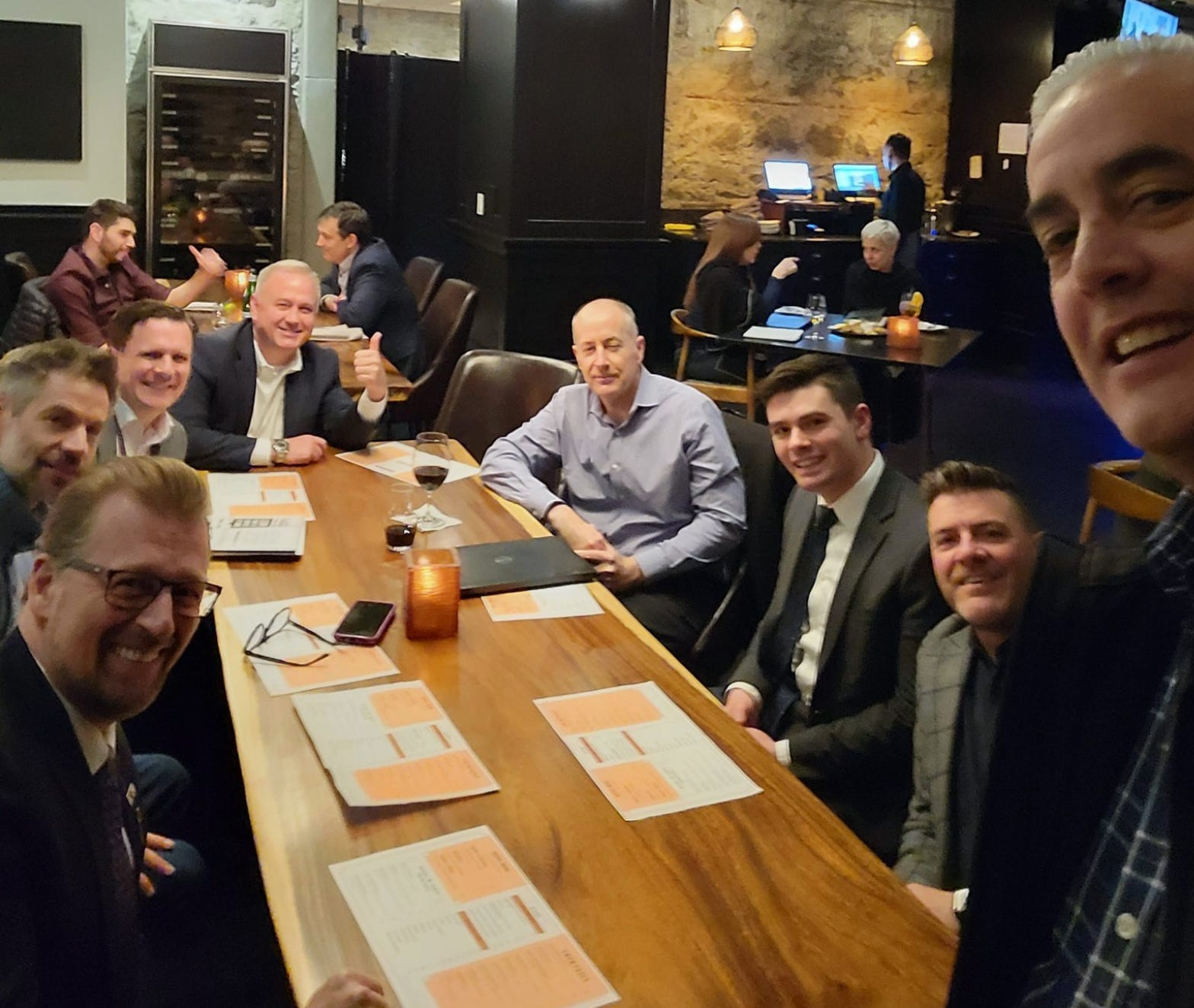
In 2022, a number of conference speakers also provided testimony to the Alberta government's committee to examine safe supply. Among those providing testimony were study co-authors Tanguay, Dr. Nickie Mathew (the only study author from outside Alberta), and Day.
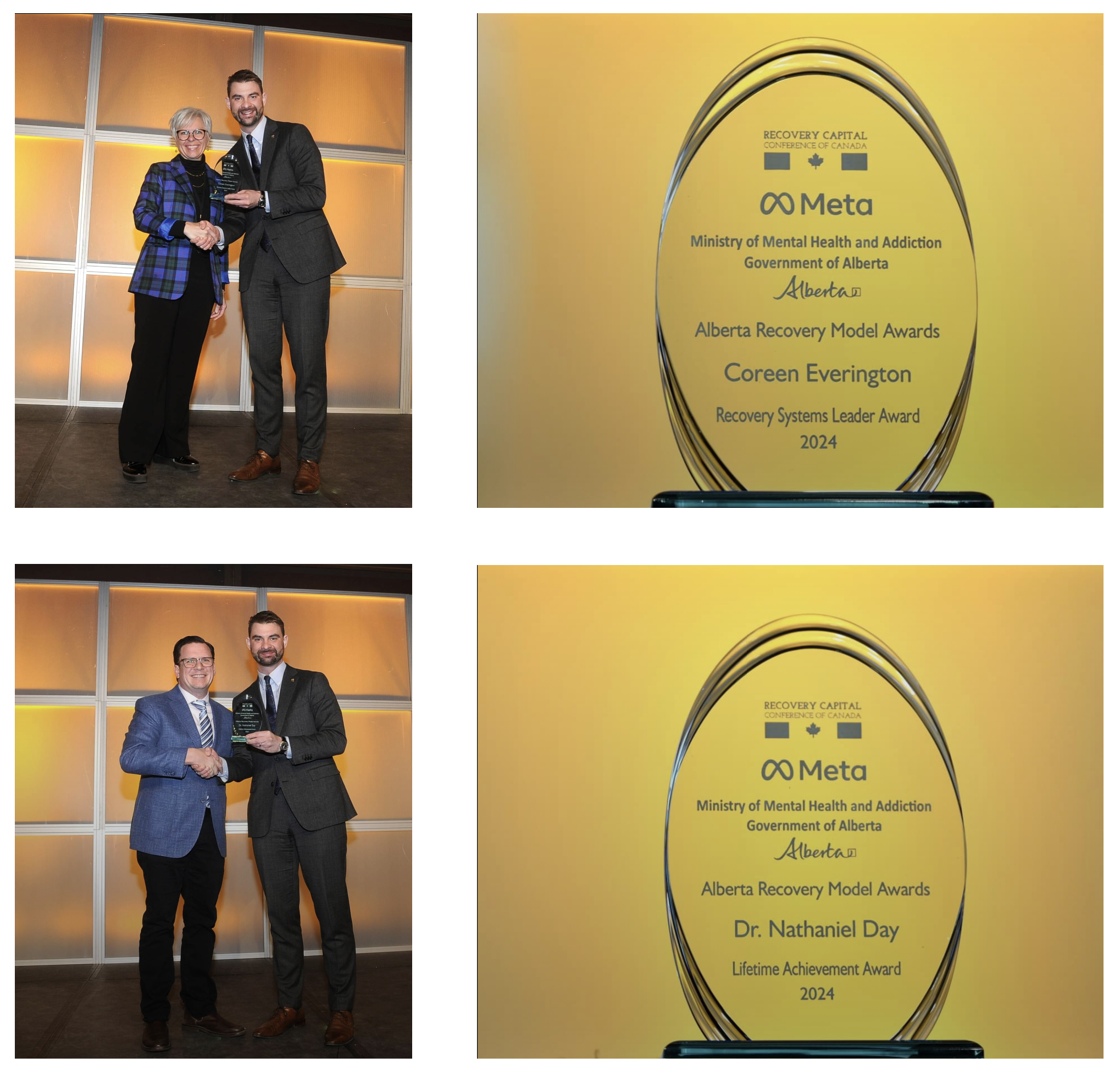
At the 2024 conference, where the Ontario, Saskatchewan, and Alberta governments announced their partnership to advance 'recovery-oriented systems of care,' Everington and Day were given awards sponsored by the Ministry and by Meta, the social media and AI company.
Last Door was asked on March 16 if these awards carried financial prizes, and whether conference speaker fees were dispensed to Robert Tanguay, Evan Romanow, or Nathaniel Day. Last Door did not respond.
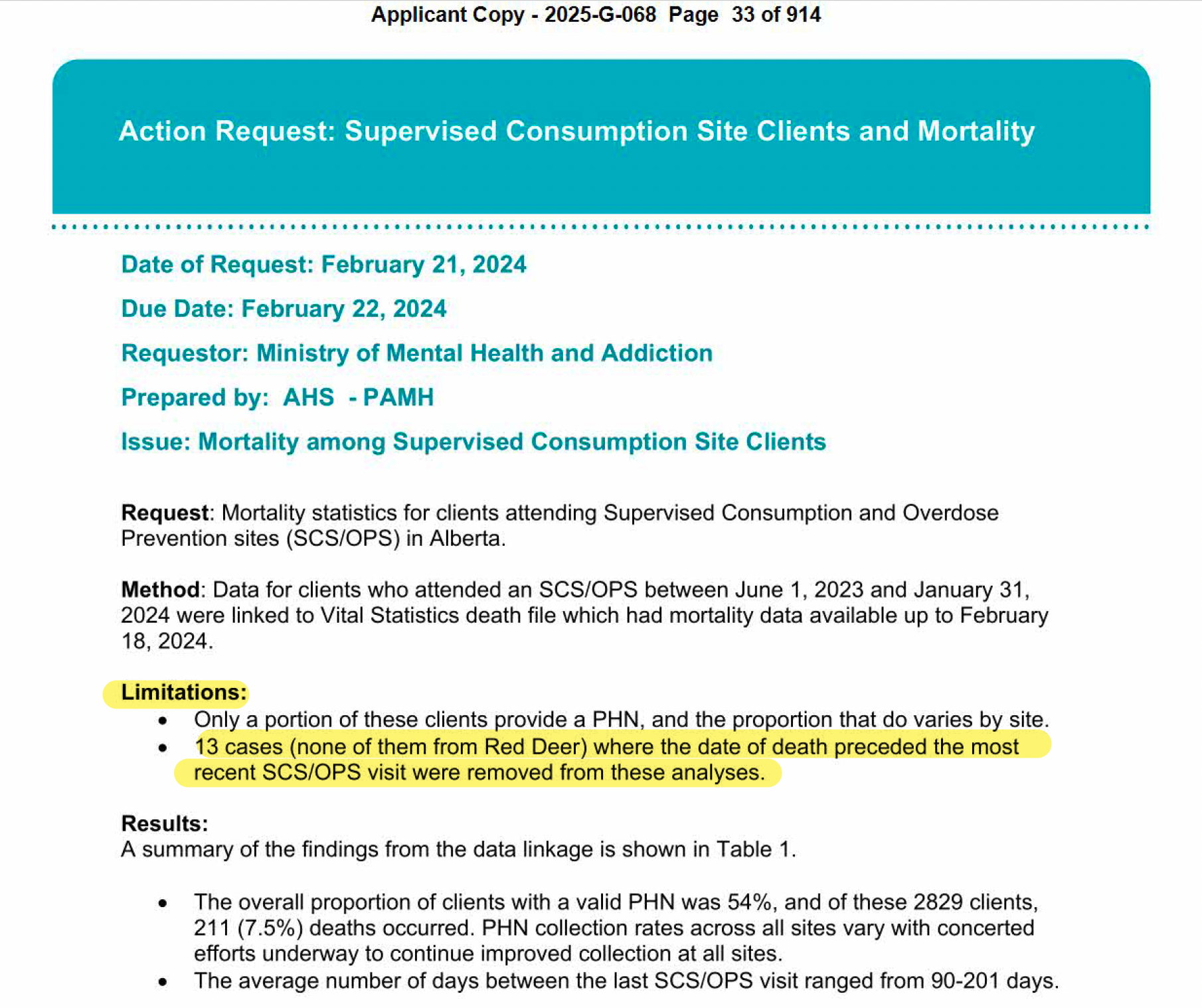
In addition to serious undisclosed conflicts of interest, the study led by Day contained a fundamental methodological flaw obscured in the publication but known to all parties, including the government and authors. Of 211 deaths of supervised consumption site clients tracked by the authors in 2023 and 2024, 13 with a "date of death that preceded the most recent visit to a [supervised consumption site] were removed from the analysis."
This means the use of personal health numbers in the study is jeopardized by the fact that people using the sites regularly swap personal health numbers to access the sites – a limitation the study did not acknowledge.
Several media outlets have reported on the study, with most failing to critically examine its conflicts of interest and methodological shortfalls. In the first of these reports, by Global News, Calgary physician Monty Ghosh described the study as "well done." Global failed to identify that for years, Ghosh and Tanguay have worked closely at Calgary's Rapid Access Addiction Medicine clinic. Ghosh and Tanguay are co-authors on at least three studies from 2019 to 2024, and in 2021, they co-presented on Alberta drug policy at the University of Calgary O'Brien Institute of Public Health. It is possible that while Ghosh gave his statement to Global, Tanguay was in the office next door.
Drug Data Decoded also revealed in July that Ghosh is helping to embed private 'recovery' services in emergency departments. His ongoing federal grant is contracting Bowline Health, one of the five ROSC Solutions Group subsidiaries.
At last, in a March 15 story, CBC News raised critical questions about the study, interviewing Dr. Daniel Werb, who was corresponding author on a landmark study showing reduced deaths in Toronto neighbourhoods containing supervised consumption sites. That study was ignored by the authors of the Alberta government study and by Ford in making his announcement around closing the remaining sites.
Werb told CBC News, "this is a report that has been produced by a Crown agency of the government… by people who have key roles in creating the policy that this Alberta government is banking a lot of its reputation on."
Matters that remain unaddressed by media, study authors, and critics in academia include the study's reliance on inaccurate personal health number data, the undisclosed donations by Day and Tanguay to the United Conservative Party, Day's undisclosed service as expert witness for the Ontario government’s closure of sites, and Tanguay's undisclosed private holdings benefiting from Alberta government contracts.
Together, the study and the shadow money flowing through the Ministry of Mental Health and Addiction, which employs ten of eleven study authors, raises questions about how ideology is infecting scientific practices inside the Alberta government – and how people are compensated for advancing that ideology.
Lacking a full account of how these government grants were allocated by Last Door, Albertans are left with what appears to be a slush fund trading academic credentials for political expedience.
Disclosure: The author of this story publicly withdrew from participating in the Alberta government's 2022 Select Special Committee to Examine Safe Supply, and helped organize a protest against the 2023 Alberta Recovery Conference, citing conflicts of interest between the conference and Alberta government.
Documents used in this story:
An early version of this story was shared with Paid subscribers on March 16.
Drug Data Decoded provides analysis using news sources, publicly available data sets and freedom of information submissions, from which the author draws reasonable opinions. The author is not a journalist.
This content is not available for AI training. All rights reserved.