
"We can help": How Recovery Alberta facilitated consumption site closures (Part 1)
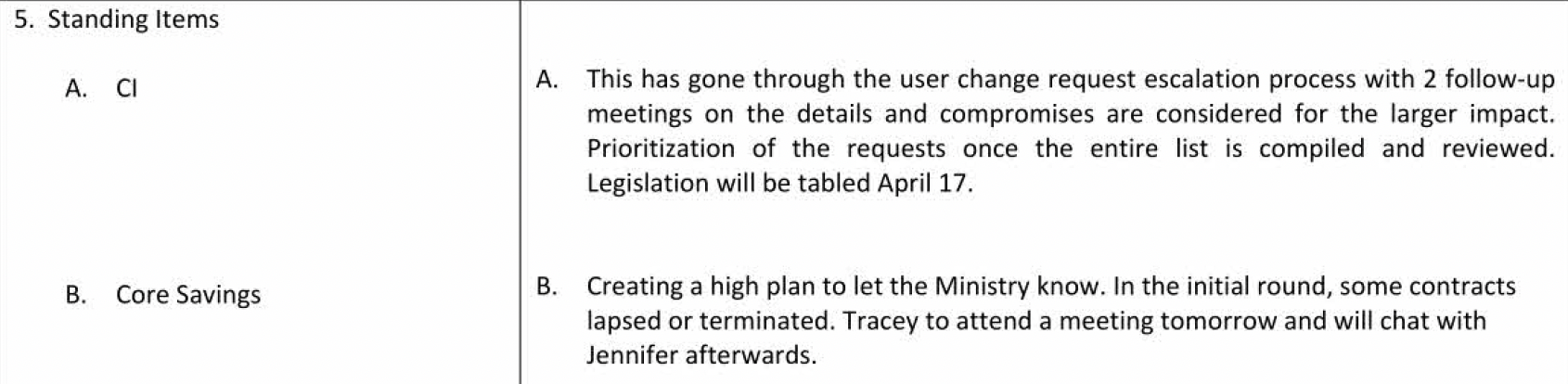
"No other sites shutting down," Recovery Alberta leaders told staff in late 2024, as the Red Deer site closure was announced. A year later, the Royal Alex Hospital site was closed. New documents reveal both closures relied on suppression and distortion of service usage data by Recovery Alberta.


At the United Conservative Party's October 2023 convention, a resolution was passed calling for the Government of Alberta to defund supervised consumption sites. That idea turned early results, with the government declaring the impending closure of the Red Deer site a few months later.
New documents detail the tactics employed by Recovery Alberta and Ministry of Mental Health and Addiction officials to facilitate the closure of the Red Deer consumption site and Edmonton's Royal Alexandra Hospital site in 2025.
The documents were obtained through a freedom of information request to Recovery Alberta and include nearly 1,000 pages of internal correspondence, meeting minutes, reports, and presentations. They detail suppression and distortion of evidence favourable to supervised consumption services, and the dismantling of frontline services to isolate and vacate consumption sites.
The documents reveal that the same tactics are now in play to shutter the Calgary and Lethbridge sites.
Recovery Alberta was launched in April 2024 after the Alberta government splintered Alberta Health Services into four new agencies. Meeting minutes suggest trepidation among staff around job security, as the organizations were realigned with the United Conservative Party's implicit intent to privatize services.
This two-part series will wade through documents thick with tactics to maintain secrecy around official activities. Many exchanges are redacted as 'advice' or 'deliberations,' while unredacted discussions are often densely coded. Sensitive conversations are frequently moved off-line to private meetings, without records.
Suppression of supervised consumption site data
Red Deer News NOW and Drug Data Decoded previously reported on coordination between United Conservative MLAs and two city councillors, Kraymer Barnstable and Vesna Higham, around the closure of the city's supervised consumption site. The outcome was a February 2024 city council vote to ask the province to close the site.
Five days after that crucial vote, the Ministry of Mental Health and Addiction sent an urgent request to Dr. Shelly Vik, then-director of Knowledge, Evidence & Innovation at Recovery Alberta, and Vik's team of analysts. The Ministry sought data on how many people who used supervised consumption services were dying or being hospitalized compared with people who presented at hospitals for opioid-related reasons without using supervised consumption services.
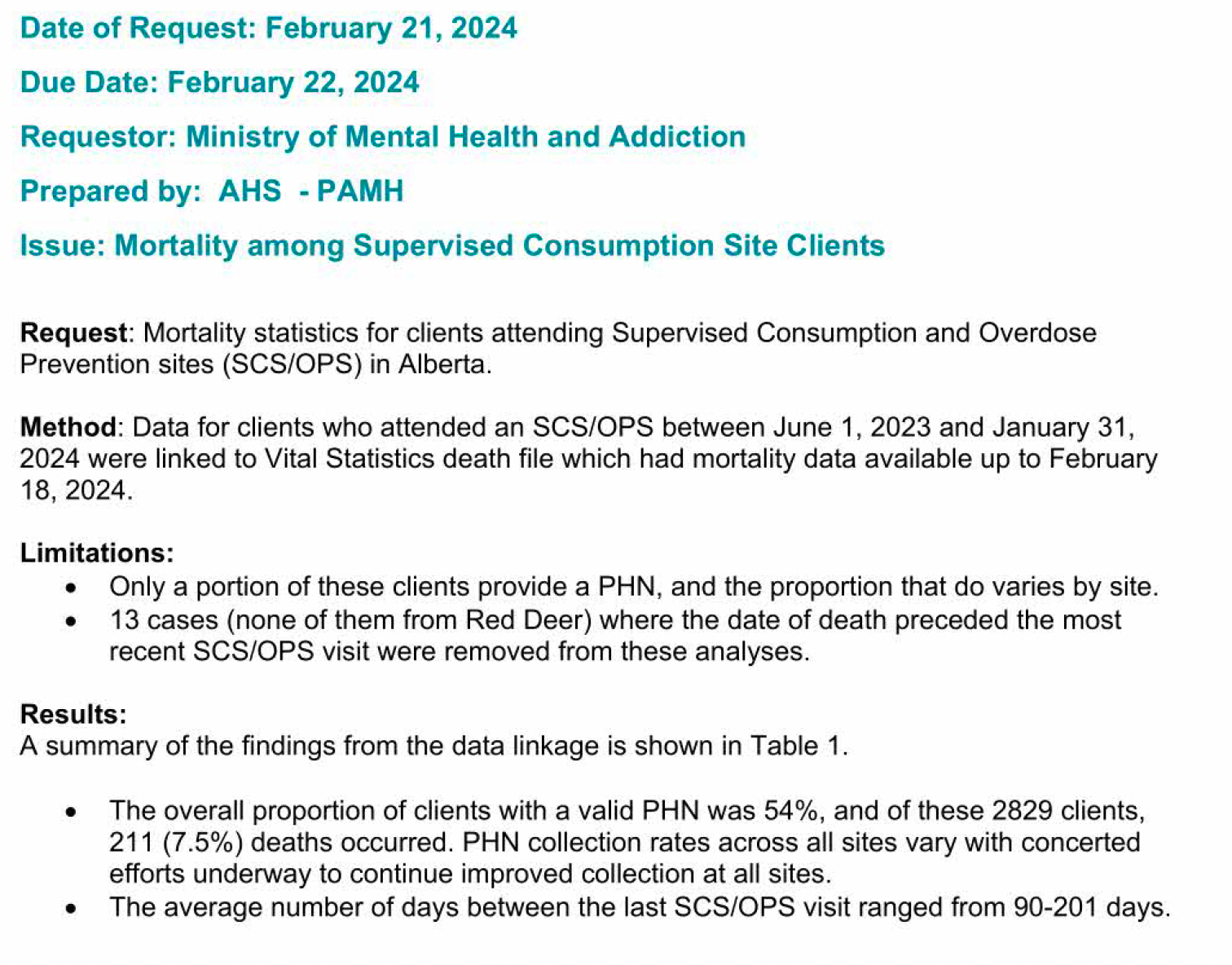
The data revealed a considerable shortfall in the reliability of personal health number (PHN) collection: thirteen of the 211 people who died after providing a PHN during a supervised consumption service visit had a visit to a service recorded after their deaths. This suggests that site clients routinely exchange PHNs, perhaps to disrupt surveillance of their activities.
Taking this into account, the data sent to the Ministry by Recovery Alberta showed that the death rate among clients of the Red Deer consumption site was the lowest in the province by a wide margin. Across sites, 7.5 percent of supervised consumption clients providing PHNs died during the period of analysis, while in Red Deer, that figure was 1.2 percent.
This critical data point was not mentioned in the summary to the Ministry, which instead emphasized the disparity in PHN collection across sites and the duration between last consumption site visit and deaths.
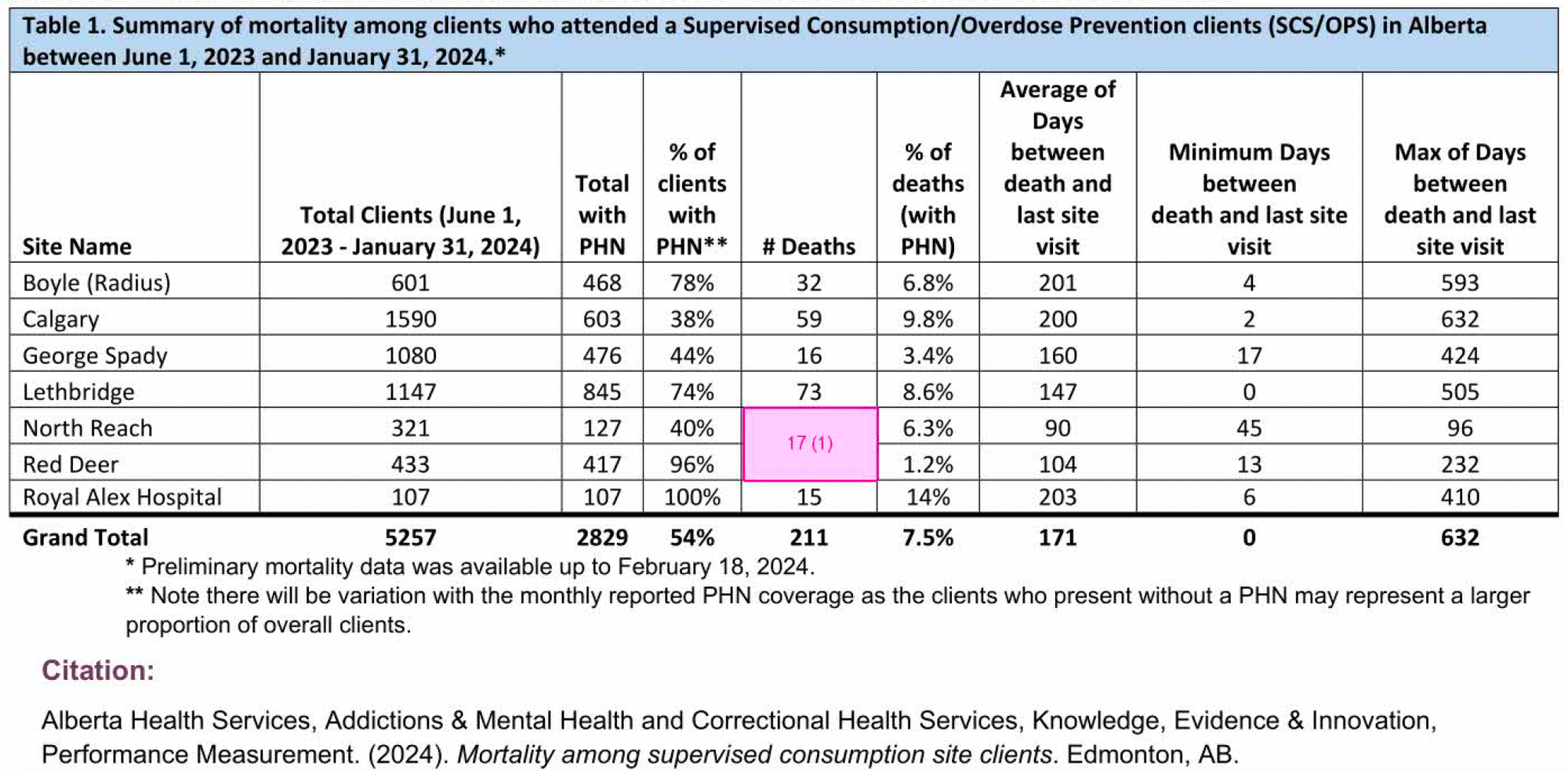
A full month before the fateful vote, Vik informed her staff that the collection of PHNs at the Red Deer consumption site "may have resulted in some reduction of visits." The site's manager believed that this was not the case, and shared this with Vik, who replied, "very good to hear your note on PHN request not having much impact. We were hoping not, because having that PHN makes the outcome assessments much more robust."
It is unclear how the conclusion was reached that PHN collection did not interfere with supervised consumption site access, or why it was so readily accepted by Vik, who was responsible for program evaluations at Recovery Alberta.
A provincial court found in a 2021 lawsuit against the Province that requiring supervised consumption site users to share PHNs would cause some people to turn away from the service. The government continued to assure the public that access to sites will not be refused if people do not provide a PHN – effectively placing the decision to attend back on clients, in exchange for their private information.
Regardless, the city council vote passed on February 18, 2024 with only two city councillors voting against the motion: Cindy Jefferies, who was elected mayor in 2025, and Dianne Wyntjes, who was also re-elected to city council in 2025. Both confirmed to Drug Data Decoded that no information was shared by the Ministry to the council ahead of the 2024 vote, and neither was able to say whether or not other councillors received information from the Ministry at that time.
Councillor Kraymer Barnstable, who was overheard in 2023 discussing the removal of Turning Point as the site's service provider "with a provincial colleague," was asked on February 18 if he had received any information from the Ministry ahead of the 2024 vote. He did not respond.
Seven months after the Red Deer vote passed, the government announced the consumption site would close in the spring of 2025. The first measure it took was to reduce its operation to 12 hours per day, beginning that January.
Before the site was closed, consumption site client Aaron Brown secured a court injunction forcing the site to return to 24/7 operations. Brown's injunction was not extended in ensuing court proceedings, and the site was successfully closed on March 31, 2025 after six years of operation.
On December 18, 2024 – a month before the site transitioned to 12-hour days – Recovery Alberta officials held data showing that initiation of opioid agonist treatment (OAT), such as methadone or buprenorphine, was far higher among supervised consumption site clients than non-clients. Sustained OAT medication, ('retention,' a measure of efficacy) also appeared somewhat higher among site clients.
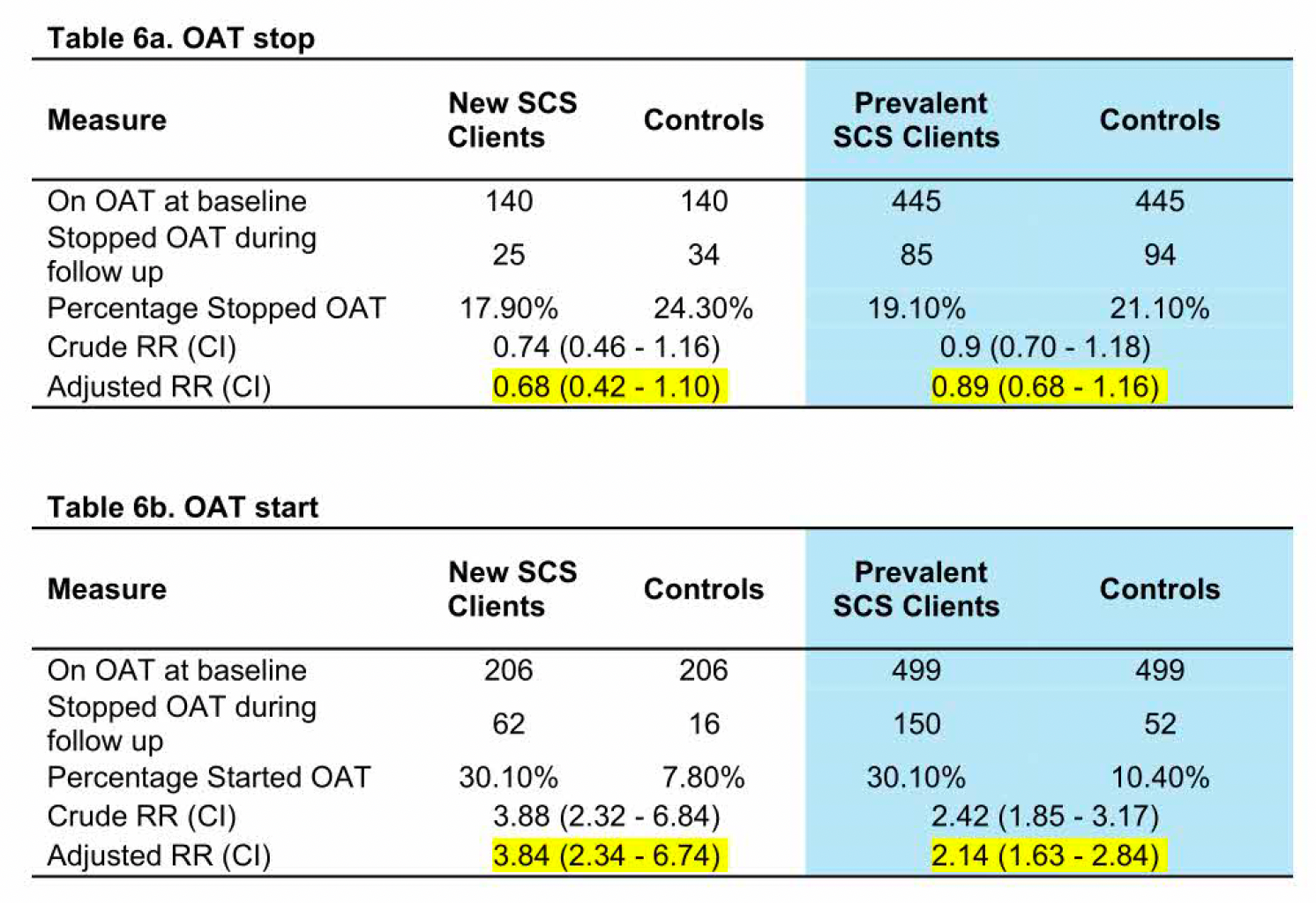
The Ministry was asked if these data were included in decision-making around the site closure, shared with Red Deer city council members ahead of its vote, or shared in Aaron Brown's court proceedings. The Ministry did not respond.
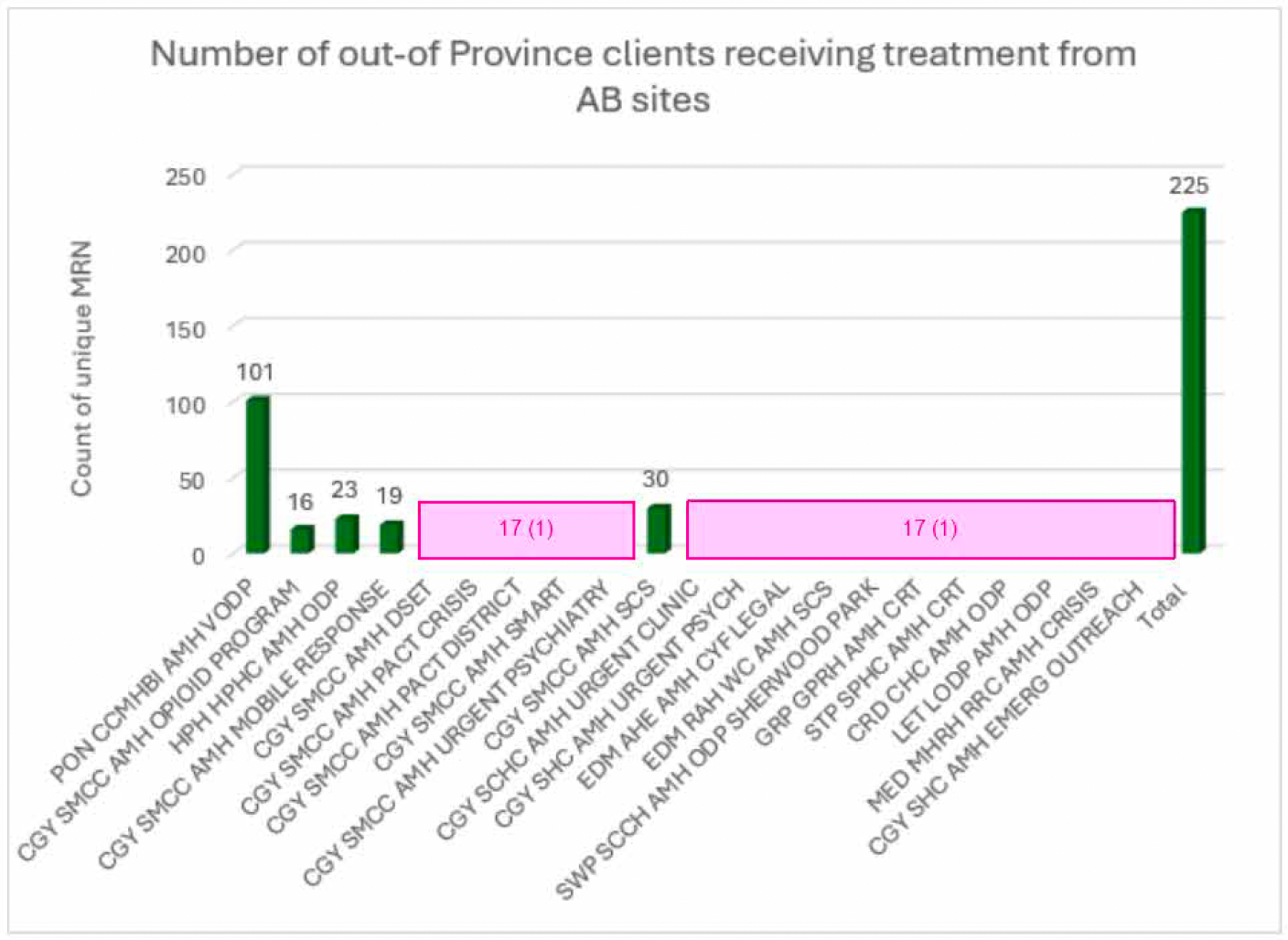
Also in December 2024, a Ministerial Order was circulated to require people without Alberta health insurance to be billed for a range of medical services including supervised consumption site access. The effective date of the billing was April 1, 2024 – six months prior to the Order. A number of services were exempted from the order, including youth substance use detention facilities. This indicates that Recovery Alberta officials were aware of the Order in advance, but did not appear to mitigate the impacts on supervised consumption services.
In February 2025, exemptions to the Ministerial Order were finally issued for supervised consumption, but it is not known how many people were turned away from services in the intervening months.
Internally, Recovery Alberta officials tallied thirty people accessing the Calgary supervised consumption service without insurance, who would be affected by the Order. The number of affected Royal Alexandra Hospital site clients was redacted (likely meaning fewer than ten), and the five other active sites were not discussed.
Recovery Alberta and the Ministry did not respond to questions about the known impacts of the Ministerial Order, including whether people were known to have lost access to the sites or died in the period before the exemption was in place.
Royal Alexandra Hospital supervised consumption site
Minutes from an October 22, 2024 meeting of senior Recovery Alberta officials and supervised consumption site managers recorded that the latter were "concerned about the status of OPS in Lethbridge given the announcement of the closure of the Red Deer OPS." (OPS means 'overdose prevention site,' which is equivalent to 'supervised consumption site' for the current purpose.)
Recovery Alberta officials revealed anxiety about blowback from the Red Deer announcement when they stated at the same meeting that security guards were blocking media from questioning staff and clients of the Calgary supervised consumption site.
Attempting to relieve some of this internal pressure, Recovery Alberta 'leadership' recommended "that staff continue to be reassured that there are no other sites shutting down."
Three months later, an ominous email was sent by the Ministry's Director of Capital Planning, Kenton Puttick, to Recovery Alberta executives, asking for "verification of client visits, both current and future, to the services which Recovery is now providing." The "services" referenced are primarily the supervised consumption site and Acute Care Addiction Recovery Program. The email noted that the Ministry was "involved within the business process for the Royal Alex re-development project."
The subsequent paragraphs are redacted, and Puttick's closing sentence affirms, "Just need confirmation of these numbers and any information related to the future needs of these services/programs."
![From: Glen Bosecke. To: Sara Tomlinson, Steven Clelland, Thomas Mountain, Yvonne Carrigan. Date: January 13, 2025. Subject: Royal Alex Hospital. Text of email: MHA is involved within the business process for the Royal Alex re-development project, and I have several requests for verification of client visits, both current and future, to the services which Recovery Alberta is now providing. [Multiple paragraphs redacted.] Just need confirmation of these numbers and any information related to the future needs of these services/programs.](https://drugdatadecoded.ca/content/images/2026/02/Screenshot-2026-02-16-at-9.30.33---AM.png)
In an otherwise redacted response the same day, Shelly Vik informed the Recovery Alberta executives, "We can help."
On November 19, Minister of Mental Health and Addiction Rick Wilson revealed to CBC News that the consumption site at the Royal Alexandra Hospital would be closed the next month. The sole reason Wilson gave for closing the site was its low use rate. "There's only like one or two people max, new inpatients per day," he said. "So the use was pretty low."
Wilson's statement was misleading in two key ways. The data circulated internally among Recovery Alberta officials shows 1,448 site visits in 2024, of which 1,136 were consumption events – meaning more than three consumption events per day. This number was a three-fold reduction from 2023, owing specifically to political interference with related frontline services.
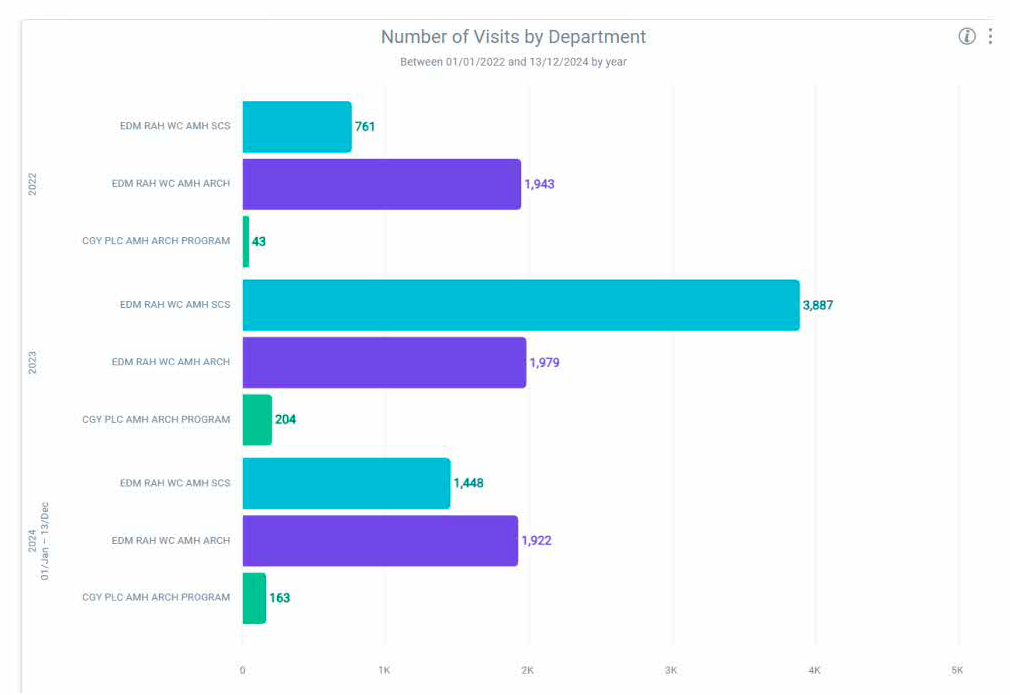
Shelly Vik explained the reason for this reduction in an email to her team: "I believe clients were going from the emergency department and inpatient for hydromorphone shots at the supervised consumption site, so this has dropped."
Drug Data Decoded spoke with a frontline health care worker at the hospital, who deciphered Vik's wording on condition of anonymity, fearing for their job. The worker explained that Vik was referring to patients dispensed hydromorphone through the hospital-based injectable opioid agonist treatment (iOAT) program. These patients routinely brought that hydromorphone to the consumption site – until a Ministry inspection determined that the site was only licensed for consumption of unregulated drugs, not drugs provided through iOAT.
As a result, attendance at the consumption site dropped from nearly 4,000 visits in 2023 to fewer than 1,500 in 2024 – the justification used by Minister Wilson to close the site.
The Calgary site
The same strategy now appears to be at play in Calgary. A site worker who asked to remain anonymous confirmed to Drug Data Decoded that Safeworks outreach teams are being ordered to stop distributing harm reduction supplies, including glass pipes, sterile syringes and perhaps even safe sex supplies, beginning on April 1. CBC News is reporting that overnight neighbourhood outreach is being eliminated at the site.
The worker said that despite having received memos outlining new policies from the Ministry in the past, "There is no documentation around this – at least none our leadership is sharing... we were told the news came from the Ministry, [but] the fact there is no documentation is strange."
(The implications of closing supervised consumption-affiliated services such as sterile tool distribution will be discussed in greater detail in Part 2 of this series.)
 Euan Thomson
In January, for the second time in sixteen months, Calgary city council was forced to vote down a committee motion asking for the downtown consumption site to be closed. Where the 2024 motion was brought by golf enthusiast and city councillor Dan McLean, the 2026 iteration was put forth by another suburban councillor, Landon Johnston. Johnston made his name in 2024 by launching a recall petition against then-Mayor Jyoti Gondek, which was formally thrown out after problems were discovered in every signature of a random sample.
Mayor Jeromy Farkas, who loudly opposed the consumption site during his first stint on city council, did not take the bait and instead voted against the motion.
Calgary's site has been a flagship in the provincial system since the Lethbridge inhalation site was closed. Uniquely, Calgary Safeworks published years of detailed monthly reports that documented swings in the toxicity of the drug supply and showed the number of referrals to other services, such as detox. These reports underpinned the earliest analysis by Drug Data Decoded, including the finding that provincial death rates closely follow non-fatal drug poisoning rates at Safeworks and could serve as an early-warning system.
But in October 2024, Shelly Vik asked the Safeworks manager to pull down these reports and stop sharing new ones. "Down the road...we could discuss just adding a link to [Alberta Substance Use Surveillance System]," Vik suggested, "but I think the removal for now would be reasonable."
This matches the Alberta government's broader resistance to reporting data that could contradict the declared success of its 'recovery-oriented system of care.' For example, as British Columbia, Saskatchewan, and Ontario issue public health warnings about a new tranquilizer in the unregulated opioid supply, Albertans are being left in the dark amid record emergency calls. Up-to-date adverse events at supervised consumption sites have not been reported, and, as Part 2 of this series will detail, may not even tell the full story.
The Lethbridge site
Meanwhile, the Lethbridge supervised consumption service was the first target of the United Conservative Party under Jason Kenney, who stated his infamous refusal to "help addicts inject poison" in a 2018 Lethbridge Herald op-ed. In 2020, after the Province smeared the service provider with unfounded claims of financial impropriety, that consumption site was collapsed from a brick-and-mortar building with thirteen injection booths and two inhalation rooms into a trailer containing just three injection booths, in a different part of town.
This has had devastating consequences in Lethbridge. Morgan Magnuson, a nurse and PhD candidate at the University of Lethbridge, told Drug Data Decoded, "The majority of our people in Lethbridge, like everybody else, are smoking rather than injecting. And they are not accessing the site because it does not have the capacity."
Echoing the events in Red Deer, Lethbridge city council voted to ask the province to close the site – four months after the Royal Alex consumption site closure was announced in Edmonton. Magnuson recently spoke to a group of city councillors, who expressed surprise at the number of people using the site in Lethbridge. "It was 15,000 visits in the most recent quarter, over 600 people. Lethbridge was the busiest site in the province last quarter."
"The high utilization rates in Lethbridge should be justification for keeping a really effective service operating – not doing the opposite of that," says Magnuson. And, it appears, hundreds of local people agree. An open letter opposing the closure of the site, launched by Magnuson, has garnered over 800 signatures. At least 550 of them are from people in Lethbridge.
(Actions to manipulate data by Recovery Alberta that could facilitate the Lethbridge site closure will be explored in Part 2 of this series.)
Fallout
By December 2024, as key data were being scrubbed from websites or withheld from public conversations, the Ministry of Mental Health and Addiction asked Recovery Alberta for weekly reports on visits and drug poisonings at the Red Deer consumption site.
On March 27, 2025, four days before the consumption site's closure, the Ministry was again demanding a weekly report of Red Deer poisoning events, including "trends to date with projection if possible." Half an hour later, on learning Recovery Alberta's numbers were behind by six weeks and that drug poisoning 'projections' would be impossible, the Ministry responded, "Don't worry about the projections. Trends is fine – will just want it over a long enough time frame [to] see within context of the norm!"
It is unclear what the Ministry meant by 'projections,' given that unregulated drug supply toxicity frequently fluctuates. The Ministry has never shared data from these reports publicly – an indication that the intent was political, rather than informational. The ministry did not respond to questions about this.
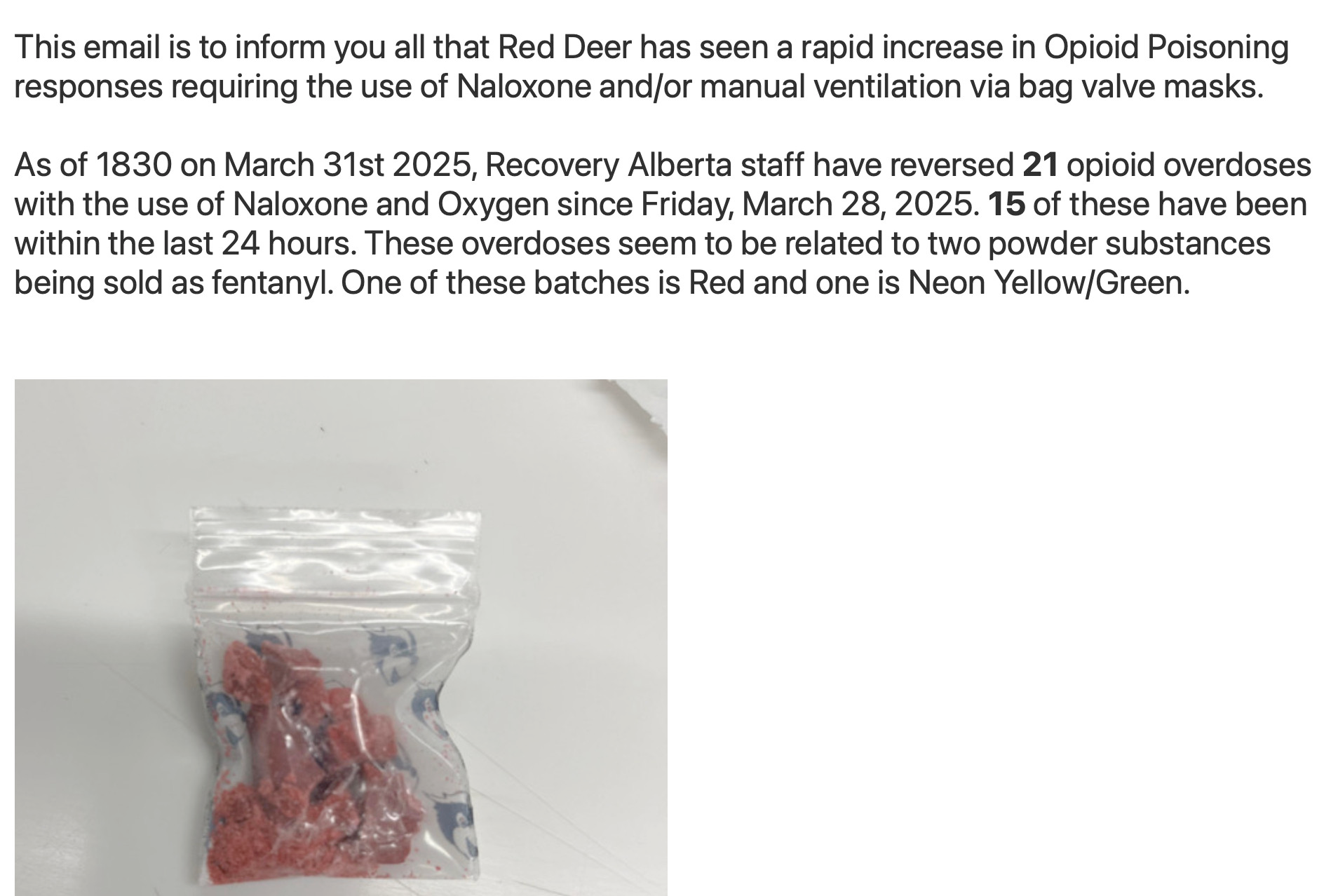
The effects of the Red Deer closure were felt immediately, with a record-breaking number of overdose dispatches the month following the closure. Workers there reported 15 poisoning reversals in the site's final 24 hours – five times the average poisoning rate of Red Deer's worst quarter on record.
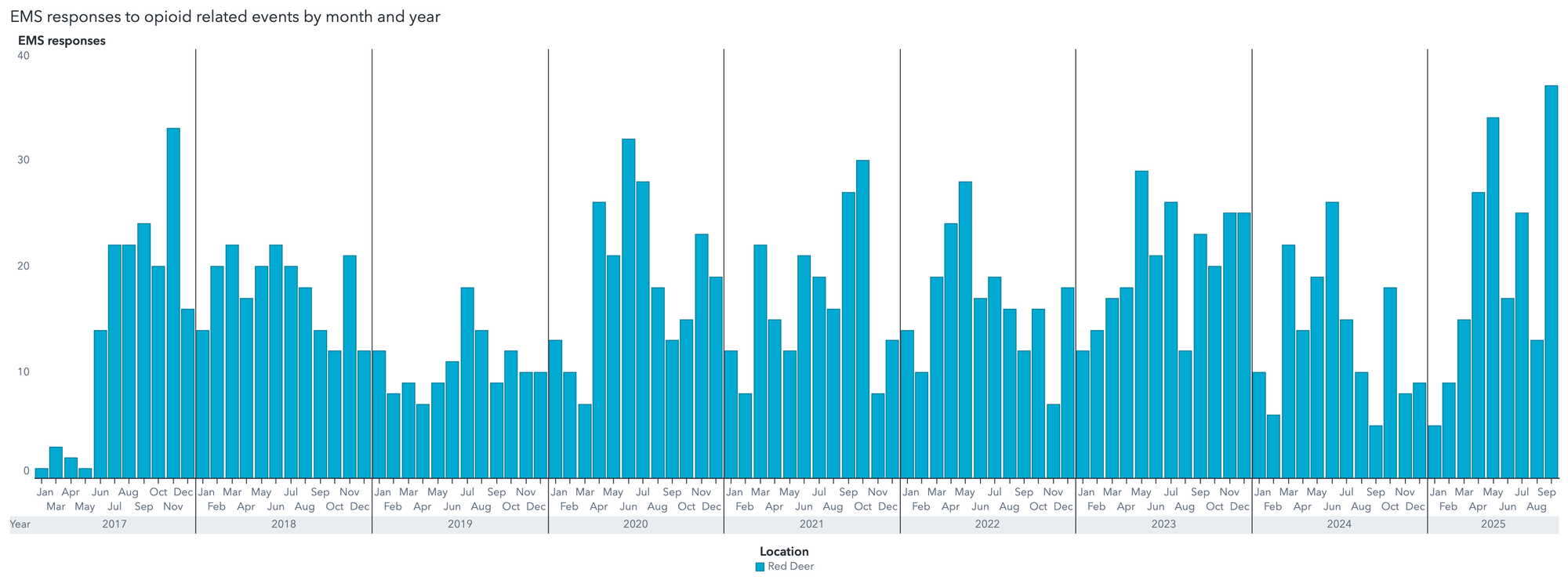
The decision to refuse an extension of Aaron Brown's 2025 court injunction is being appealed with a hearing scheduled for May. In the meantime, up to four clients of the consumption site reportedly died in the three months following its closure. If accurate, this more than doubles the death rate of site clients while it was open, as measured by Recovery Alberta analysts.
Brown has experienced two near-fatal overdoses since the judge allowed the Ministry to close the site. In making his decision, the judge said he could not conclude "Brown will suffer unavoidable irreparable harm if the OPS closes."
In January, facing criticism from exhausted Red Deer firefighters, the Ministry responded that there's no link between record-breaking overdoses and the consumption site closure. The fire department measured a 50% year-over-year increase in calls for opioid toxicity after the site's closure.
“When you close down the prevention site, you are also closing off the access to [naloxone] they have at those sites,” the local firefighters' union president said on CBC Radio.
As Mike Parker, president of the union representing 30,000 paramedics and other health professionals, told Drug Data Decoded in January, the government is "creating a data stream that fits the narrative for their provincial model change."
With the government having closed two sites in 2025 and turning its attention to the Lethbridge and Calgary sites, health authority leadership is tangled up in the politics of public health – an untenable situation for frontline workers facing burnout and moral injury. It may fall to unions to demand a new 'data stream' – and a new provincial model.
Watch for Part 2 of this series.
Documents used in this story (a third file will be provided in Part 2) cost $378 in FOI fees to Recovery Alberta:
An early version of this story was shared with Paid subscribers on February 19.
This story is in loving memory of Isaac Lee.
Thanks to over 100 Paid subscribers for making this work possible.
Drug Data Decoded provides analysis using news sources, publicly available data sets and freedom of information submissions, from which the author draws reasonable opinions. The author is not a journalist.
This content is not available for AI training. All rights reserved.