
Paramedics union head: "How do you resource a system when you're not telling the truth about it?"
Mike Parker, the president of the Alberta union that includes paramedics, reacts to reporting by Drug Data Decoded showing the Alberta government under-reports ambulance dispatches to drug toxicity by as much as 89 percent.

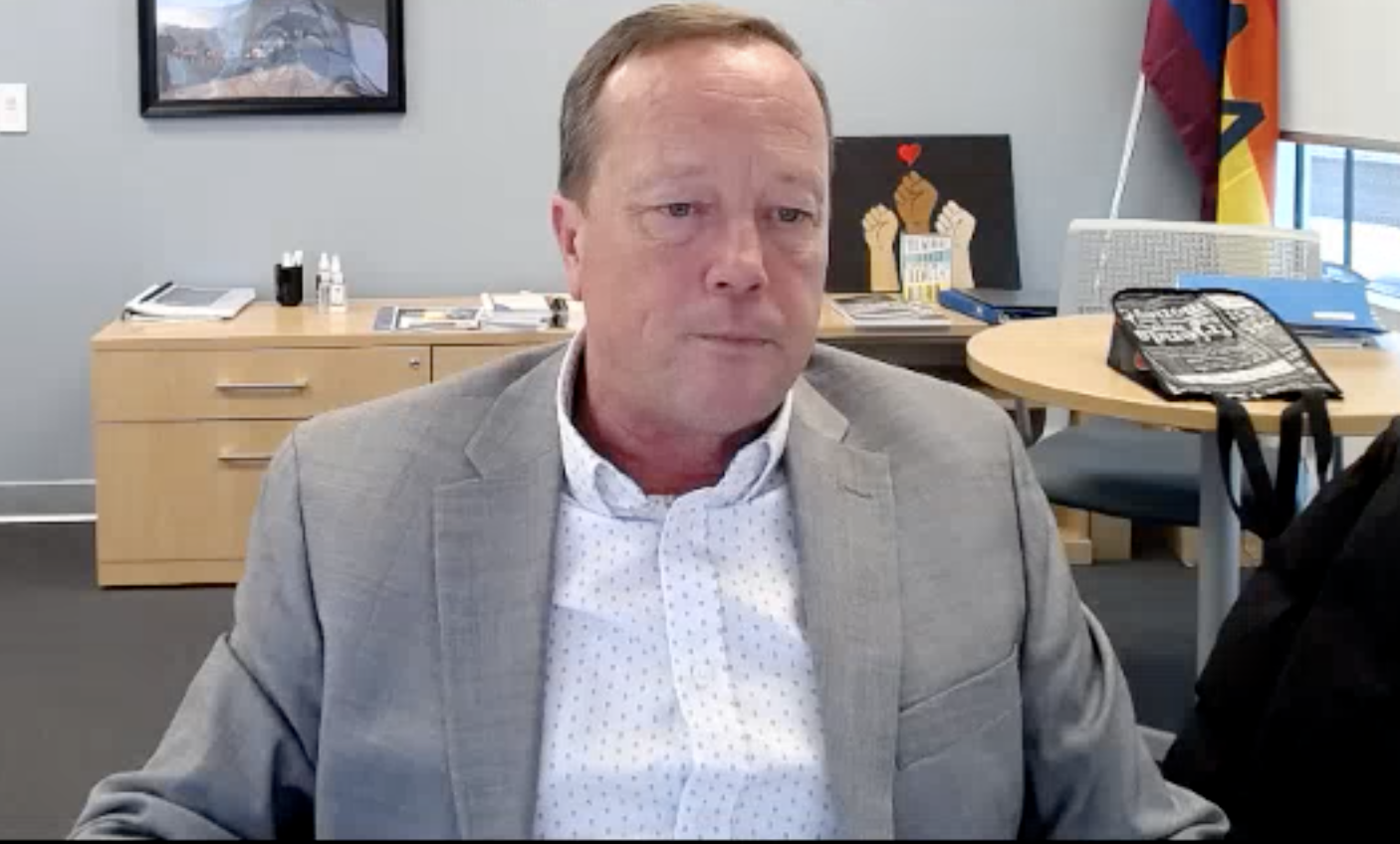
"Some of our folks are just letting their licences expire and going to look for other careers," says Mike Parker, the president of the Health Sciences Association of Alberta.
The union of 30,000 workers, comprising paramedics and 240 other health care professions, recently settled on a new contract with the Alberta government, after months of negotiations. Anxiety among the workforce stemmed in part from an "atrocious" level of under-staffing that leaves workers on the hook for a system in such deep crisis, deaths and near misses are happening while people wait for emergency care.
However, recent reporting by Drug Data Decoded shows the degree to which the government is misinforming the public about the strain placed on these and other health care workers by the unmanaged drug toxicity crisis.
That reporting revealed that the Alberta government has been under-counting the ambulances sent to drug poisonings by as much as 89 percent. By the government's accounting, one in thirty-six ambulances in 2023 went to a drug poisoning. But the health service records show it was one in six – and 2025 exceeded 2023 in drug toxicity volume.
The government's reporting system reports "EMS dispatches to opioid-related events." However, data obtained in two freedom of information requests to Alberta Health Services (AHS) shows that the government's reporting not only omits all non-opioid drug poisonings – it doesn't even capture a majority of the opioid poisonings it claims to show.
"We need honest reporting on these issues," says Parker, referencing a recent Auditor General's report that slammed AHS for failing to "reflect characteristics of effective performance reporting.” Heather Smith, president of the United Nurses of Alberta, described the decisions guiding the restructuring of AHS as "political."
That restructuring is "blowing apart" AHS into four new provincial health agencies that, according to ER physician Paul Parks, are siloed off from one another. "The leaders from middle management up to the top all the way to frontlines have no clue what's going on," Parks told CBC News.
The Auditor General's report also said that in press conferences and promotional materials, the government and AHS used "exclusively narrative-type reporting which tilted consistently towards the positive." Parker agrees with this in context with reporting of EMS data, saying the government is "creating a data stream that fits the narrative for their provincial model change."
Part of that change has included dramatic reductions in the delivery of harm-reduction services. Firefighters in Red Deer recently raised the alarm about a large rise in drug toxicity since the city's only supervised consumption site was closed by the government last spring after it influenced a municipal vote.
But, says Parker, the government continues to dismiss the testimonies of frontline workers. "It erases the experience of these workers," he says.
"We've got paramedics talking about showing up and a patient's been laying there for six hours."
Parker thinks the uncontrolled rise in drug toxicities across the province – considerably higher than BC from 2021 to 2023, according to the internal AHS figures – is connected to the political decisions of the Alberta government. "We were implementing harm reduction back then," he says, referring to the pre-COVID, pre-United Conservative period. "We're in a different state today."
All this comes at a tremendous cost to people exposed to the unregulated drug supply, as thousands continue to perish each year, with perhaps fifteen times that number suffering hypoxic brain injuries. Parker agrees with reporting by Drug Data Decoded showing that EMS dispatches to drug toxicity have set a record in 2025. Because of their close correlation, this means fatalities could follow suit – after years of updates. "The repeated overdoses that cause this long-term damage creates this entire system," he says, describing "a generation" of people experiencing this trauma.
 Euan Thomson
Costs run even deeper than the people directly harmed by the government's failures to regulate and protect people. "Time and again, I say we're working 30,000 hours of overtime monthly – but some of this is mandatory forced overtime. We have no one else to do the job."
"That's where we're at, and the solution is accurate reporting. How do you resource a system when you're not even telling the truth about it?"
Individually, workers resuscitating people every day are suffering moral injury, burnout, and post-traumatic stress disorder. "You train four or six years or more to be a health care professional, whether you're respiratory therapy or a psychologist or an addictions mental health or a paramedic on the street," Parker says. But, when the government refused to address the underlying issues in a decade-long crisis, "you walk away from that going, 'I can't do it.'"
"In the breaking point, you still get out of bed, get ready, and go back for another shift on the front lines of health care, whether you're in the ER or in the EMS system. And all we are seeing now is people saying, ‘I'm going to go find a different career that is not even health care.’"
According to Parker, all this has led to a 12 percent vacancy in EMS positions filled. For a profession already hand-to-mouth with excess overtime and stress leave, this spells disaster. He is careful to note, however, that "the other professions are also getting hammered in all of this – the emergency rooms, right into the ICUs now."
For its part, the HSAA has previously tried to obtain reporting data to what Drug Data Decoded was handed. What came back from AHS was "90 percent redacted," according to Parker – "just sheets and sheets of black. Because they don't want it out – they want their narrative held."
But, says Parker, people on the frontline can't take much more secrecy or moral injury from these unmitigated health care disasters. "We've got paramedics talking about showing up and a patient's been laying there for six hours."
And, he says, neither should the public. When public officials "lie about it, when the data is inaccurate... it undermines the public trust. And in the end, that's all healthcare workers have."
The Ministry of Mental Health and Addiction did not respond to requests for comment sent on January 14 and January 28 concerning the EMS dispatch data.
Update, January 28 (17:23 MST): Initial version of the story claimed EMS dispatches for drug toxicity in Alberta were "considerably higher than BC from 2022 to 2024," but the available show this for 2021 to 2023. Alberta datasets for 2024 and 2025 have not yet been obtained through freedom of information. BC public reports its parallel data, available here.
An early version of this story was shared with Paid subscribers on January 28, 2025.
Drug Data Decoded provides analysis using news sources, publicly available data sets and freedom of information submissions, from which the author draws reasonable opinions. The author is not a journalist.
This content is not available for AI training. All rights reserved.