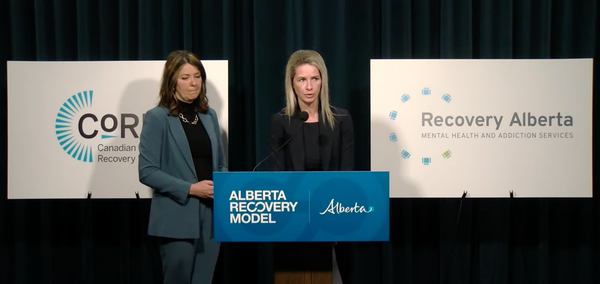
Centre of Recovery Excellence attempts to conceal Research Review Council
The Research Review Council formed in early 2025 with government authors of a recent fraudulent study on supervised consumption services. But, when asked for records of the council's authorized projects, CoRE denies its very existence.
In early 2025, the Canadian Centre of Recovery Excellence (CoRE), the Alberta government's research body for drug policy, created a Research Review Council comprising key government officials and political operatives. The council was never named in public records and is not mentioned on CoRE's website.
In February, Drug Data Decoded uncovered the council's existence in a freedom of information request. The documents, watermarked with the CoRE logo, show that in February 2025, it included Dr. Nathaniel Day, Dr. Carol Adair, Dr. Dan Devoe, Dr. Shelly Vik, Dr. Michele Dyson, Alexandra Henderson, Dr. Tosin Akintunde and Vanessa Norton.
The Research Council circulated terms of reference and instructions on how to review research applications to its members. The council's primary role appears to be to authorize researchers' access to government-held records concerning people who use drugs.
But despite all of this, the CoRE has twice denied the council's existence while refusing to support a freedom of information request concerning its activities. Responding to a request from Drug Data Decoded asking for "research agreements for all projects approved by the CoRE Research Council" from January 1, 2025 to February 19, 2026, the CoRE's Privacy Office replied that "there is no CoRE Research Council at this time."
 Euan Thomson
On April 8, Drug Data Decoded pressed the CoRE Privacy Office to explain how the "Research Council" could be referenced in multiple documents, including research reviews, and yet not exist. The Privacy Office responded that "our search efforts determined that there is no body formally identified as the 'CoRE Research Council,'... We note that the records you cited relate to a body that is distinctly named (Research Review Council) and described differently from the entity identified in your access request (CoRE Research Council)."
In effect, the Privacy Office was demanding that to fulfill the information request, the precise name for a body obscured from public view be provided by a member of the public having no way to know its name – as if a secret code-word was needed.
Alberta's Access to Information Act dictates that public bodies must "make every reasonable effort to assist applicants and to respond to each applicant openly, accurately and completely." This is not the first instance of apparent secrecy from the CoRE Privacy Office. In April 2025, CoRE demanded nearly $1,000 to fulfill a request covering eight months of records and just eight search terms. An identical request was completed for 2.5 years by Recovery Alberta for just $164.
Fortunately, those documents were obtained from Recovery Alberta, and revealed the Research Council, its members, and its apparent mandate.
Those documents describing the Research Council contain the identities of four research applicants, which are redacted under privacy legislation. However, perhaps by mistake, four last names were not redacted from email attachments of research applications from February 2025. Three were authorized by the council and one was denied.
One application had the name "Rittenbach," suggesting it was submitted by Dr. Kay Rittenbach. Since leaving Alberta's Ministry of Mental Health and Addiction in 2024, Rittenbach now holds a position in the University of Calgary Department of Psychiatry and studies how people navigate substance use treatment in Calgary.
Rittenbach was asked on April 8 about the nature of this application to CoRE, and told Drug Data Decoded, "I did receive the data and did not receive any funding (the data was pulled by an analyst in Recovery Alberta - which is sometimes considered in kind support)." Rittenbach did not provide details on the data provided by CoRE and Recovery Alberta.
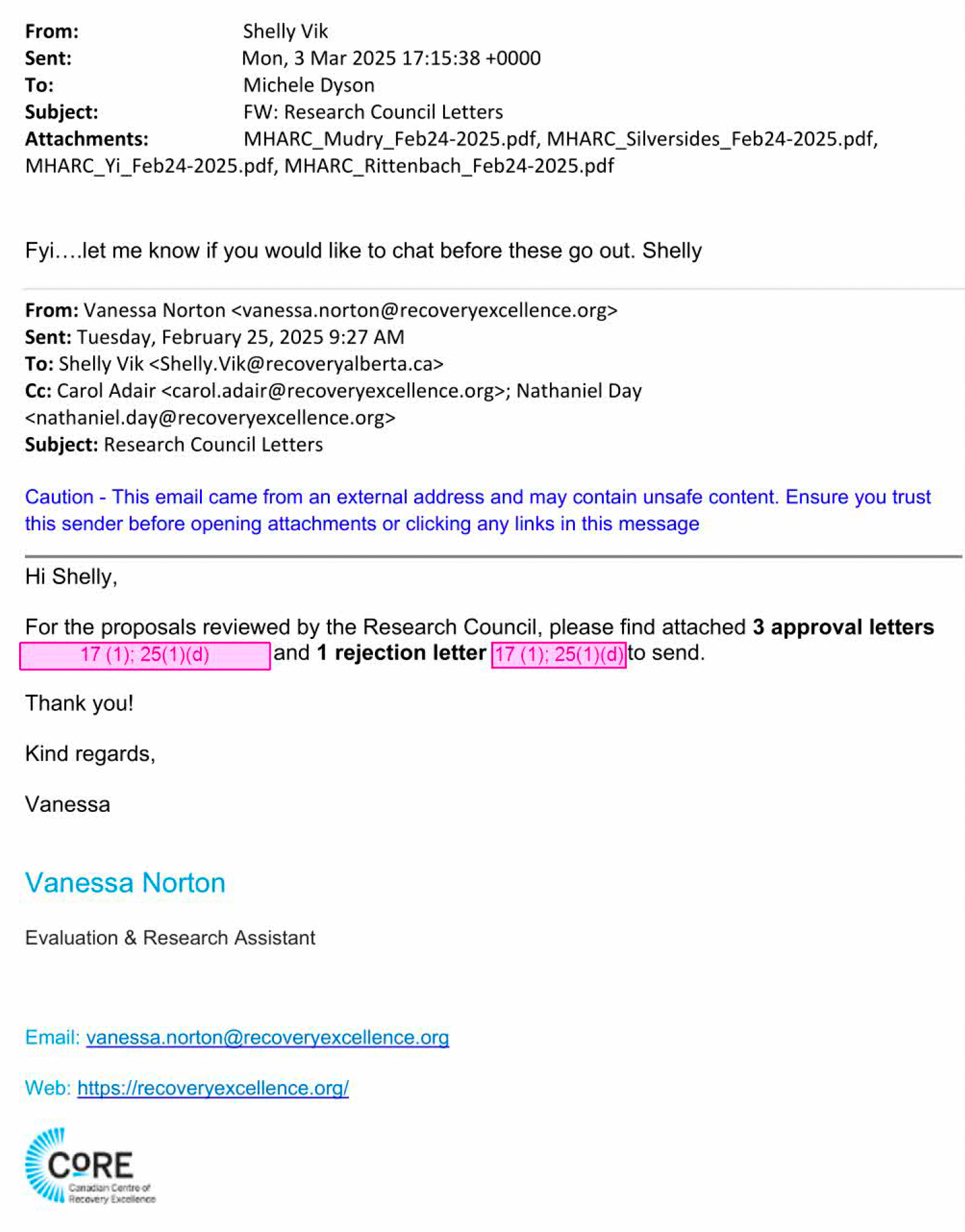
This leaves two applications that were approved and one that was rejected from that first panel in February 2025. One was attached in the email under the name "Silversides." Only one researcher by this name could be found but did not reply to a request for comment sent on April 8. (An Alberta bible camp by this name was also identified but is unlikely to be the applicant.)
A third applicant, "Cao," likely refers to University of Alberta Psychiatry Department professor Cloud Cao, who studies "predicting and improving real-world outcomes of mental and substance use disorders and substance overdose using electronic health data and machine learning." A final application under "Tamblyn" appears to be Robyn Tamblyn at McGill University, who currently studies ways to reduce drug prescribing among older adults. Cao and Tamblyn also did not reply to requests for comment in time for publication.
Drug Data Decoded was able to confirm applications by other researchers since February 2025 who preferred to remain anonymous, but these were sent to Recovery Alberta. This may indicate that oversight the Research Council was transferred from CoRE to Recovery Alberta after February 2025, validating the CoRE's disingenuous insistence of "no CoRE Research Council at this time."
Playing sides: competing interests in first CoRE study
The eleven-member author list of the CoRE study on supervised consumption sites published in Addiction Journal in March included four members of the CoRE Research Council as it stood in February 2025: Day, Devoe, Dyson and Norton. It is unknown if their presence on the council played any role in how the study was researched or advanced to publication.
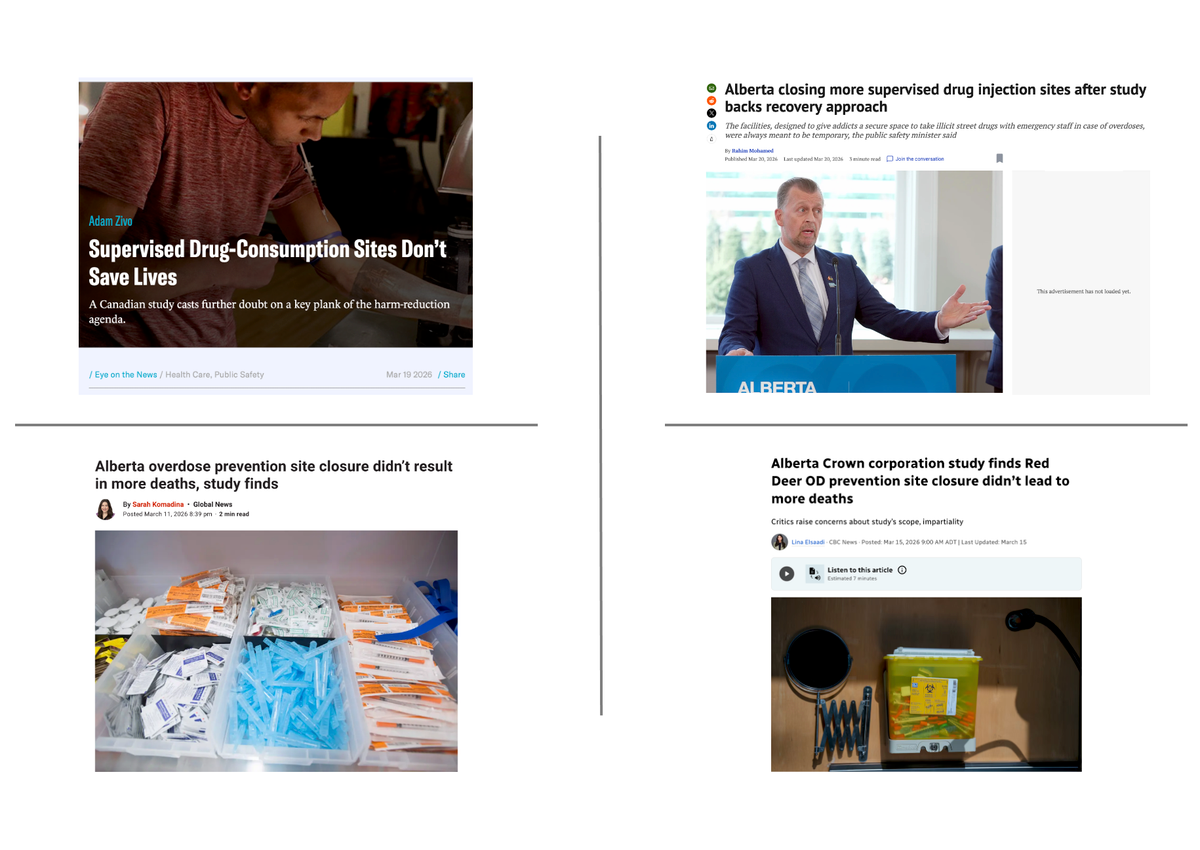
Regardless of the internal path the study took, researchers have been increasingly alarmed as Day, its lead author who also holds a position as Chief Scientific Officer at CoRE, has appeared to overstate and misrepresent the study's findings, defending his position by suggesting that "with any research there are always limitations." The political impacts of the study have thus far included the scheduled closures of no fewer than nine supervised consumption sites in Ontario and Alberta in June, as well as unexpected delays in opening Manitoba's first site.
Indirectly related, Prairie Harm Reduction announced its immediate closure on April 9, following a financial shortfall uncovered in March. The organization has operated a supervised consumption site in Saskatoon without provincial funding since 2020. The site recently fell under renewed attacks by local Conservative MP Brad Redekopp, who cited the Alberta government study in demanding the site’s closure by the federal government.
The study compared health outcomes of people who use supervised consumption sites in Red Deer and Lethbridge before and after the closure of the site in Red Deer. These included a stated increase in the uptake of opioid agonist treatments (OAT) and a lack of increase in drug toxicity-related events.
Multiple retraction requests have been submitted to Addiction by researchers on the basis of undisclosed conflicts of interest among study authors, omission of key confounding factors related to the study, and methodological flaws. A press release by the Canadian Society of Addiction Medicine on April 8 described the study as "flawed."
These flaws were carefully detailed in a Critical Appraisal by the Ontario Drug Policy Research Network (ODPRN) and the Centre on Drug Policy Evaluation (CDPE), published on March 25.
The appraisal identified no fewer than eight conflicts of interest among study authors that should have been disclosed in accordance with the journal's rules for Declaration of Interests. Among these were the employment of ten of eleven authors by Alberta's Ministry of Mental Health and Addiction, the direct funding of the study by the Alberta government, multiple Alberta government advisory panel positions among authors, and Day's role as expert witness for the Ontario government in its 2025 legal defence of supervised consumption site closures.
In addition to the conflicts raised by the Critical Appraisal, the company co-founded by study author Robert Tanguay, Newly Institute, is listed as a psychedelic treatment service provider by the Alberta government. Day and likely other study authors also received speaking fees from Alberta government-funded conferences. Over $7,000 in donations were made by Day and Tanguay to the political party that forms the Alberta government and their employer. None of these were disclosed in the study's competing interests declaration.
Further conflicts arise concerning the 2023-24 Alberta government Recovery Advisory Expert Panel, which included Day and Tanguay and was chaired by the Deputy Editor-in-Chief of Addiction Journal, Keith Humphreys. Humphreys' roles as a paid board member and shareholder of pharmaceutical company Indivior, which sells opioid agonist treatments into Alberta's Opioid Dependency Program, are not visible in Addiction's online materials.
The Critical Appraisal also emphasized confounding factors omitted from the study, including the study's failure to note key measures put in place in Red Deer before and after the supervised consumption site closure on March 31, 2025. These were designed to reduce drug toxicity events among the site's clients included the deployment of a patrolling Overdose Response Team in the immediate vicinity of the site and a Mobile Rapid Access to Addiction Medicine (MRAAM) clinic.
The period of analysis of the data for OAT uptake among site clients also appears to have been cherry-picked by the study authors, as it began after the government's announcement of the closure of the site, months before the closure of the site itself. This happens to match the moment at which the MRAAM clinic was deployed.
Further to conflicts of interest and confounding factors, the Critical Appraisal addressed the study's serious methodological flaws, including low or even no statistical power to detect changes in health outcomes before and after the Red Deer site closure, and several methodological reasons why Lethbridge provided a poor comparator for Red Deer during the study period. These introduced selection bias and violated the key assumption underpinning the study's statistical approach. The appraisal notes that "differences exist between the methods described... and the results reported," suggesting that the authors may have been fitting their findings to their methods and results – science done backwards.
Internal conversations between study authors and Alberta's Ministry of Mental Health and Addiction, uncovered by Drug Data Decoded in February, show that the personal health numbers (PHN) on which all data in this study are based are unreliable. Study authors noted in their 2024 correspondence that of 211 deaths among supervised consumption site clients they had analyzed, 13 of their PHNs were used after their deaths by people accessing sites. This calls into question the validity of all PHN data collected for this study, by revealing that site clients routinely exchange PHNs or use fake PHNs to access sites.
The authors noted in a 2024 preliminary report that these data were simply removed from their analysis, but it is not apparent that any new measures were taken since that discovery to ensure the integrity of the data being collected. The matter was not addressed or even mentioned as a limitation in the Alberta government study.
Additional public scrutiny of the study includes an opinion piece submitted to the Edmonton Journal by Alberta-based public health researchers and physicians titled "Flawed study on Red Deer OD prevention site closure could put lives at risk." This article agreed with several of the points later raised in the Critical Appraisal, and highlighted that "if you take away a safety net, like a [supervised consumption site], and replace it with more people standing below to catch the fallout, you haven’t proven the net was useless, only how hard you have to work to compensate for its absence."
The article also noted that the Alberta government study failed to acknowledge or contend with the decades of research supporting positive health outcomes linked to supervised consumption sites.
Together with the repeated stonewalling by its Privacy Office, the CoRE has rapidly devolved into an institution overtly dedicated to consent manufacturing, weaponizing the inability of non-experts to discern good science from bad and leveraging the truism that people remember headlines, not retractions.
Recently, the founders of Retraction Watch amended their 2013 position that approaching study authors and editors is the appropriate action to take in seeking scientific corrections. Retraction Watch now recommends contacting research integrity officers at the institutions that employ the authors. While corrective action from the Alberta government's CoRE is unlikely, several study authors also hold positions at the University of Calgary, Mount Royal University, and the University of British Columbia.
As retraction requests continue to pile up, it remains to be seen if Addiction – or the research offices at UofC, Mount Royal, and UBC – will take accountability for the study or its authors.
An early version of this story was shared with Paid subscribers on April 9.
Thanks to over 100 Paid subscribers for making this work possible.
Drug Data Decoded provides analysis using news sources, publicly available data sets and freedom of information submissions, from which the author draws reasonable opinions. The author is not a journalist.
This content is not available for AI training. All rights reserved.